
Operators associated with the Lazarus sub-group BlueNoroff have
been linked to a series of cyberattacks targeting small and
medium-sized companies worldwide with an aim to drain their
cryptocurrency funds, in what’s yet another financially motivated
operation mounted by the prolific North Korean state-sponsored
actor.
Russian cybersecurity company Kaspersky, which is tracking the
intrusions under the name “SnatchCrypto,” noted
that the campaign has been running since at 2017, adding the
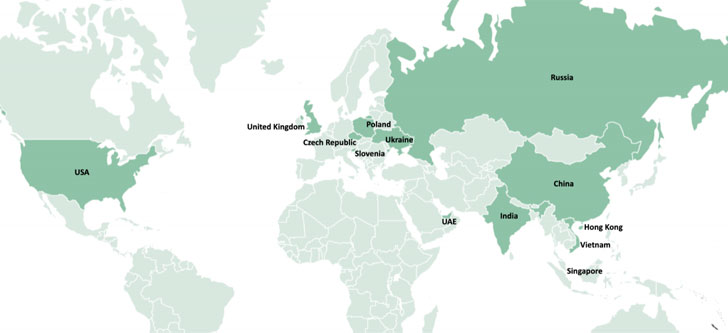
attacks are aimed at startups in the FinTech sector located in
China, Hong Kong, India, Poland, Russia, Singapore, Slovenia, the
Czech Republic, the U.A.E., the U.S., Ukraine, and Vietnam.
“The attackers have been subtly abusing the trust of the
employees working at targeted companies by sending them a
full-featured Windows backdoor with surveillance functions,
disguised as a contract or another business file,” the researchers
said[1]. “In order to eventually
empty the victim’s crypto wallet, the actor has developed extensive
and dangerous resources: complex infrastructure, exploits and
malware implants.”
BlueNoroff, and the larger Lazarus umbrella, are known[2]
for deploying a diverse arsenal of malware[3] for a multi-pronged assault[4]
on businesses[5]
to illicitly procure funds[6], including relying on a
mix of advanced phishing tactics and sophisticated malware, for the
sanctions-hit North Korean regime and generate revenue for its
nuclear weapons and ballistic missile programs.
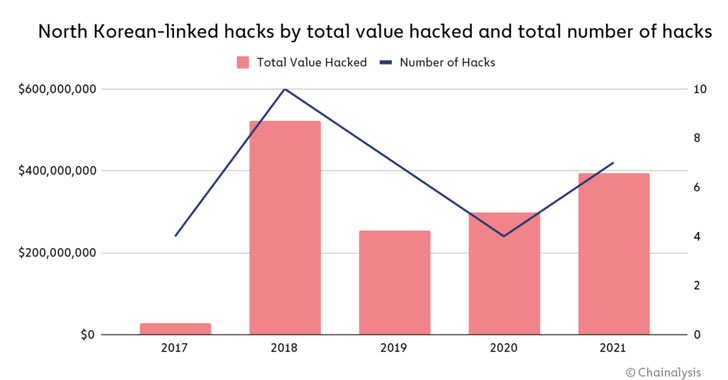
If anything, these cyber offensives are paying off big time.
According to a new report[7]
published by blockchain analytics firm Chainalysis, the Lazarus
Group has been linked to seven attacks on cryptocurrency platforms
that extracted almost $400 million worth of digital assets in 2021
alone, up from $300 million in 2020.
“These attacks targeted primarily investment firms and
centralized exchanges […] to siphon funds out of these
organizations’ internet-connected ‘hot’ wallets[8]
into DPRK-controlled addresses,” the researchers said. “Once North
Korea gained custody of the funds, they began a careful laundering
process to cover up and cash out” through mixers[9]
to obscure the trail.
Documented malicious activity involving the nation-state actor
have take the form of cyber-enabled heists against foreign
financial institutions, notably the SWIFT banking network hacks[10] in 2015-2016, with
recent campaigns resulting in the deployment of a backdoor called
AppleJeus[11] that poses as a
cryptocurrency trading platform to plunder and transfer money to
their accounts.
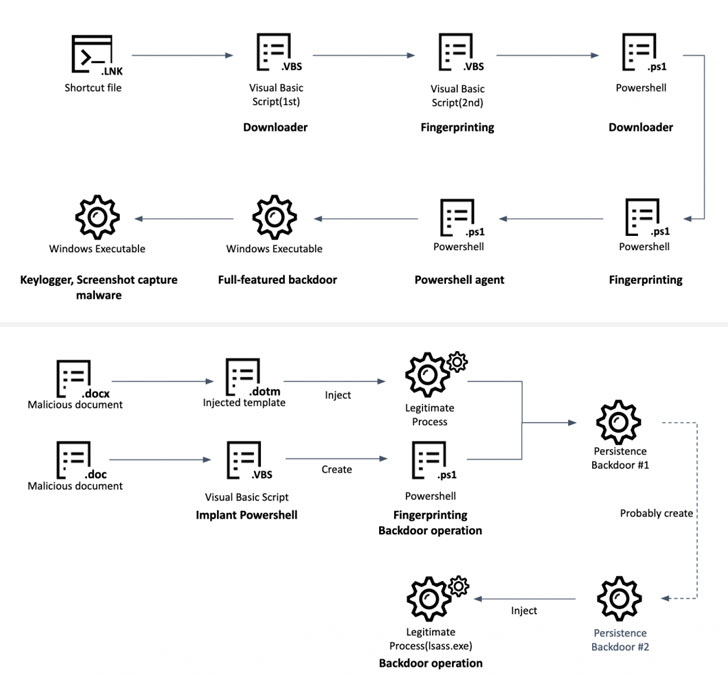
The SnatchCrypto attacks are no different in that they concoct
elaborate social engineering schemes to build trust with their
targets by posing as legitimate venture capitalist firms, only to
use bait the victims into opening malware-laced documents that
retrieve a payload designed to run a malicious executable received
over an encrypted channel from a remote server.
An alternative method used to trigger the infection chain is the
use of Windows shortcut files (“.LNK”) to fetch the next-stage
malware, a Visual Basic Script, that then acts a jump off point to
execute a series of intermediary payloads, before installing a
full-featured backdoor that comes with “enriched” capabilities to
capture screenshots, record keystrokes, steal data from Chrome
browser, and execute arbitrary commands.
The ultimate goal of the attacks, however, is to monitor
financial transactions of the compromised users and steal
cryptocurrency. Should a potential target use a Chrome extension
like Metamask to manage crypto wallets, the adversary stealthily
moves to locally replace the main component of the extension with a
fake version that alerts the operators every time a large transfer
is kicked off to another account.
To siphon the funds, malicious code injection is performed to
intercept and modify the transaction details on demand. “The
attackers modify not only the recipient [wallet] address, but also
push the amount of currency to the limit, essentially draining the
account in one move,” the researchers explained[12].
“Cryptocurrency is a heavily targeted sector when it comes to
cybercrime due to the decentralized nature of the currencies and
the fact that, unlike with credit card or bank transfers, the
transaction happens quickly and is impossible to reverse,” Erich
Kron, security awareness advocate at KnowBe4, said in a
statement.
“Nation-states, especially those under strict tariffs or other
financial restrictions, can benefit greatly by stealing and
manipulating cryptocurrency. Many times, a cryptocurrency wallet
can contain multiple types of cryptocurrency, making them a very
appealing target,” Kron added.
References
- ^
said
(usa.kaspersky.com) - ^
known
(www.bloomberg.com) - ^
diverse
arsenal of malware (thehackernews.com) - ^
multi-pronged assault
(thehackernews.com) - ^
businesses
(thehackernews.com) - ^
illicitly procure funds
(thehackernews.com) - ^
new
report (blog.chainalysis.com) - ^
‘hot’
wallets (www.investopedia.com) - ^
mixers
(en.wikipedia.org) - ^
SWIFT
banking network hacks (thehackernews.com) - ^
AppleJeus
(thehackernews.com) - ^
explained
(securelist.com)
Read more https://thehackernews.com/2022/01/north-korean-hackers-stole-millions.html