
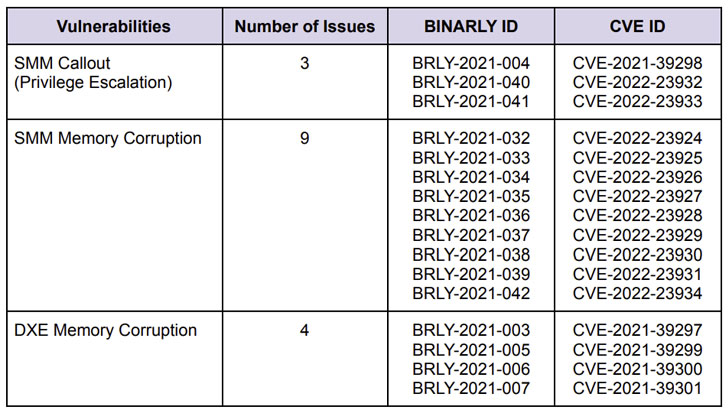
Cybersecurity researchers on Tuesday disclosed[1]
16 new high-severity vulnerabilities in various implementations of
Unified Extensible Firmware Interface (UEFI) firmware impacting
multiple HP enterprise devices.
The shortcomings[2], which have CVSS scores
ranging from 7.5 to 8.8, have been uncovered in HP’s UEFI firmware.
The variety of devices affected includes HP’s laptops, desktops,
point-of-sale (PoS) systems, and edge computing nodes.
“By exploiting the vulnerabilities disclosed, attackers can
leverage them to perform privileged code execution in firmware,
below the operating system, and potentially deliver persistent
malicious code that survives operating system re-installations and
allows the bypass of endpoint security solutions (EDR/AV), Secure
Boot and Virtualization-Based Security isolation,” firmware
security firm Binarly said in a report shared with The Hacker
News.
The most severe of the flaws concern a number of memory
corruption vulnerabilities in the System Management Mode (SMM[3]) of the firmware,
thereby enabling the execution of arbitrary code with the highest
privileges.
Following a coordinated disclosure process with HP and CERT
Coordination Center (CERT/CC), the issues were addressed as part of
a series of security[4]
updates[5]
shipped in February and March 2022.
“Unfortunately, most of the issues […] are repeatable failures,
some of which are due to the complexity of the codebase or legacy
components that get less security attention, but are still widely
used in the field,” the researchers pointed out.
The disclosure arrives a little over a month after Binarly
publicized[6]
the discovery of 23 high-impact vulnerabilities in Insyde
Software’s InsydeH2O UEFI firmware that could be weaponized to
deploy persistent malware that’s capable of evading security
systems.
The latest findings are also significant in light of the fact
that firmware has emerged as an ever-expanding attack surface for
threat actors to launch highly-targeted devastating attacks. At
least five different firmware malware strains[7] have been detected in
the wild to date since 2018.
“Securing the firmware layer is often overlooked, but it is a
single point of failure in devices and is one of the stealthiest
methods in which an attacker can compromise devices at scale,” the
U.S. Commerce and Homeland Security departments highlighted[8]
in a report published last month.
References
- ^
disclosed
(www.binarly.io) - ^
shortcomings
(github.com) - ^
SMM
(en.wikipedia.org) - ^
security
(support.hp.com) - ^
updates
(support.hp.com) - ^
publicized
(thehackernews.com) - ^
firmware
malware strains (thehackernews.com) - ^
highlighted
(www.dhs.gov)
Read more https://thehackernews.com/2022/03/new-16-high-severity-uefi-firmware.html