


New findings released last week showcase the overlapping source
code and techniques between the operators of Shamoon[1]
and Kwampirs[2], indicating that they
“are the same group or really close collaborators.”
“Research evidence shows identification of co-evolution between
both Shamoon and Kwampirs malware families during the known
timeline,” Pablo Rincón Crespo of Cylera Labs said[3].
“If Kwampirs is based on the original Shamoon, and Shamoon 2 and
3 campaign code is based on Kwampirs, […] then the authors of
Kwampirs would be potentially the same as the authors of Shamoon,
or must have a very strong relationship, as has been seen over the
course of many years,” Rincón Crespo added.
Shamoon, also known as DistTrack, functions as an
information-stealing malware that also incorporates a destructive
component that allows it to overwrite the Master Boot Record (MBR)
with arbitrary data so as to render the infected machine
inoperable.
The malware, developed by the eponymous hacking crew also
tracked as Magic Hound, Timberworm, COBALT GIPSY, was first documented[4]
by Broadcom-owned Symantec in August 2012. At least two updated
versions of Shamoon have since emerged, Shamoon 2 in 2016 and
Shamoon 3 in 2018.
In July 2021, the U.S. government attributed[5]
Shamoon as the handiwork of Iranian state-sponsored
actors[6], linking it to cyber
offensives targeting industrial control systems.
On the other hand, attack activity involving the Kwampirs backdoor[7]
has been connected to a threat group known as Orangeworm, with
Symantec disclosing an intrusion campaign aimed at entities in the
healthcare sector in the U.S., Europe, and Asia.
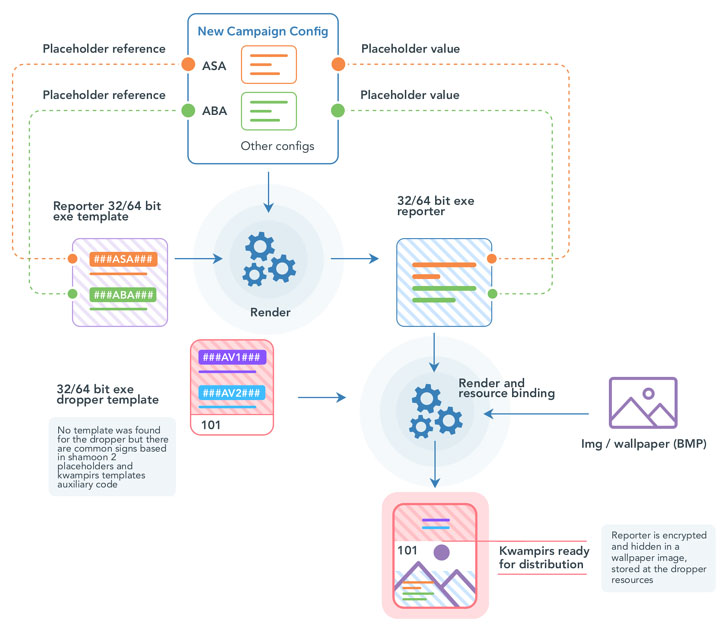 |
| “Kwampirs New Campaign Building Process” explained by Cylera |
“First identified in January 2015, Orangeworm has also conducted
targeted attacks against organizations in related industries as
part of a larger supply-chain attack in order to reach their
intended victims,” Symantec said[8]
in an analysis in April 2018.
Cylera Labs’ uncovering of the connection stems from malware
artifacts and previously unnoticed components, one of which is said
to be an intermediary “stepping stone” version. It’s a Shamoon
dropper but sans the wiper feature, while simultaneously reusing
the same loader code as Kwampirs.
What’s more, code-level similarities have been uncovered between
Kwampirs and subsequent versions of Shamoon. This includes the
functionality to retrieve system metadata, fetch MAC address, and
the victim’s keyboard layout information as well as the use of the
same InternetOpenW[9]
Windows API to craft HTTP requests to the command-and-control (C2)
server.
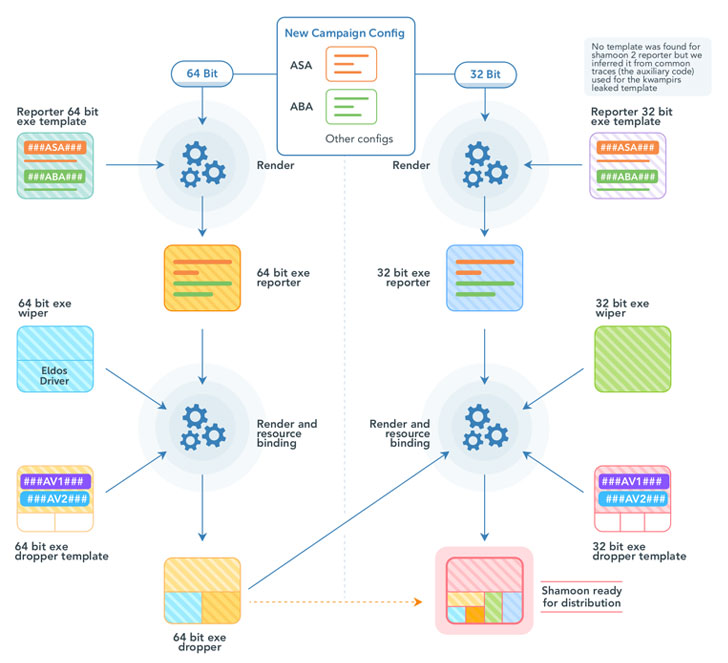 |
| “Shamoon 2 New Campaign Building Process” explained by Cylera |
Also put to use is a common template system to create the
reporter module that houses capabilities to upload host information
and download additional payloads to execute from their C2 servers,
a feature that was missing in the first version of Shamoon.
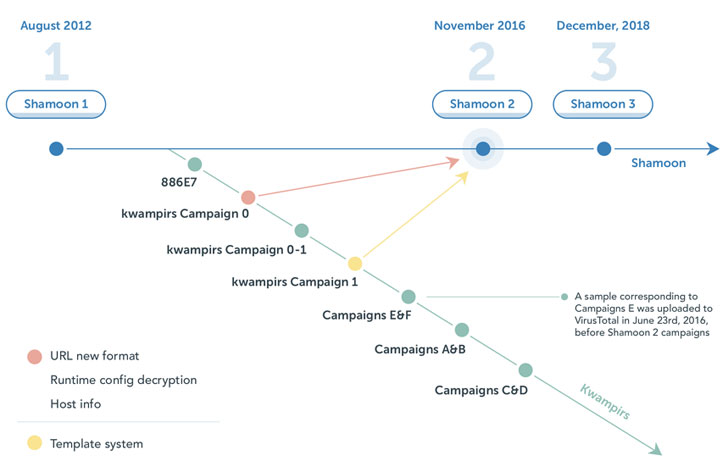
In connecting the disparate dots, the investigation has led to
the assessment that Kwampirs is likely based on Shamoon 1 and that
Shamoon 2 inherited some of its code from Kwampirs, implying that
the operators of both the malware are different sub-groups of a
larger umbrella groups or that it’s the work of a single actor.
Such a claim isn’t without precedence. Just last week, Cisco
Talos detailed[10] the TTPs of another
Iranian actor called MuddyWater, noting that the nation-state actor
is a “conglomerate” of multiple teams operating independently
rather than a single threat actor group.
“These conclusions, if indeed correct, would recast Kwampirs as
a large-scale, multi-year attack on global healthcare supply chains
conducted by a foreign state actor,” the researchers concluded.
“The data gathered and systems accessed in these campaigns have
a wide range of potential usage, including theft of intellectual
property, gathering of medical records of targets like dissidents
or military leaders, or reconnaissance to aid in the planning of
future destructive attacks.”
References
- ^
Shamoon
(malpedia.caad.fkie.fraunhofer.de) - ^
Kwampirs
(malpedia.caad.fkie.fraunhofer.de) - ^
said
(resources.cylera.com) - ^
first
documented (community.broadcom.com) - ^
attributed
(www.cisa.gov) - ^
Iranian state-sponsored actors
(www.cisa.gov) - ^
Kwampirs
backdoor (blog.reversinglabs.com) - ^
said
(symantec-enterprise-blogs.security.com) - ^
InternetOpenW
(docs.microsoft.com) - ^
detailed
(thehackernews.com)
Read more https://thehackernews.com/2022/03/researchers-find-new-evidence-linking.html