Microsoft and authentication services provider Okta said they
are investigating claims of a potential breach alleged by the
LAPSUS$ extortionist gang.
The development, which was first reported by Vice[1]
and Reuters[2], comes after the cyber
criminal group posted screenshots and source code of what it said
were the companies’ internal projects and systems on its Telegram
channel.
The leaked 37GB archive shows that the group may have accessed
the repositories related to Microsoft’s Bing, Bing Maps, and
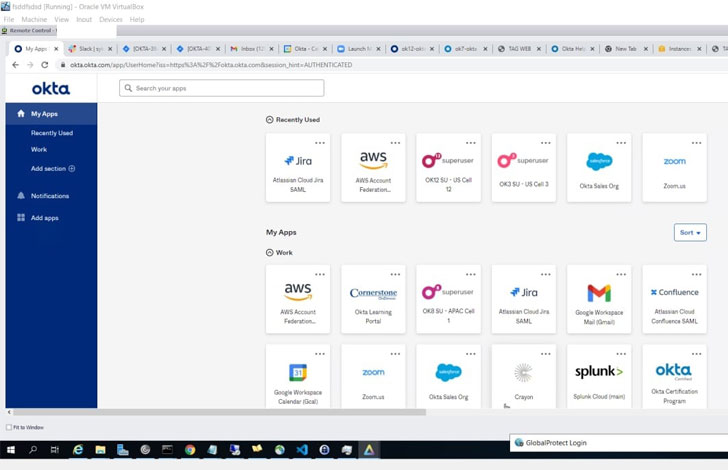
Cortana, with the images[3]
highlighting Okta’s Atlassian suite and in-house Slack
channels.
“For a service that powers authentication systems to many of the
largest corporations (and FEDRAMP approved) I think these security
measures are pretty poor,” the group wrote on Telegram.
On top of this, the group alleged that it breached LG
Electronics (LGE) for the “second time” in a year.
Bill Demirkapi, a security researcher at Zoom, noted[4]
that “LAPSUS$ appears to have gotten access to the Cloudflare
tenant with the ability to reset employee passwords,” adding the
company “failed to publicly acknowledge any breach for at least two
months.”
LAPSUS$ has since clarified that it did not breach Okta’s
databases and that “our focus was ONLY on Okta customers.” This
could pose serious implications for other government agencies and
companies that rely on Okta to authenticate user access to internal
systems.
“In late January 2022, Okta detected an attempt to compromise
the account of a third-party customer support engineer working for
one of our subprocessors. The matter was investigated and contained
by the subprocessor,” Okta CEO Todd McKinnon said[5]
in a tweet.
“We believe the screenshots shared online are connected to this
January event. Based on our investigation to date, there is no
evidence of ongoing malicious activity beyond the activity detected
in January,” McKinnon added.
Cloudflare, in response, said[6]
it’s resetting the Okta credentials of employees who have changed
their passwords in the last four months, out of abundance of
caution.
Unlike traditional ransomware groups that follow the double
extortion playbook of stealing data from a victim and then
encrypting that information in return for a payment, the new
entrant to the threat landscape focuses more[7]
on data theft and using it to blackmail the targets.
In the months since it went active in late December 2021, the
cybercrime gang has racked up a long list of high-profile victims,
including Impresa, NVIDIA[8], Samsung[9], Mercado Libre,
Vodafone, and most recently Ubisoft[10].
“Any successful attack against a service provider or software
developer can have further impact beyond the scope of that initial
attack,” Mike DeNapoli, lead security architect of Cymulate, said
in a statement. “Users of the services and platforms must be
alerted to the fact that there are possible supply-chain attacks
that will need to be defended against.”
References
Read more https://thehackernews.com/2022/03/lapsus-hackers-claim-to-have-breached.html