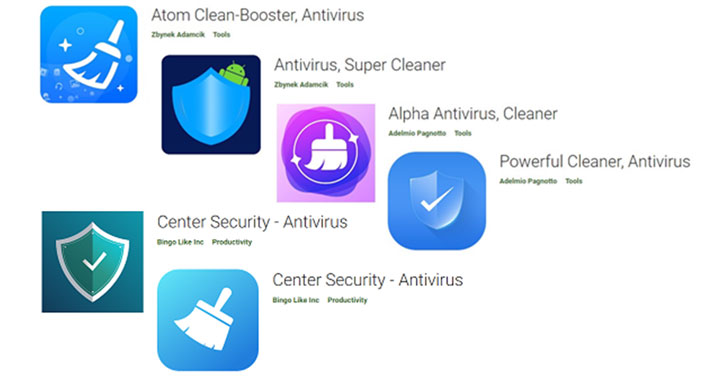
As many as seven malicious Android apps discovered on the Google
Play Store masqueraded as antivirus solutions to deploy a banking
trojan called SharkBot.
“SharkBot steals credentials and banking information,” Check
Point researchers Alex Shamshur and Raman Ladutska said[1]
in a report shared with The Hacker News. “This malware implements a
geofencing feature and evasion techniques, which makes it stand out
from the rest of malwares.”
Particularly, the malware is designed to ignore users from
China, India, Romania, Russia, Ukraine, and Belarus. The rogue apps
are said to have been installed more than 15,000 times prior to
their removal, with most of the victims located in Italy and the
U.K.
The report complements previous findings[2]
from NCC Group, which found the bankbot posing as antivirus apps to
carry out unauthorized transactions via Automatic Transfer Systems
(ATS).
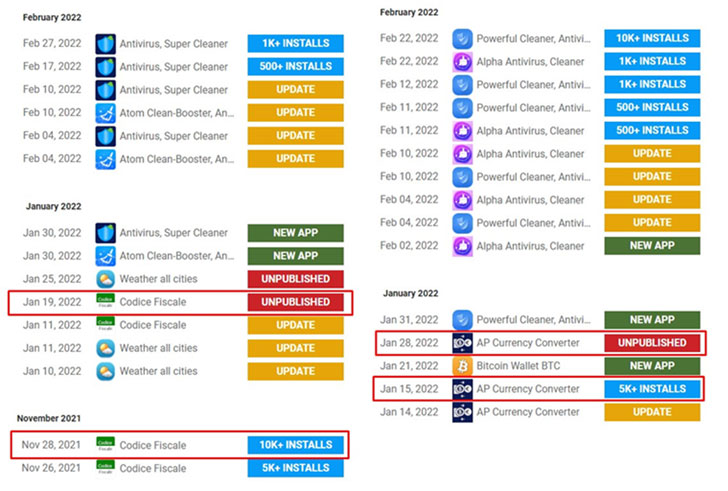
SharkBot takes advantage of the Accessibility Services
permissions to present fake overlay windows on top of legitimate
banking apps. Thus when unsuspecting users enter their usernames
and passwords in the windows that mimic benign credential input
forms, the captured data is sent to a malicious server.
One new notable feature of SharkBot is its ability to auto reply
to notifications from Facebook Messenger and WhatsApp to distribute
a phishing link to the antivirus app, thus propagating the malware
in a worm-like fashion. A similar feature was incorporated[3]
in FluBot earlier this February.
The latest findings come as Google took steps to banish 11 apps[4]
from the Play Store on March 25 after they were caught
incorporating an invasive SDK to discreetly harvest user data[5], including precise
location information, email and phone numbers, nearby devices, and
passwords.
“What’s also noteworthy here is that the threat actors push
messages to victims containing malicious links, which leads to
widespread adoption,” Alexander Chailytko, cyber security, research
and innovation manager at Check Point Software, said.
“All in all, the use of push-messages by the threat actors
requesting an answer from users is an unusual spreading
technique.”
References
- ^
said
(research.checkpoint.com) - ^
previous
findings (thehackernews.com) - ^
incorporated
(thehackernews.com) - ^
banish
11 apps (www.wsj.com) - ^
discreetly harvest user data
(blog.appcensus.io)
Read more https://thehackernews.com/2022/04/sharkbot-banking-trojan-resurfaces-on.html