Researchers have disclosed a previously undocumented local file
inclusion (LFI[1]) vulnerability in
Hashnode[2], a developer-oriented
blogging platform, that could be abused to access sensitive data
such as SSH keys, server’s IP address, and other network
information.
“The LFI originates in a Bulk Markdown Import feature[3] that can be manipulated
to provide attackers with unimpeded ability to download local files
from Hashnode’s server,” Akamai researchers said in a report[4]
shared with The Hacker News.
Local file inclusion flaws occur when a web application is
tricked into exposing or running unapproved files on a server,
leading to directory traversal, information disclosure, remote code
execution, and cross-site scripting (XSS) attacks.
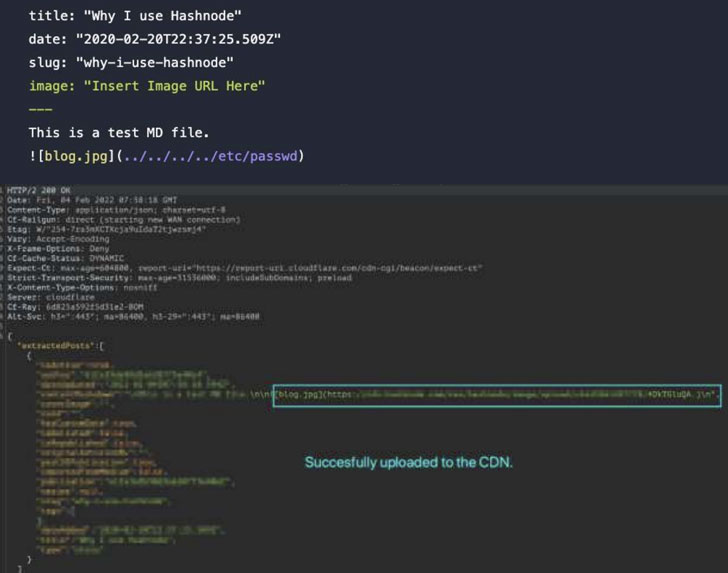
The flaw, caused due to the web application failing to
adequately sanitize the path to a file that’s passed as input,
could have serious repercussions in that an assailant could
navigate to any path on the server and access sensitive
information, including the /etc/passwd
file[5] that contains a list of
users on the server.
Armed with this exploit, the researchers said they were able to
identify the IP address and the private secure shell (SSH[6]) key associated with the
server.
While the vulnerability has since been addressed, the findings
come as Akamai said it recorded more than five billion LFI attacks
between September 1, 2021, and February 28, 2022, marking a 141%
increase over the previous six months[7].
“LFI attacks are an attack vector that could cause major damage
to an organization, as a threat actor could obtain information
about the network for future reconnaissance,” the researchers
said.
References
- ^
LFI
(en.wikipedia.org) - ^
Hashnode
(hashnode.com) - ^
Bulk
Markdown Import feature
(support.hashnode.com) - ^
report
(www.akamai.com) - ^
/etc/passwd file
(en.wikipedia.org) - ^
SSH
(en.wikipedia.org) - ^
previous
six months (www.akamai.com)
Read more https://thehackernews.com/2022/04/critical-lfi-vulnerability-reported-in.html