Cybersecurity researchers have shed light on an actively
maintained remote access trojan called DCRat (aka DarkCrystal RAT)
that’s offered on sale for “dirt cheap” prices, making it
accessible to professional cybercriminal groups and novice actors
alike.
“Unlike the well-funded, massive Russian threat groups crafting
custom malware […], this remote access Trojan (RAT) appears to be
the work of a lone actor, offering a surprisingly effective
homemade tool for opening backdoors on a budget,” BlackBerry
researchers said in a report[1]
shared with The Hacker News.
“In fact, this threat actor’s commercial RAT sells at a fraction
of the standard price such tools command on Russian underground
forums.”
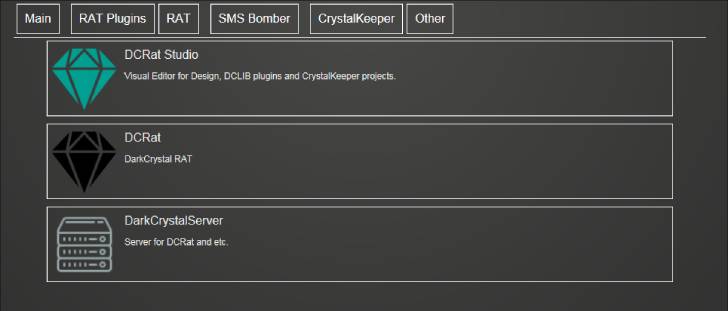
Written in .NET by an individual codenamed “boldenis44” and
“crystalcoder,” DCRat is a full-featured backdoor whose
functionalities can be further augmented by third-party plugins
developed by affiliates using a dedicated integrated development
environment (IDE[2]) called DCRat
Studio.
It was first released in 2018, with version 3.0 shipping on May
30, 2020, and version 4.0 launching nearly a year later on March
18, 2021.
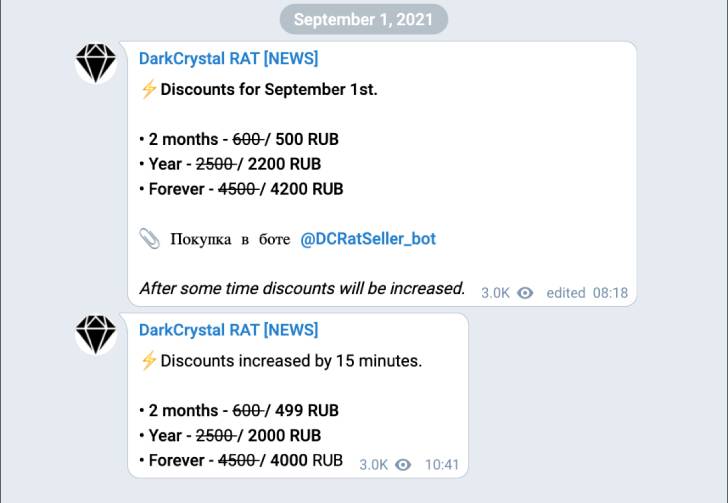
Prices for the trojan start at 500 RUB ($5) for a two-month
license, 2,200 RUB ($21) for a year, and 4,200 RUB ($40) for a
lifetime subscription, figures which are further reduced during
special promotions.
While a previous analysis[3]
by Mandiant in May 2020 traced the RAT’s infrastructure to
files.dcrat[.]ru, the malware bundle is currently hosted on a
different domain named crystalfiles[.]ru, indicating a shift in
response to public disclosure.
“All DCRat marketing and sales operations are done through the
popular Russian hacking forum lolz[.]guru, which also handles some
of the DCRat pre-sales queries,” the researchers said.
Also actively used for communications and sharing information
about software and plugin updates is a Telegram
channel[4] which has about 2,847
subscribers as of writing.
Messages posted on the channel in recent weeks cover updates to
CryptoStealer, TelegramNotifier, and WindowsDefenderExcluder
plugins, as well as “cosmetic changes/fixes” to the panel.
“Some Fun features have been moved to the standard plugin,” a
translated message shared on April 16 reads. “The weight of the
build has slightly decreased. There should be no detects that go
specifically to these functions.”
Besides its modular architecture and bespoke plugin framework,
DCRat also encompasses an administrator component that’s engineered
to stealthily trigger a kill switch, which allows the threat actor
to remotely render the tool unusable.
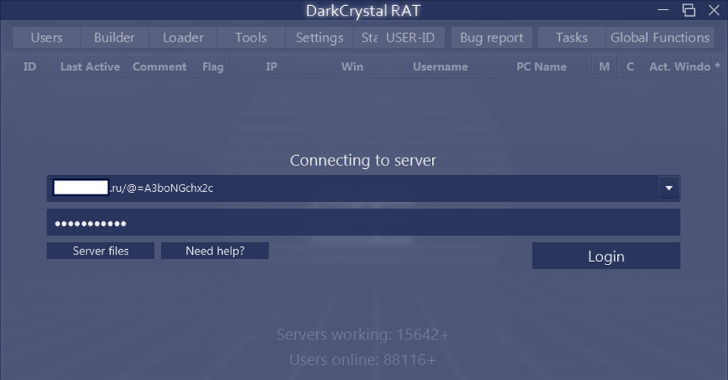
The admin utility, for its part, enables subscribers to sign in
to an active command-and-control server, issue commands to infected
endpoints, and submit bug reports, among others.
Distribution vectors employed to infect hosts with DCRat include
Cobalt Strike Beacons and a traffic direction system (TDS) called
Prometheus[5], a subscription-based
crimeware-as-a-service (CaaS) solution used to deliver a variety of
payloads.
The implant, in addition to gathering system metadata, supports
surveillance, reconnaissance, information theft, and DDoS attack
capabilities. It can also capture screenshots, record keystrokes,
and steal content from clipboard, Telegram, and web browsers.
“New plugins and minor updates are announced almost every day,”
the researchers said. “If the threat is being developed and
sustained by just one person, it appears that it’s a project they
are working on full-time.”
References
- ^
report
(blogs.blackberry.com) - ^
IDE
(en.wikipedia.org) - ^
previous
analysis (www.mandiant.com) - ^
Telegram
channel (telegram.me) - ^
Prometheus
(thehackernews.com)
Read more https://thehackernews.com/2022/05/experts-sound-alarm-on-dcrat-backdoor.html