
An espionage-focused threat actor known for targeting China,
Pakistan, and Saudi Arabia has expanded to set its sights on
Bangladeshi government organizations as part of an ongoing campaign
that commenced in August 2021.
Cybersecurity firm Cisco Talos attributed the activity with
moderate confidence to a hacking group dubbed the Bitter APT[1]
based on overlaps in the command-and-control (C2) infrastructure
with that of prior campaigns mounted by the same actor.
“Bangladesh fits the profile we have defined for this threat
actor, previously targeting Southeast Asian countries including
China[2], Pakistan, and Saudi
Arabia,” Vitor Ventura, lead security researcher at Cisco Talos,
told[3]
The Hacker News.
“And now, in this latest campaign, they have widened their reach
to Bangladesh. Any new country in southeast Asia being targeted by
Bitter APT shouldn’t be of surprise.”
Bitter (aka APT-C-08 or T-APT-17) is suspected to be a South
Asian hacking group motivated primarily by intelligence gathering,
an operation that’s facilitated by means of malware such as
BitterRAT, ArtraDownloader, and AndroRAT. Prominent targets include
the energy, engineering, and government sectors.
The earliest attacks were distributing the mobile version of
BitterRAT date back to September 2014, with the actor having a
history of leveraging zero-day flaws — CVE-2021-1732[4]
and CVE-2021-28310[5]
— to its advantage and accomplish its adversarial objectives.
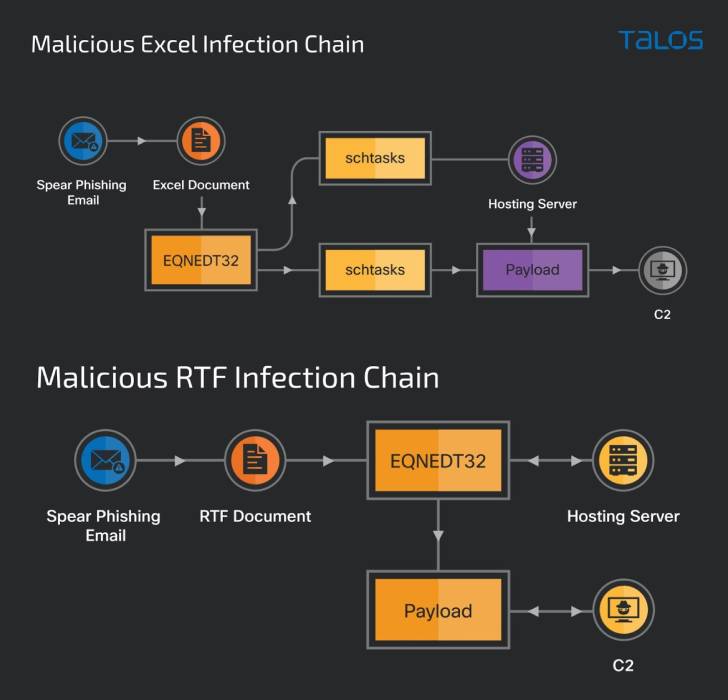
The latest campaign, targeting an elite entity of the Bangladesh
government, involves sending spear-phishing emails to high-ranking
officers of the Rapid Action Battalion Unit of the Bangladesh
police (RAB).
As is typically observed in other social engineering attacks of
this kind, the missives are designed to lure the recipients into
opening a weaponized RTF document or a Microsoft Excel spreadsheet
that exploits previously known flaws in the software to deploy a
new trojan; dubbed “ZxxZ.”
ZxxZ, named so after a separator used by the malware when
sending information back to the C2 server, is a 32-bit Windows
executable compiled in Visual C++.
“The trojan masquerades as a Windows Security update service and
allows the
malicious actor to perform remote code execution, allowing the
attacker to perform any other activities by installing other
tools,” the researchers explained.
While the malicious RTF document exploits a memory corruption
vulnerability in Microsoft Office’s Equation Editor (CVE-2017-11882[6]), the Excel file abuses
two remote code execution flaws, CVE-2018-0798[7]
and CVE-2018-0802[8], to activate the
infection sequence.
“Actors often change their tools to avoid detection or
attribution, this is part of the lifecycle of a threat actor
showing its capability and determination,” Ventura said.
References
- ^
Bitter
APT (malpedia.caad.fkie.fraunhofer.de) - ^
China
(www.anomali.com) - ^
old
(blog.talosintelligence.com) - ^
CVE-2021-1732
(blog.cyble.com) - ^
CVE-2021-28310
(thehackernews.com) - ^
CVE-2017-11882
(thehackernews.com) - ^
CVE-2018-0798
(msrc.microsoft.com) - ^
CVE-2018-0802
(msrc.microsoft.com)
Read more https://thehackernews.com/2022/05/bitter-apt-hackers-add-bangladesh-to.html