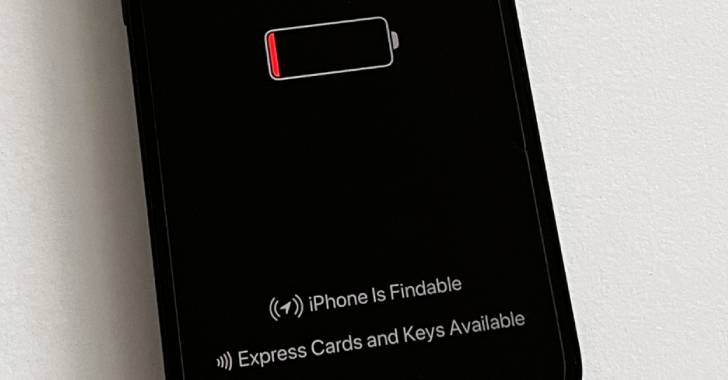
A first-of-its-kind security analysis of iOS Find My function
has identified a novel attack surface that makes it possible to
tamper with the firmware and load malware onto a Bluetooth chip
that’s executed while an iPhone is “off.”
The mechanism takes advantage of the fact that wireless chips
related to Bluetooth, Near-field communication (NFC[1]), and ultra-wideband
(UWB[2]) continue to operate
while iOS is shut down when entering a “power reserve” Low Power
Mode (LPM).
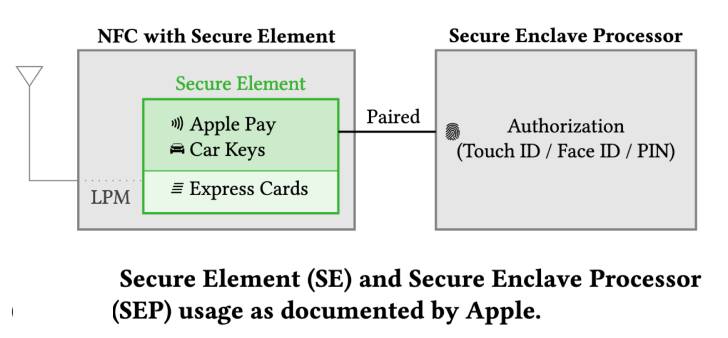
While this is done so as to enable features like Find My[3]
and facilitate Express Card transactions[4], all the three wireless
chips have direct access to the secure element, academics from the
Secure Mobile Networking Lab (SEEMOO[5]) at the Technical
University of Darmstadt said[6] in a paper.
“The Bluetooth and UWB chips are hardwired to the Secure Element
(SE) in the NFC chip, storing secrets that should be available in
LPM,” the researchers said.
“Since LPM support is implemented in hardware, it cannot be
removed by changing software components. As a result, on modern
iPhones, wireless chips can no longer be trusted to be turned off
after shutdown. This poses a new threat model.”
The findings are set to be presented[7]
at the ACM Conference on Security and Privacy in Wireless and
Mobile Networks (WiSec 2022) this week.
The LPM features, newly introduced last year with iOS 15, make
it possible to track lost devices using the Find My network even
when run out of battery power or have been shut off. Current
devices with Ultra-wideband support include[8] iPhone 11, iPhone 12,
and iPhone 13.
A message displayed when turning off iPhones reads thus[9]: “iPhone remains
findable after power off. Find My helps you locate this iPhone when
it is lost or stolen, even when it is in power reserve mode or when
powered off.”
Calling the current LPM implementation “opaque,” the researchers
not only sometimes observed failures when initializing Find My
advertisements during power off, effectively contradicting the
aforementioned message, they also found that the Bluetooth firmware
is neither signed nor encrypted.
By taking advantage of this loophole, an adversary with
privileged access can create malware that’s capable of being
executed on an iPhone Bluetooth chip even when it’s powered
off.
However, for such a firmware compromise to happen, the attacker
must be able to communicate to the firmware via the operating
system, modify the firmware image, or gain code execution on an
LPM-enabled chip over-the-air by exploiting flaws such as BrakTooth[10].
Put differently, the idea is to alter the LPM application thread
to embed malware, such as those that could alert the malicious
actor of a victim’s Find My Bluetooth broadcasts[11], enabling the threat
actor to keep remote tabs on the target.
“Instead of changing existing functionality, they could also add
completely new features,” SEEMOO researchers pointed out, adding
they responsibly disclosed all the issues to Apple, but that the
tech giant “had no feedback.”
With LPM-related features taking a more stealthier approach to
carrying out its intended use cases, SEEMOO called on Apple to
include a hardware-based switch to disconnect the battery so as to
alleviate any surveillance[12] concerns[13] that could arise out of
firmware-level attacks.
“Since LPM support is based on the iPhone’s hardware, it cannot
be removed with system updates,” the researchers said. “Thus, it
has a long-lasting effect on the overall iOS security model.”
“Design of LPM features seems to be mostly driven by
functionality, without considering threats outside of the intended
applications. Find My after power off turns shutdown iPhones into
tracking devices by design, and the implementation within the
Bluetooth firmware is not secured against manipulation.”
References
- ^
NFC
(en.wikipedia.org) - ^
UWB
(en.wikipedia.org) - ^
Find
My (thehackernews.com) - ^
Express
Card transactions (support.apple.com) - ^
SEEMOO
(www.seemoo.tu-darmstadt.de) - ^
said
(arxiv.org) - ^
presented
(wisec2022.cs.utsa.edu) - ^
include
(support.apple.com) - ^
reads
thus (www.macrumors.com) - ^
BrakTooth
(thehackernews.com) - ^
Find
My Bluetooth broadcasts (thehackernews.com) - ^
surveillance
(thehackernews.com) - ^
concerns
(thehackernews.com)
Read more https://thehackernews.com/2022/05/researchers-find-way-to-run-malware-on.html