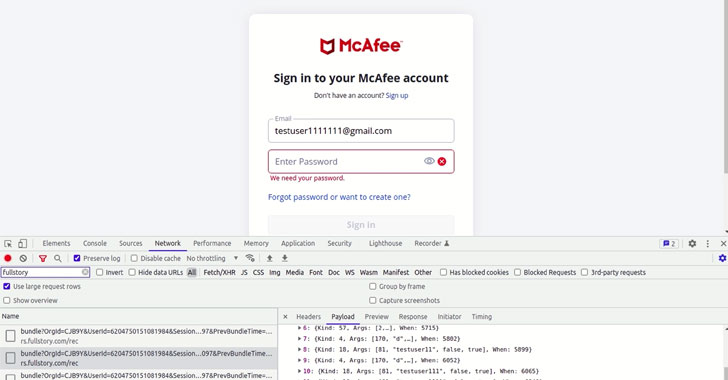
A new research published by academics from KU Leuven, Radboud
University, and the University of Lausanne has revealed that users’
email addresses are exfiltrated to tracking, marketing, and
analytics domains before such is submitted and without prior
consent.
The study involved[1]
crawling 2.8 million pages from the top 100 websites, and found
that as many as 1,844 websites allowed trackers to capture email
addresses before form submission in the European Union, a number
that jumped to 2,950 when the same set of websites are visited from
the U.S.
“Emails (or their hashes) were sent to 174 distinct domains
(eTLD+1[2]) in the U.S. crawl, and
157 distinct domains in the EU crawl,” the researchers said[3]. Furthermore, 52
websites were determined to be collecting passwords in the same
manner, an issue that has since been addressed following
responsible disclosure.
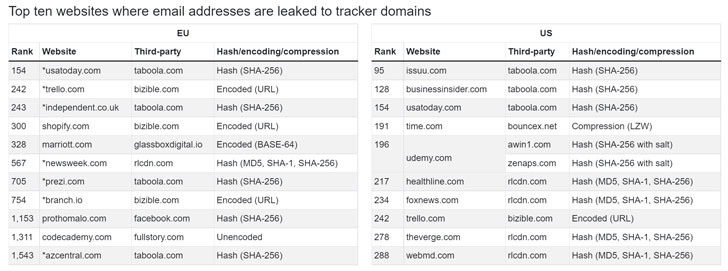
LiveRamp, Taboola, Adobe, Verizon, Yandex, Meta, TikTok,
Salesforce, Listrak, and Oracle are some of the top third-party
trackers that have been spotted logging email addresses, while
Yandex, Mixpanel, and LogRocket lead the list in the
password-grabbing category.
Email addresses pose a number of advantages. Not only are they
unique, enabling third-parties to track users across devices, it
can also be employed to match their online and offline activities,
say, in scenarios where they make an in-store purchase that
requires them to share their email address or sign up for a loyalty
card.
The idea behind harvesting email addresses entered in online
forms, even in cases where the users do not submit any form, has
also been fueled by ongoing attempts by browser vendors to drop support for third-party
cookies[4], forcing marketers to
look for alternative static identifiers to track users.
This is not the first time such a concern has been raised. In
June 2017, Gizmodo discovered[5]
that a third party called NaviStone was collecting personal
information from mortgage calculator forms prior to their
submission, with very few websites explicitly disclosing this
practice in their privacy policy.
Fast forward five years later, not much has changed, the
researchers said, what with websites related to fashion/beauty,
online shopping, and general news emerging as the top categories
with the most “leaky forms[6].”
“Despite filling email fields on hundreds of websites
categorized as pornography, we have not a single email leak,” the
findings show, noting how it lines up with previous studies[7]
that have shown that adult websites have relatively fewer
third-party trackers when compared to general sites with comparable
popularity.
What’s more, such a practice may be in violation of at least
three different General Data Protection Regulation (GDPR[8]) requirements in the
E.U., contravening principles of transparency, purpose limitation,
and user consent.
“Users should assume that the personal information they enter
into web forms may be collected by trackers—even if the form is
never submitted,” the researchers concluded, calling on a further
investigation from browser vendors, privacy tool developers, and
data protection agencies.
References
- ^
involved
(www.usenix.org) - ^
eTLD+1
(web.dev) - ^
said
(homes.esat.kuleuven.be) - ^
drop
support for third-party cookies
(thehackernews.com) - ^
discovered
(thehackernews.com) - ^
leaky forms
(github.com) - ^
previous
studies (papers.ssrn.com) - ^
GDPR
(en.wikipedia.org)
Read more https://thehackernews.com/2022/05/web-trackers-caught-intercepting-online.html