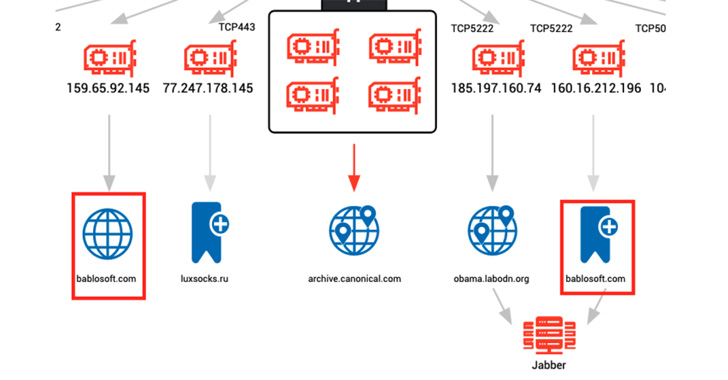
Cybersecurity researchers are calling attention to a free-to-use
browser automation framework that’s being increasingly used by
threat actors as part of their attack campaigns.
“The framework contains numerous features which we assess may be
utilized in the enablement of malicious activities,” researchers
from Team Cymru said[1]
in a new report published Wednesday.
“The technical entry bar for the framework is purposefully kept
low, which has served to create an active community of content
developers and contributors, with actors in the underground economy
advertising their time for the creation of bespoke tooling.”
The U.S. cybersecurity company said it observed
command-and-control (C2) IP addresses associated with malware such
as Bumblebee[2], BlackGuard[3], and RedLine Stealer[4]
establishing connections to the downloads subdomain of Bablosoft
(“downloads.bablosoft[.]com”), the maker of the Browser Automation
Studio (BAS).
Bablosoft was previously documented[5]
by cloud security and application delivery firm F5 in February
2021, pointing to the framework’s ability to automate tasks in
Google’s Chrome browser in a manner similar to legitimate developer
tools like Puppeteer and Selenium.
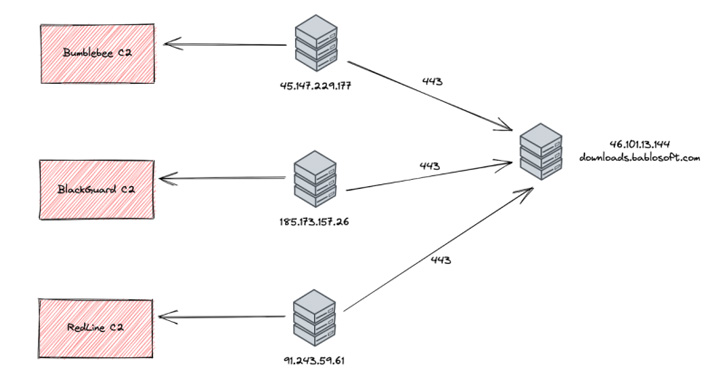
Threat telemetry for the subdomain’s IP address —
46.101.13[.]144 — shows that a vast majority of activity is
originating from locations in Russia and Ukraine, with open source
intelligence indicating that Bablosoft’s owner is allegedly based
in the Ukrainian capital city of Kyiv.
It’s being suspected that the operators of the malware campaigns
connected to the Bablosoft subdomain for purposes of downloading
additional tools for use as part of post-exploitation
activities.
Also identified are several hosts associated with cryptojacking
malware like XMRig and Tofsee communicating with a second subdomain
named “fingerprints.bablosoft[.]com” to use a service that helps
the mining malware conceal its behavior.
“Based on the number of actors already utilizing tools offered
on the Bablosoft website, we can only expect to see BAS becoming a
more common element of the threat actor’s toolkit,” the researchers
said.
References
- ^
said
(team-cymru.com) - ^
Bumblebee
(thehackernews.com) - ^
BlackGuard
(thehackernews.com) - ^
RedLine
Stealer (thehackernews.com) - ^
documented
(www.f5.com)
Read more https://thehackernews.com/2022/05/hackers-increasingly-using-browser.html