The Iranian state-sponsored threat actor tracked under the
moniker Lyceum has turned to using a new custom .NET-based backdoor
in recent campaigns directed against the Middle East.
“The new malware is a .NET based DNS Backdoor which is a
customized version of the open source tool ‘DIG.net,'” Zscaler
ThreatLabz researchers Niraj Shivtarkar and Avinash Kumar said[1]
in a report published last week.
“The malware leverages a DNS attack technique called ‘DNS
Hijacking’ in which an attacker-controlled DNS server manipulates
the response of DNS queries and resolves them as per their
malicious requirements.”
DNS hijacking is a redirection attack[2]
in which DNS queries to genuine websites are intercepted to take an
unsuspecting user to fraudulent pages under an adversary’s control.
Unlike cache poisoning[3], DNS hijacking targets
the DNS record of the website on the nameserver, rather than a
resolver’s cache.
Lyceum[4], also known as Hexane,
Spirlin, or Siamesekitten, is primarily known for its cyber attacks
in the Middle East and Africa. Earlier this year, Slovak
cybersecurity firm ESET tied its activities[5]
to another threat actor called OilRig (aka APT34).
The latest infection chain involves the use of a macro-laced
Microsoft Document downloaded from a domain named
“news-spot[.]live,” impersonating a legitimate news report[6]
from Radio Free Europe/Radio Liberty about Iran’s drone strikes in
December 2021.
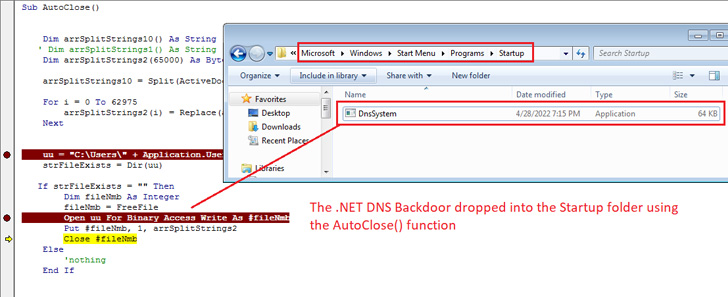
Enabling the macro results in the execution of a malicious code
that drops the implant to the Windows Startup folder[7]
to establish persistence and ensure it automatically runs every
time the system is restarted.
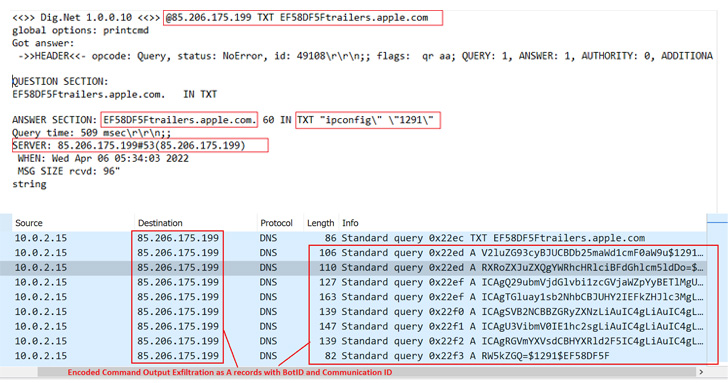
The .NET DNS backdoor, dubbed DnsSystem, is a reworked variant
of the open-source DIG.net[8]
DNS resolver tool, enabling the Lyceum actor to parse DNS responses
issued from the DNS server (“cyberclub[.]one”) and carry out its
nefarious goals.
In addition to abusing the DNS protocol for command-and-control
(C2) communications to evade detection, the malware is equipped to
upload and download arbitrary files to and from the remote server
as well as execute malicious system commands remotely on the
compromised host.
“APT threat actors are continuously evolving their tactics and
malware to successfully carry out attacks against their targets,”
the researchers said. “Attackers continuously embrace new
anti-analysis tricks to evade security solutions; re-packaging of
malware makes static analysis even more challenging.”
References
- ^
said
(www.zscaler.com) - ^
redirection attack
(www.cloudflare.com) - ^
cache
poisoning (thehackernews.com) - ^
Lyceum
(thehackernews.com) - ^
tied its
activities (thehackernews.com) - ^
legitimate news report
(www.rferl.org) - ^
Windows
Startup folder (support.microsoft.com) - ^
DIG.net
(www.codeproject.com)
Read more https://thehackernews.com/2022/06/iranian-hackers-spotted-using-new-dns.html