
When it comes to keeping SaaS stacks secure, IT and security
teams need to be able to streamline the detection and remediation
of misconfigurations in order to best protect their SaaS stack from
threats. However, while companies adopt more and more apps, their
increase in SaaS security tools and staff has lagged behind, as
found in the 2022 SaaS Security Survey Report.[1]
The survey report, completed by Adaptive Shield in conjunction
with Cloud Security Alliance (CSA), dives into how CISOs today are
managing the growing SaaS app attack surface and the steps they are
taking to secure their organizations.
The report finds that at least 43% of organizations have
experienced a security incident as a result of a SaaS
misconfiguration; however, with another 20% being “unsure,” the
real number could be as high as 63%. These numbers
are particularly striking when compared to the 17% of organizations
experiencing security incidents due to an IaaS
misconfiguration.
Bearing this in mind, the question follows: how fast
are SaaS misconfigurations detected, and how long does it
take to remediate the issue? In order to answer these questions,
it’s important to make a distinction between organizations that
have implemented an SSPM solution and those that have not.
Manual Detection and Remediation
For organizations that are yet to onboard an SSPM, the IT and
security teams can only manually check the apps’ many
configurations to secure their SaaS stack. This means security
teams need to not only be on top of remediating misconfigurations
but also conduct regular security checks in order to detect any of
these misconfigurations manually. The longer either of these
actions takes to be completed, the longer the company is exposed to
threats.
Learn how to fast track SaaS security
detection and remediation>>>[2]
One of the major problems for organizations’ security teams is
the overwhelming amount of manual work. Companies today are reliant
on dozens upon dozens of business-critical apps, each with hundreds
of configurations, which then need to be set according to the
hundreds to thousands of employees.
Nearly half (46%) of the survey respondents, as seen in figure
2, check their SaaS security monthly or less frequently, and
another 5% don’t check at all. It seems that security teams are
overwhelmed with the workload and are struggling to stay on top of
all the settings and permissions. As organizations continue to
adopt more and more apps, their gap of visibility into all
configurations grows.
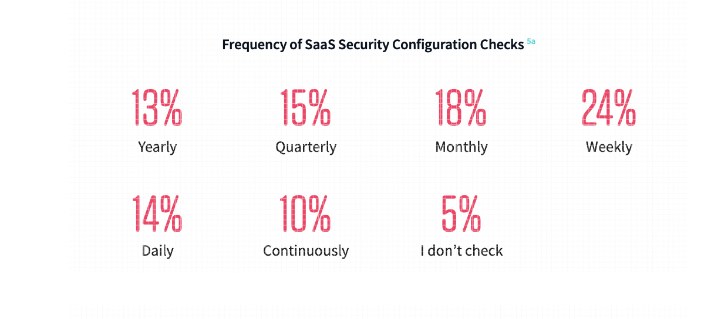 |
| Figure 2. Frequency of SaaS Security Configuration Checks |
When a security check fails, security teams must then go in and
understand why exactly the check failed and the best course of
action to fix it. Approximately 1 in 4 organizations, as seen in
figure 3, take one week or longer to resolve a misconfiguration
when remediating manually. Overall, security teams trying to manage
their SaaS security is not only overwhelmed but are also, in turn,
leaving the organization exposed for a longer period of time.
Get a quick 15-minute demo on how to spot
and fix your SaaS misconfigurations[3]
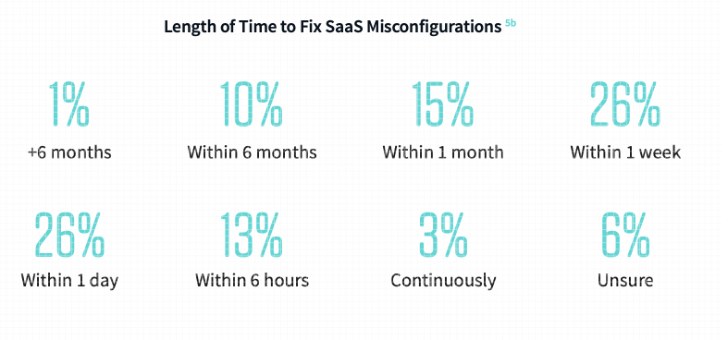 |
| Figure 3. Length of Time to Fix Saas Misconfigurations |
How SSPM Fast Tracks Remediation and Detection
Organizations using SSPM, like Adaptive Shield, are able to
complete security checks more often and fix misconfigurations
within a shorter time frame. An SSPM enables security teams to
conduct frequent checks in compliance with both industry standards
and company policy. The 2022 SaaS Security Survey Report found that
the majority of these organizations (78%) run security checks once
per week or more often, as seen in figure 4.
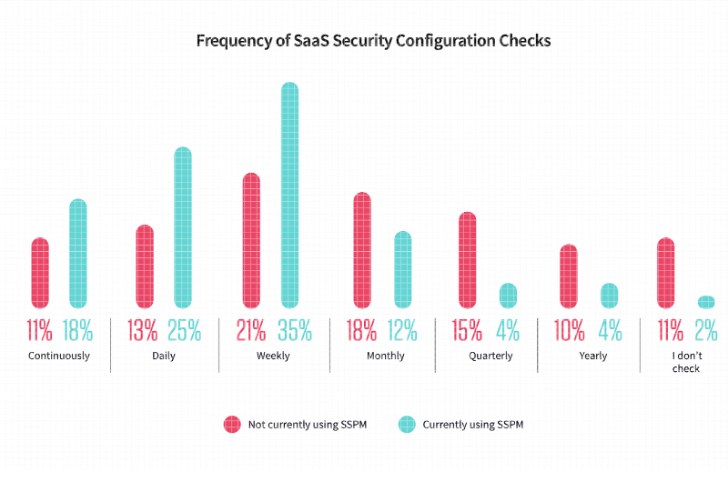 |
| Figure 4. Comparison of Frequency of SaaS Security Configuration Checks |
When a misconfiguration is detected, 73% of organizations using
an SSPM resolved it within a day, and 81% resolved it within the
week, as seen in figure 5. A good SSPM solution, however, will not
only evaluate failed security checks caused by misconfigurations
but will also assess risk and configuration weakness — and provide
exact instruction on how to remediate the issue.
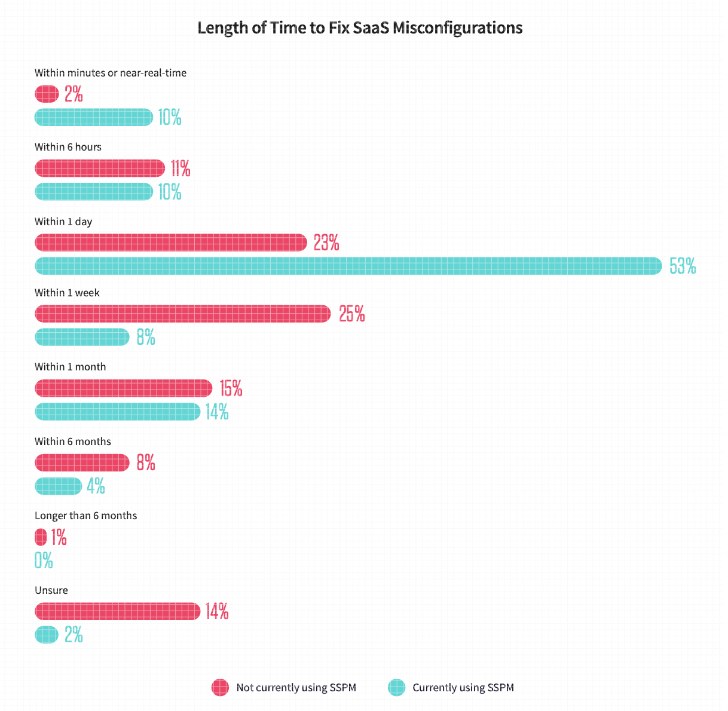 |
| Figure 5. Comparison of Length of Time to Fix Misconfigurations |
Conclusion
SSPM not only reduces the workload on security teams but also
eliminates the need for them to be experts on each SaaS app and its
settings. The data presented in the 2022 SaaS Security Survey
Report highlights the drastic differences between companies using
SSPM and those not, showing how valuable an SSPM, like Adaptive Shield[4], is to SaaS security
detection and remediation.
References
- ^
2022
SaaS Security Survey Report.
(www.adaptive-shield.com) - ^
Learn
how to fast track SaaS security detection and
remediation>>>
(www.adaptive-shield.com) - ^
Get a
quick 15-minute demo on how to spot and fix your SaaS
misconfigurations (www.adaptive-shield.com) - ^
Adaptive
Shield (www.adaptive-shield.com)
Read more https://thehackernews.com/2022/06/manual-vs-sspm-research-on-what.html