
A week after it emerged that sophisticated mobile spyware dubbed
Hermit was used by the government of Kazakhstan within its borders,
Google said it has notified Android users of infected devices.
Additionally, necessary changes have been implemented in
Google Play Protect[1]
— Android’s built-in malware defense service — to protect all
users, Benoit Sevens and Clement Lecigne of Google Threat Analysis
Group (TAG) said[2]
in a Thursday report.
Hermit, the work of an Italian vendor named RCS Lab, was
documented[3]
by Lookout last week, calling out its modular feature-set and its
abilities to harvest sensitive information such as call logs,
contacts, photos, precise location, and SMS messages.
Once the threat has thoroughly insinuated itself into a device,
it’s also equipped to record audio and make and redirect phone
calls, in addition to abusing its permissions to accessibility
services to keep tabs on the foreground apps used by the
victims.
Its modularity also enables it to be wholly customizable,
equipping the spyware’s functionality to be extended or altered at
will. It’s not immediately clear who were targeted in the campaign,
or which of RCS Lab clients were involved.
The Milan-based company, operating since 1993, claims[4]
to provide “law enforcement agencies worldwide with cutting-edge
technological solutions and technical support in the field of
lawful interception for more than twenty years.” More than 10,000
intercepted targets are purported to be handled daily in Europe
alone.
“Hermit is yet another example of a digital weapon being used to
target civilians and their mobile devices, and the data collected
by the malicious parties involved will surely be invaluable,”
Richard Melick, director of threat reporting for Zimperium,
said.
The targets have their phones infected with the spy tool via
drive-by downloads as initial infection vectors, which, in turn,
entails sending a unique link in an SMS message that, upon
clicking, activates the attack chain.
It’s suspected that the actors worked in collaboration with the
targets’ internet service providers (ISPs) to disable their mobile
data connectivity, followed by sending an SMS that urged the
recipients to install an application to restore mobile data
access.
“We believe this is the reason why most of the applications
masqueraded as mobile carrier applications,” the researchers said.
“When ISP involvement is not possible, applications are masqueraded
as messaging applications.”
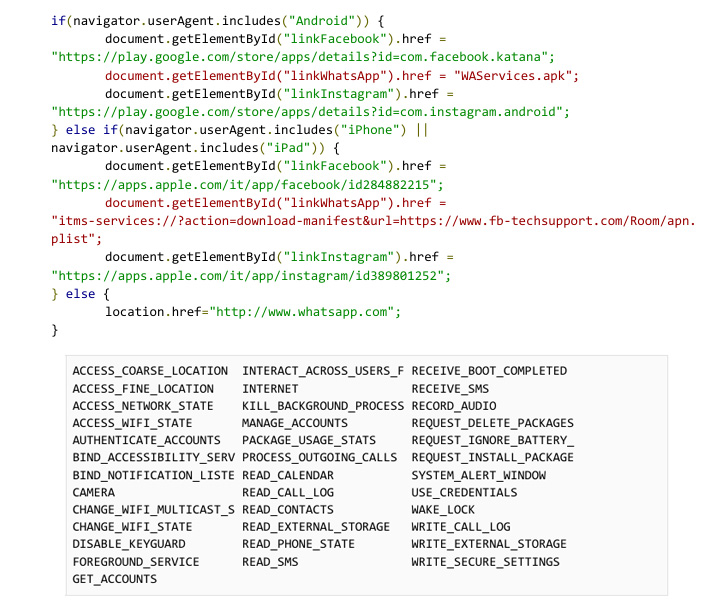
To compromise iOS users, the adversary is said to have relied on
provisioning profiles that allow fake carrier-branded apps to be
sideloaded onto the devices without the need for them to be
available on the App Store.
An analysis of the iOS version of the app shows that it
leverages as many as six exploits — CVE-2018-4344[5], CVE-2019-8605[6], CVE-2020-3837[7], CVE-2020-9907[8], CVE-2021-30883[9], and CVE-2021-30983[10] — to exfiltrate files
of interest, such as the WhatsApp database, from the device.
“As the curve slowly shifts towards memory corruption
exploitation getting more expensive, attackers are likely shifting
too,” Google Project Zero’s Ian Beer said[11] in a deep-dive analysis
of an iOS artifact that impersonated the My Vodafone carrier
app.
On Android, the drive-by attacks require that victims enable a
setting to install third-party applications from unknown sources,
doing so which results in the rogue app, masquerading as smartphone
brands like Samsung, requests for extensive permissions to achieve
its malicious goals.
The Android variant, besides attempting to root the device for
entrenched access, is also wired differently in that instead of
bundling exploits in the APK file, it contains functionality that
permits it to fetch and execute arbitrary remote components that
can communicate with the main app.
“This campaign is a good reminder that attackers do not always
use exploits to achieve the permissions they need,” the researchers
noted. “Basic infection vectors and drive by downloads still work
and can be very efficient with the help from local ISPs.”
Stating that seven of the nine zero-day exploits it discovered
in 2021 were developed by commercial providers[12] and sold to and used by
government-backed actors[13], the tech behemoth said
it’s tracking more than 30 vendors with varying levels of
sophistication who are known to trade exploits and surveillance
capabilities.
What’s more, Google TAG raised concerns that vendors like RCS
Lab are “stockpiling zero-day vulnerabilities in secret” and
cautioned that this poses severe risks considering a number of
spyware vendors have been compromised over the past ten years,
“raising the specter that their stockpiles can be released publicly
without warning.”
“Our findings underscore the extent to which commercial
surveillance vendors have proliferated capabilities historically
only used by governments with the technical expertise to develop
and operationalize exploits,” TAG said.
“While use of surveillance technologies may be legal under
national or international laws, they are often found to be used by
governments for purposes antithetical to democratic values:
targeting dissidents, journalists, human rights workers and
opposition party politicians.”
References
- ^
Google
Play Protect (support.google.com) - ^
said
(blog.google) - ^
documented
(thehackernews.com) - ^
claims
(www.rcslab.it) - ^
CVE-2018-4344
(nvd.nist.gov) - ^
CVE-2019-8605
(nvd.nist.gov) - ^
CVE-2020-3837
(nvd.nist.gov) - ^
CVE-2020-9907
(nvd.nist.gov) - ^
CVE-2021-30883
(thehackernews.com) - ^
CVE-2021-30983
(thehackernews.com) - ^
said
(googleprojectzero.blogspot.com) - ^
commercial providers
(thehackernews.com) - ^
government-backed actors
(thehackernews.com)
Read more https://thehackernews.com/2022/06/google-says-isps-helped-attackers.html