A widespread software supply chain attack has targeted the NPM
package manager at least since December 2021 with rogue modules
designed to steal data entered in forms by users on websites that
include them.
The coordinated attack, dubbed IconBurst by ReversingLabs,
involves no fewer than two dozen NPM packages that include
obfuscated JavaScript, which comes with malicious code to harvest
sensitive data from forms embedded downstream mobile applications
and websites.
“These clearly malicious attacks relied on typo-squatting, a
technique in which attackers offer up packages via public
repositories with names that are similar to — or common
misspellings of — legitimate packages,” security researcher Karlo
Zanki said[1]
in a Tuesday report. “Attackers impersonated high-traffic NPM
modules like umbrellajs and packages published by ionic.io.”
The packages in question, most of which were published in the
last months, have been collectively downloaded more than 27,000
times to date. Worse, a majority of the modules continue to be
available for download from the repository.
Some of the most download malicious modules are listed below
–
- icon-package (17,774)
- ionicio (3,724)
- ajax-libs (2,440)
- footericon (1,903)
- umbrellaks (686)
- ajax-library (530)
- pack-icons (468)
- icons-package (380)
- swiper-bundle (185), and
- icons-packages (170)
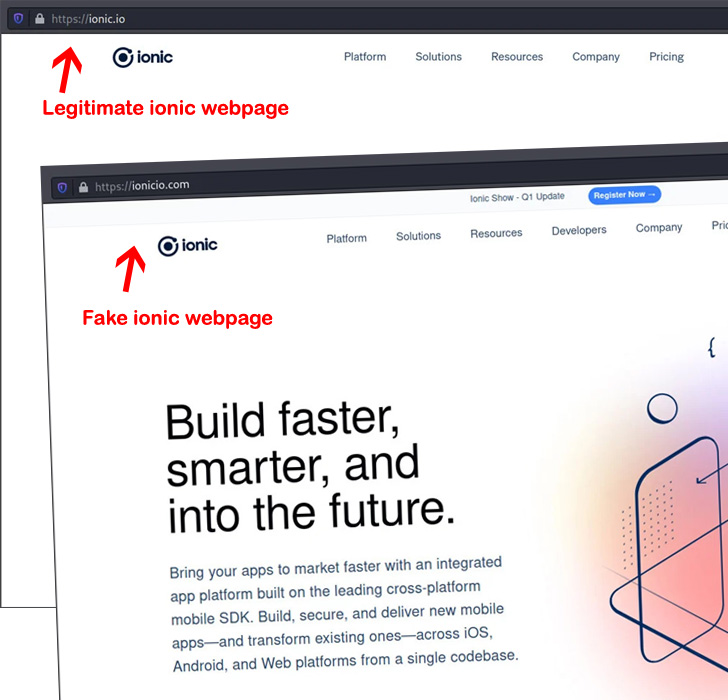
In one instance observed by ReversingLabs, data exfiltrated by
icon-package was routed to a domain named ionicio[.]com, a
lookalike page engineered to resemble the legitimate ionic[.]io
website.
The malware authors behind the campaign further switched up
their tactics in recent months to gather information from every
form element on the web page, indicating an aggressive approach to
data harvesting.
“The decentralized and modular nature of application development
means that applications and services are only as strong as their
least secure component,” Zanki noted. “The success of this attack
[…] underscores the freewheeling nature of application
development, and the low barriers to malicious or even vulnerable
code entering sensitive applications and IT environments.”
Read more https://thehackernews.com/2022/07/researchers-uncover-malicious-npm.html