
The U.S. Cybersecurity and Infrastructure Security Agency (CISA)
is warning of a handful of unpatched security vulnerabilities in
MiCODUS MV720[1]
Global Positioning System (GPS) trackers outfitted in over 1.5
million vehicles that could lead to remote disruption of critical
operations.
“Successful exploitation of these vulnerabilities may allow a
remote actor to exploit access and gain control of the global
positioning system tracker,” CISA said[2]. “These vulnerabilities
could impact access to a vehicle fuel supply, vehicle control, or
allow locational surveillance of vehicles in which the device is
installed.”
Available on sale for $20 and manufactured by the China-based
MiCODUS, the company’s tracking devices are employed by major
organizations in 169 countries spanning aerospace, energy,
engineering, government, manufacturing, nuclear power plant, and
shipping sectors.
The top countries with the most users include Chile, Australia,
Mexico, Ukraine, Russia, Morocco, Venezuela, Brazil, Poland, Italy,
Indonesia, Uzbekistan, and South Africa.
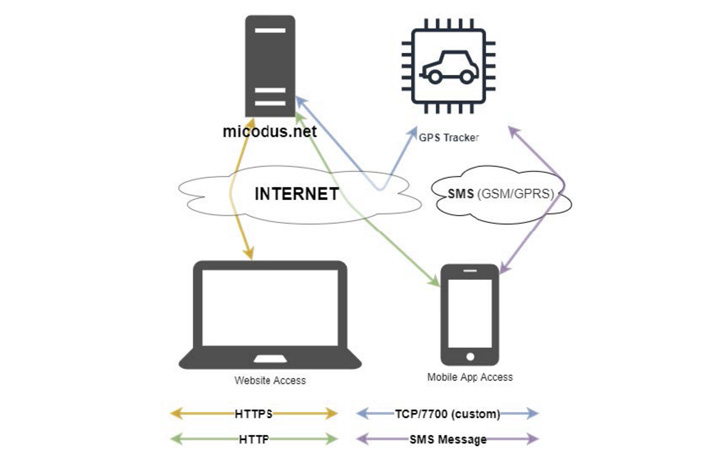
The issues, which were identified during the course of a
security audit by BitSight, could also be potentially abused to
track individuals without their knowledge, disable vehicles, and
even pose national security implications in light of the fact that
militaries and law enforcement agencies use the trackers for
real-time monitoring.
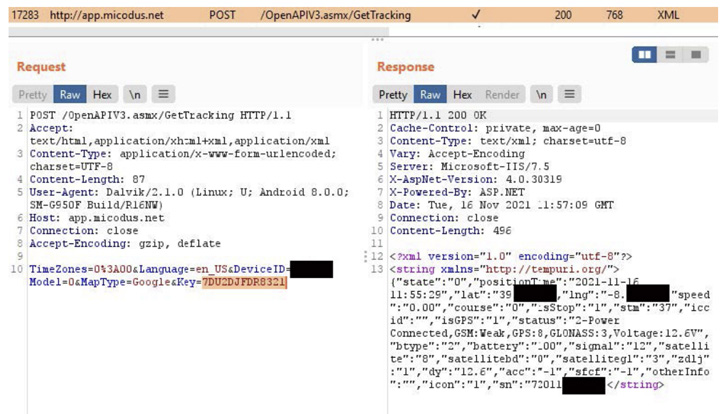
“A nation-state adversary could potentially exploit the
tracker’s vulnerabilities to gather intelligence on
military-related movements including supply routes, regular troop
movements, and recurring patrols,” BitSight researchers pointed out[3].
The list of flaws that were disclosed to MiCODUS in September
2021 is below –
- CVE-2022-2107 (CVSS score: 9.8) – Use of a
hard-coded master password that could enable an unauthenticated
attacker to carry out adversary-in-the-middle (AitM) attacks and
seize control of the tracker. - CVE-2022-2141 (CVSS score: 9.8) – Broken
authentication scheme in the API server that enables an attacker to
control all traffic between the GPS tracker and the original server
and gain control. - No assigned CVE (CVSS score: 8.1) – Use of a
preconfigured default password “123456” that allows attackers to
access any GPS tracker at random. - CVE-2022-2199 (CVSS score: 7.5) – A reflected
cross-site scripting (XSS) vulnerability in the web server that
could lead to the execution of arbitrary JavaScript code in the web
browser. - CVE-2022-34150 (CVSS score: 7.1) – An access
control vulnerability stemming from Insecure Direct Object
Reference (IDOR[4]) that could result in
the exposure of sensitive information. - CVE-2022-33944 (CVSS score: 6.5) – A case of
authenticated IDOR vulnerability that could be leveraged to
generate Excel reports about device activity.
In a nutshell, the flaws could be weaponized to obtain access to
location, routes, fuel cutoff commands as well as the ability to
disarm various features such as alarms.
But with no workaround in sight, users of the GPS tracker in
question are advised to take steps to minimize exposure or
alternatively cease using the devices and disable them altogether
until a fix is made available by the company.
“Having a centralized dashboard to monitor GPS trackers with the
ability to enable or disable a vehicle, monitor speed, routes and
leverage other features is useful to many individuals and
organizations,” the researchers said. “However, such functionality
can introduce serious security risks.”
References
- ^
MiCODUS
MV720 (www.micodus.com) - ^
said
(www.cisa.gov) - ^
pointed
out (www.bitsight.com) - ^
IDOR
(en.wikipedia.org)
Read more https://thehackernews.com/2022/07/unpatched-gps-tracker-bugs-could-let.html