
Details of an eight-year-old security vulnerability in the Linux
kernel have emerged that the researchers say is “as nasty as Dirty
Pipe.”
Dubbed DirtyCred[1] by a group of academics
from Northwestern University, the security weakness exploits a
previously unknown flaw (CVE-2022-2588[2]) to escalate privileges
to the maximum level.
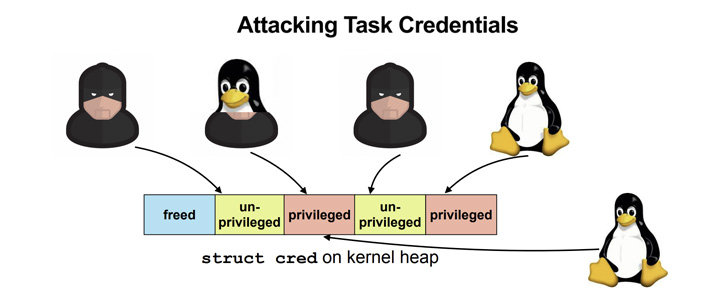
“DirtyCred is a kernel exploitation concept that swaps
unprivileged kernel credentials[3]
with privileged ones to escalate privilege,” researchers Zhenpeng
Lin, Yuhang Wu, and Xinyu Xing noted. “Instead of overwriting any
critical data fields on kernel heap, DirtyCred abuses the heap
memory reuse mechanism to get privileged.”
This entails three steps –
- Free an in-use unprivileged credential with the
vulnerability - Allocate privileged credentials in the freed memory slot by
triggering a privileged userspace process such as su, mount, or
sshd - Operate as a privileged user
The novel exploitation method, according to the researchers,
pushes the dirty pipe to the next level, making it more general as
well as potent in a manner that could work on any version of the
affected kernel.
“First, rather than tying to a specific vulnerability, this
exploitation method allows any vulnerabilities with double-free
ability to demonstrate dirty-pipe-like ability,” the researchers
said[4].
“Second, while it is like the dirty pipe that could bypass all
the kernel protections, our exploitation method could even
demonstrate the ability to escape the container actively that Dirty
Pipe is not capable of.”
Dirty Pipe[5], tracked as
CVE-2022-0847 (CVSS score: 7.8) and affecting Linux kernel versions
starting from 5.8, refers to a security vulnerability in the
pipe subsystem[6]
that allows underprivileged processes to write to arbitrary
readable files, leading to privilege escalation.
The exploitable vulnerability was so called after the Dirty Cow[7]
vulnerability discovered in 2016 based on their similarities.
Given that objects are isolated based on their type and not
privileges, the researchers recommend isolating privileged
credentials from unprivileged ones using virtual memory to prevent
cross-cache attacks.
References
- ^
DirtyCred
(github.com) - ^
CVE-2022-2588
(access.redhat.com) - ^
kernel
credentials (www.kernel.org) - ^
said
(www.blackhat.com) - ^
Dirty
Pipe (thehackernews.com) - ^
pipe
subsystem (en.wikipedia.org) - ^
Dirty
Cow (thehackernews.com)
Read more https://thehackernews.com/2022/08/as-nasty-as-dirty-pipe-8-year-old-linux.html