Researchers have disclosed multiple vulnerabilities impacting
Ultra-wideband (UWB) Real-time Locating Systems (RTLS[1]), enabling threat actors
to launch adversary-in-the-middle (AitM) attacks and tamper with
location data.
“The zero-days found specifically pose a security risk for
workers in industrial environments,” cybersecurity firm Nozomi
Networks disclosed[2]
in a technical write-up last week. “If a threat actor exploits
these vulnerabilities, they have the ability to tamper with safety
zones designated by RTLS to protect workers in hazardous
areas.”
RTLS is used to automatically identify and track the location of
objects or people in real-time, usually within a confined indoor
area. This is achieved by making use of tags that are attached to
assets, which broadcast USB signals to fixed reference points
called anchors that then determine their location.
But flaws identified in RTLS solutions – Sewio Indoor Tracking RTLS UWB Wi-Fi
Kit[3]a and Avalue Renity Artemis Enterprise
Kit[4] – meant that they could
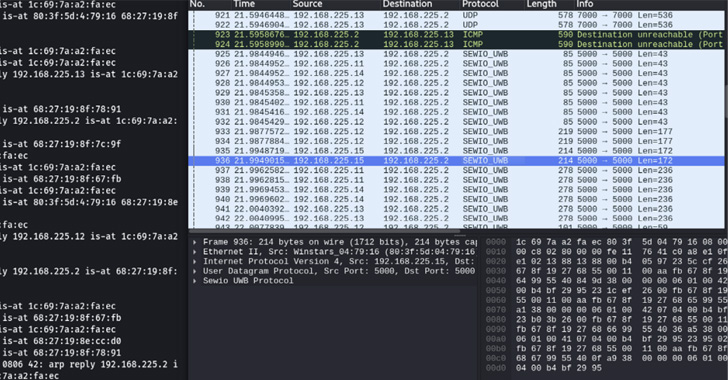
be weaponized to intercept network packets exchanged between
anchors and the central server and stage traffic manipulation
attacks.

Put simply, the idea is to estimate the anchor coordinates and
use it to manipulate the geofencing rules of the RTLS system,
effectively tricking the software into granting access to
restricted areas and even causing disruption to production
environments.
“If an attacker is able to alter the position of a tag by
modifying the positioning packet related to that tag, it may become
possible to enter restricted zones or steal valuable items without
the operators being able to detect that a malicious activity is
ongoing.”
Even worse, by altering the position of tags and placing them
inside areas monitored by geofencing rules, an adversary can cause
the stoppage of entire production lines by showing that a worker is
nearby even when no one is actually around.
In an alternate scenario, the location data could be tampered to
place a worker outside of a geofencing zone so that dangerous
machinery would restart while a worker is in close proximity,
posing severe safety risks.
But it’s worth pointing out that doing so necessitates that an
attacker either compromises a computer connected to that network,
or surreptitiously adds a rogue device to gain unauthorized access
to the network.
To remediate such attacks, it’s recommended to enforce network
segregation and add a traffic encryption layer on top of the
existing communications to prevent AitM attacks.
“Weak security requirements in critical software can lead to
safety issues that cannot be ignored,” researchers Andrea Palanca,
Luca Cremona, and Roya Gordon said. “Exploiting secondary
communications in UWB RTLS can be challenging, but it is
doable.”
References
- ^
RTLS
(en.wikipedia.org) - ^
disclosed
(www.nozominetworks.com) - ^
Sewio
Indoor Tracking RTLS UWB Wi-Fi Kit
(www.sewio.net) - ^
Avalue
Renity Artemis Enterprise Kit
(rtls.avalue.com.tw)
Read more https://thehackernews.com/2022/08/rtls-systems-found-vulnerable-to-mitm.html