Entities located in East and Southeast Asia as well as Ukraine
have been targeted at least since 2020 by a previously undocumented
subgroup of APT41[1], a prolific Chinese
advanced persistent threat (APT).
Cybersecurity firm Trend Micro, which christened[2]
the espionage crew Earth Longzhi, said the actor’s
long-running campaign can be split into two based on the toolset
deployed to attack its victims.
The first wave from May 2020 to February 2021 is said to have
targeted government, infrastructure, and healthcare industries in
Taiwan and the banking sector in China, whereas the succeeding set
of intrusions from August 2021 to June 2022 infiltrated
high-profile victims in Ukraine and several countries in Asia.
This included defense, aviation, insurance, and urban
development industries in Taiwan, China, Thailand, Malaysia,
Indonesia, Pakistan, and Ukraine.
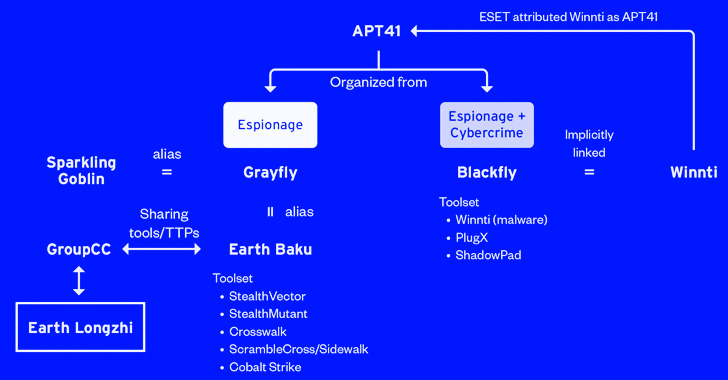
The victimology patterns and the targeted sectors overlap with
attacks mounted by a distinct sister group of APT41[3]
(aka Winnti) known as Earth Baku[4], the Japanese
cybersecurity company added.
Some of Earth Baku’s malicious cyber activities have been tied
to groups called by other cybersecurity firms ESET and Symantec
under the names SparklingGoblin and Grayfly, respectively.
“SparklingGoblin’s Tactics, Techniques and Procedures (TTPs)
partially overlap with APT41 TTPs,” ESET researcher Mathieu Tartare
previously told[5]
The Hacker News. “Grayfly’s definition given by Symantec seems to
(at least partially) overlap with SparklingGoblin.”
Now Earth Longzhi adds to another piece in the APT41 attack
puzzle, what with the actor also sharing links to a third subgroup
dubbed GroupCC[6]
(aka APT17, Aurora Panda, or Bronze Keystone).
Attacks orchestrated by the hacker group leverage spear-phishing
emails as the initial entry vector. These messages are known to
embed password-protected archives or links to files hosted on
Google Drive that, when opened, launches a Cobalt Strike loader
dubbed CroxLoader.
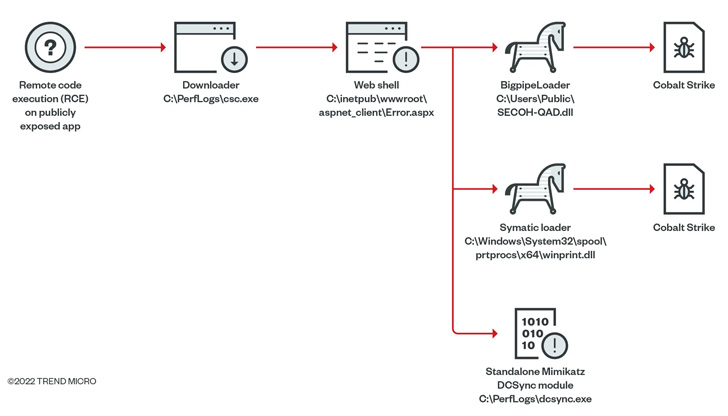
In some cases, the group has been observed weaponizing remote
code execution flaws in publicly exposed applications to deliver a
web shell capable of dropping a next-stage loader referred to as
Symatic that’s engineered to deploy Cobalt Strike.
Also put to use as part of its post-exploitation activities is
an “all in one tool,” which combines several publicly available and
custom functions in one package and is believed to have been
available since September 2014.
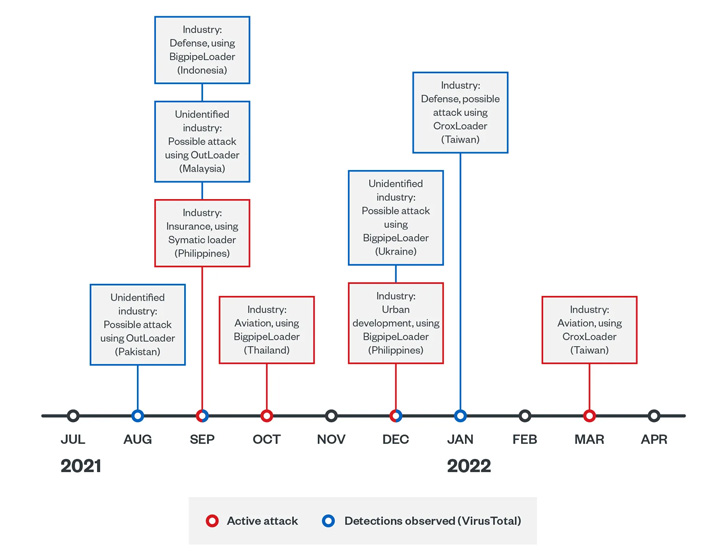
The second series of attacks initiated by Earth Longzhi follow a
similar pattern, the main difference being the use of different
Cobalt Strike loaders named CroxLoader, BigpipeLoader, and
OutLoader to drop the red team framework on infected hosts.
The recent attacks further stand out for the use of bespoke
tools that can disable security software, dump credentials using a
modified version of Mimikatz, and leverage flaws in the Windows
Print Spooler component (i.e., PrintNightmare[7]) to escalate
privileges.
What’s more, incapacitating the installed security solutions is
pulled off by a method called bring your own vulnerable driver
(BYOVD), which entails the exploitation of a known flaw in the
RTCore64.sys driver (CVE-2019-16098[8]).
This is carried out using ProcBurner, a tool for killing
specific running processes, while another custom malware called
AVBurner is used to unregister the endpoint detection and response
(EDR) system by removing process creation callbacks – a mechanism
that was detailed[9]
by a security researcher who goes by the alias brsn in August
2020.
It’s worth noting the outdated version of the RTCore64.sys
driver, which still has a valid digital signature, has been put to
use by multiple threat actors like BlackByte[10] and OldGremlin[11] over the past few
months.
“[Earth Longzhi’s] target sectors are in industries pertinent to
Asia-Pacific countries’ national security and economies,” the
researchers said. “The activities in these campaigns show that the
group is knowledgeable on red team operations.”
“The group uses social engineering techniques to spread its
malware and deploy customized hack tools to bypass the protection
of security products and steal sensitive data from compromised
machines.”
References
- ^
APT41
(thehackernews.com) - ^
christened
(www.trendmicro.com) - ^
APT41
(thehackernews.com) - ^
Earth
Baku (thehackernews.com) - ^
told
(thehackernews.com) - ^
GroupCC
(malpedia.caad.fkie.fraunhofer.de) - ^
PrintNightmare
(thehackernews.com) - ^
CVE-2019-16098
(nvd.nist.gov) - ^
detailed
(br-sn.github.io) - ^
BlackByte
(thehackernews.com) - ^
OldGremlin
(thehackernews.com)
Read more https://thehackernews.com/2022/11/new-earth-longzhi-apt-targets-ukraine.html