Today, most Network Detection and Response (NDR) solutions rely
on traffic mirroring and Deep Packet Inspection (DPI). Traffic
mirroring is typically deployed on a single-core switch to provide
a copy of the network traffic to a sensor that uses DPI to
thoroughly analyze the payload. While this approach provides
detailed analysis, it requires large amounts of processing power
and is blind when it comes to encrypted network traffic. Metadata
Analysis has been specifically developed to overcome these
limitations. By utilizing metadata for analysis, network
communications can be observed at any collection point and be
enriched by the information providing insights about encrypted
communication.
Network Detection and Response (NDR) solutions have become
crucial to reliably monitor and protect network operations.
However, as network traffic becomes encrypted and data volumes
continue to increase, most traditional NDR solutions are reaching
their limits. This begs the question: What detection technologies
should organizations utilize to ensure the maximum security of
their systems?
This article will shed light on the concept of Deep Packet
Inspection (DPI) and Metadata Analysis. We will compare both
detection technologies and examine how modern Network Detection and
Response (NDR) solutions can effectively protect IT/OT networks
from advanced cyber threats.
What is Deep Packet Inspection (DPI), and how does it
work?
DPI is a way of network traffic monitoring used to inspect
network packets flowing across a specific connection point or
switch. In DPI, the whole traffic is typically mirrored by a core
switch to a DPI sensor. The DPI sensor then examines both the
header and data section of the packet. If the data section is not
encrypted, DPI data are rich in information and allow for robust
analysis of the monitored connection points. Traditional NDR
solutions rely on DPI-based technologies, which are quite popular
to this day. However, in the face of rapidly expanding attack
surfaces and evolving IT environments, the limitations of DPI have
become increasingly prevalent.
Why Is DPI not enough to detect Advanced
Cyberattacks?
Organizations are increasingly using encryption to protect their
network traffic and online interactions. Although encryption brings
enormous benefits to online privacy and cybersecurity, it also
provides a suitable opportunity for cybercriminals to hide in the
dark when launching devastating cyberattacks. As DPI was not
designed for the analysis of encrypted traffic, it has become blind
to the inspection of encrypted packet payloads. This is a
significant shortfall for DPI since most modern cyberattacks, such
as APT, ransomware, and lateral movement, heavily utilise
encryption in their attack routine to receive attack instructions
from remote Command and Control Servers (C&C) scattered across
cyberspace. In addition to absent encryption capabilities, DPI
requires large amounts of processing power and time in order to
thoroughly inspect the data section of each packet. Consequently,
DPI cannot analyze all network packets in data-heavy networks,
making it an unfeasible solution for high-bandwidth networks.
The New Approach: Metadata Analysis
Metadata analysis has been developed to overcome the limitations
of DPI. By utilizing metadata for network analysis, security teams
can monitor all network communications passing through any
physical, virtualized or cloud networks without inspecting the
entire data section of each packet. Consequently, Metadata analysis
is unaffected by encryption and can deal with ever-increasing
network traffic. In order to provide security teams with real-time
intelligence of all network traffic, Metadata analysis captures
vast arrays of attributes about network communications,
applications, and actors (e.g., user logins). For instance, for
every session passing through the network, the source/destination
IP address, session length, protocol used (TCP, UDP), and the type
of services used are recorded. Metadata can capture many other key
attributes, which effectively help detect and prevent advanced
cyberattacks:
- Host and server IP address, port number, geo-location
information - DNS and DHCP information mapping devices to IP addresses
- Web page accesses, along with the URL and header
information - Users to systems mapping using DC log data
- Encrypted web pages – encryption type, cypher and hash,
client/server FQDN - Different objects hashes – such as JavaScript and images
How can Security Teams benefit from metadata-based
NDR?
Implementing a Network Detection and Response (NDR) solution
based on Metadata analysis provides security teams with reliable
insights on what happens inside their network – no matter whether
the traffic is encrypted or not. Metadata analysis supplemented by
system and application logs allows security teams to detect
vulnerabilities and improve internal visibility into blind spots,
such as shadow IT devices, which are considered a common entry
point exploited by cybercriminals. This holistic visibility is not
possible with DPI-based NDR solutions. In addition, lightweight
metadata allows for efficient log data storage of historical
records, facilitating forensics investigations. Data-heavy DPI
analysis makes long-term storage of historical data practically
infeasible or very expensive. Finally, the metadata approach allows
security teams to determine the source of all traffic passing
through corporate networks and monitor suspicious activity on all
devices connected to networks, such as IoT devices. This makes
complete visibility into corporate networks possible.
Conclusion: The Future of Cybersecurity is the analysis
of Metadata
Traditional DPI-based NDR tools will eventually become obsolete
for enterprise cybersecurity as the threat landscape expands and
more traffic becomes encrypted. These developments are already felt
across the cybersecurity industry, as more companies are adopting
MA-based security systems to effectively seal security gaps and
protect their digital assets.
ExeonTrace[1]
is a leading NDR solution based on Metadata Analysis. Unlike
traditional DPI-based NDR systems, ExeonTrace provides clever data
handling, is unaffected by encryption and does not require any
hardware sensors. Furthermore, ExeonTrace can effortlessly deal
with high-bandwidth network traffic as it reduces network volumes
and provides more efficient data storage. Consequently, ExeonTrace
is the NDR solution of choice for complex and high-bandwidth
corporate networks.
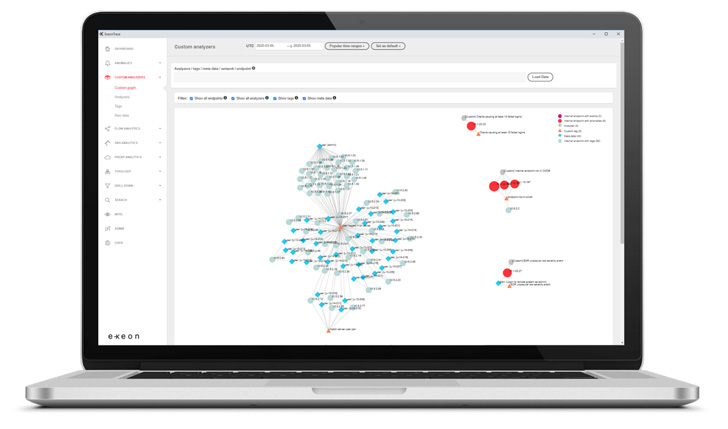 |
| ExeonTrace Platform: Screenshot of custom network analyzer graph |
Book a free
demo[2] to discover how
ExeonTrace can help address your security challenges and make your
organization more cyber-resilient.
References
- ^
ExeonTrace
(exeon.com) - ^
Book a free demo
(exeon.com)
Read more https://thehackernews.com/2022/11/deep-packet-inspection-vs-metadata.html