 |
| Credit: Marina Minkin |
A novel attack method has been disclosed against a crucial piece
of technology called time-triggered ethernet (TTE[1]) that’s used in
safety-critical infrastructure, potentially causing the failure of
systems powering spacecraft and aircraft.
Dubbed PCspooF by a group of academics and
researchers from the University of Michigan[2], the University of
Pennsylvania, and the NASA Johnson Space Center, the technique[3]
is designed to break TTE’s security guarantees and induce TTE
devices to lose synchronization for up to a second, a behavior that
can even lead to uncontrolled maneuvers in spaceflight missions and
threaten crew safety.
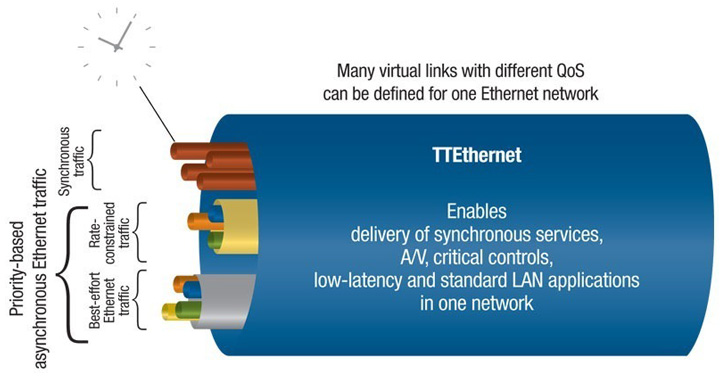
TTE[4]
is one among the networking technologies that’s part of what’s
called a mixed-criticality network wherein traffic with different
timing and faults tolerance requirements coexist in the same
physical network. This means that both critical devices, which,
say, enable vehicle control, and non-critical devices, which are
used for monitoring and data collection, share the same
network.
An obvious advantage to this approach is the fact that there are
lesser weight and power requirements as well as lower development
and time costs stemming as a result of relying on just one
technology. But this also comes with drawbacks of its own.

“This mixed-criticality approach puts a lot more pressure on the
design of the network to provide isolation,” Andrew Loveless, the
lead author of the study, told The Hacker News. “Now that critical
and non-critical items may connect to the same switch, the network
protocol and hardware need to do extra work to make sure the
critical traffic is always guaranteed to get through successfully
and on time.”
 |
| Credit: European Space Agency |
On top of that, while critical devices in the network are
subjected to thorough vetting, the non-critical counterparts are
not only commercial-off-the-shelf (COTS) devices but also lack the
same rigorous process, leading to possible avenues for supply chain
compromises that could be weaponized to activate the attack by
integrating a rogue third-party component into the system.
This is where a mixed-criticality network helps ensure that even
if the COTS device is malicious, it cannot interfere with critical
traffic.
“In PCspooF, we uncovered a way for a malicious non-critical
device to break this isolation guarantee in a TTE network,” Baris
Kasikci, an assistant professor in the electrical engineering and
computer science department at the University of Michigan, told the
publication.
This, in turn, is achieved by using the nefarious device to
inject electromagnetic interference (EMI) into a TTE switch over an
Ethernet cable, effectively tricking the switch into sending
authentic-looking synchronization messages (i.e., protocol control
frames or PCFs) and get them accepted by other TTE devices.
Such an “electrical noise” generation circuit can take up as
little as 2.5cm × 2.5cm on a single-layer printed circuit board,
requiring only minimal power and which can be concealed in a
best-effort device and integrated into a TTE system without raising
any red flags.
As mitigations, the study recommends using optocouplers or surge
protectors to block electromagnetic interference, checking the
source MAC addresses to ensure they’re authentic, hiding key PCF
fields, using a link-layer authentication protocol like IEEE
802.1AE, increasing the number of sync masters, and disabling
dangerous state transitions.
The findings show that the use of common hardware in a system
engineered to provide strict isolation assurances can sometimes
defeat those very protections, the researchers pointed out, adding
mixed-criticality software systems should be examined meticulously
in a similar manner to ensure the isolation mechanisms are
foolproof.
“The TTE protocols are very mature and well-vetted, and many of
the most important parts are formally proven,” Kasikci said.
“In a way that is what makes our attack interesting – that we
were able to figure out how to violate some guarantees of the
protocol despite its maturity. But to do that, we had to think
outside the box and figure out how to make the hardware behave in a
way the protocol does not expect.”
References
Read more https://thehackernews.com/2022/11/pcspoof-new-vulnerability-affects.html