Dec 07, 2022Ravie Lakshmanan

The China-linked nation-state hacking group referred to as
Mustang Panda is using lures related to the
ongoing Russo-Ukrainian War to attack entities in Europe and the
Asia Pacific.
That’s according to the BlackBerry Research and Intelligence
Team, which analyzed[1]
a RAR archive file titled “Political Guidance for the new EU
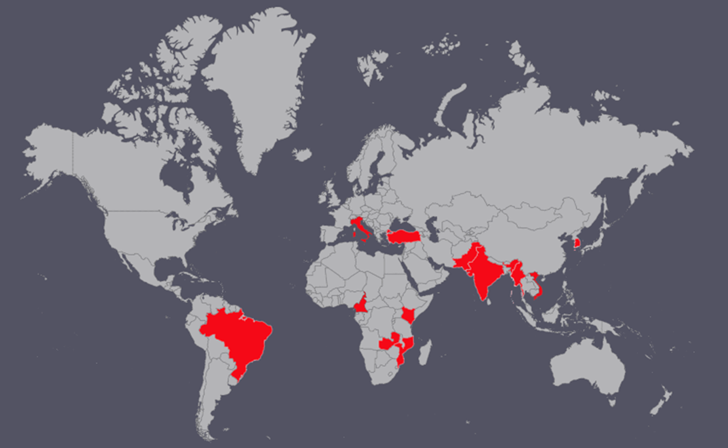
approach towards Russia.rar.” Some of the targeted countries
include Vietnam, India, Pakistan, Kenya, Turkey, Italy, and
Brazil.
Mustang Panda is a prolific cyber-espionage group from China
that’s also tracked under the names Bronze President, Earth Preta,
HoneyMyte, RedDelta, and Red Lich.
It’s believed to be active since at least July 2018, per
Secureworks’ threat profile[2], although indications
are that the threat actor has been targeting entities worldwide as
early as 2012.
Mustang Panda is known to heavily rely on sending weaponized
attachments via phishing emails to achieve initial infection, with
the intrusions eventually leading to the deployment of the PlugX
remote access trojan.
However, recent spear-phishing attacks[3] undertaken by the group
targeting government, education, and research sectors in the Asia
Pacific region have involved custom malware like PUBLOAD, TONEINS,
and TONESHELL, suggesting an expansion to its malware arsenal.
The latest findings from BlackBerry show that the core infection
process has remained more or less the same, even as Mustang Panda
continues to utilize geopolitical events to their advantage,
echoing prior reports from Google and Proofpoint[4].
Contained within the decoy archive is a shortcut to a Microsoft
Word file, which leverages DLL side-loading[5]
– a technique that was also employed in attacks[6]
aimed at Myanmar earlier this year – to kick off the execution of
PlugX in memory, before displaying the document’s contents.
“Their attack chain remains consistent with the continued use of
archive files, shortcut files, malicious loaders, and the use of
the PlugX malware, although their delivery setup is usually
customized per region/country to lure victims into executing their
payloads in the hope of establishing persistence with the intent of
espionage,” BlackBerry’s Dmitry Bestuzhev told The Hacker News.
Found this article interesting? Follow us on Twitter [7]
and LinkedIn[8]
to read more exclusive content we post.
References
- ^
analyzed
(blogs.blackberry.com) - ^
threat
profile (www.secureworks.com) - ^
recent
spear-phishing attacks (thehackernews.com) - ^
Google
and Proofpoint (thehackernews.com) - ^
DLL
side-loading (attack.mitre.org) - ^
attacks
(blogs.blackberry.com) - ^
Twitter
(twitter.com) - ^
LinkedIn
(www.linkedin.com)
Read more https://thehackernews.com/2022/12/chinese-hackers-using-russo-ukrainian.html