Jan 14, 2023Ravie Lakshmanan
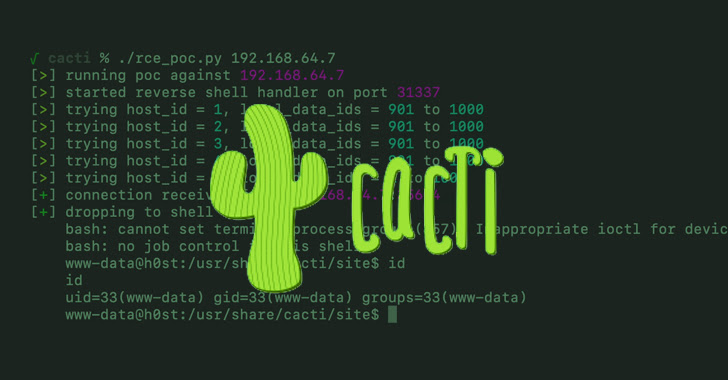
A majority of internet-exposed Cacti servers have not been
patched against a recently patched critical security vulnerability
that has come under active exploitation in the wild.
That’s according to attack surface management platform Censys,
which found[1]
only 26 out of a total of 6,427 servers to be running a patched version[2]
of Cacti (1.2.23 and 1.3.0).
The issue[3]
in question relates to CVE-2022-46169[4]
(CVSS score: 9.8), a combination of authentication bypass and
command injection that enables an unauthenticated user to execute
arbitrary code on an affected version of the open-source, web-based
monitoring solution.
Details about the flaw, which impacts versions 1.2.22 and below,
were first revealed by SonarSource. The flaw was reported to the
project maintainers on December 2, 2022.
“A hostname-based authorization check is not implemented safely
for most installations of Cacti,” SonarSource researcher Stefan
Schiller noted[5]
earlier this month, adding “unsanitized user input is propagated to
a string used to execute an external command.”
The public disclosure of the vulnerability has also led to
“exploitation attempts,” with the Shadowserver Foundation[6]
and GreyNoise[7]
warning of malicious attacks originating from one IP address
located in Ukraine so far.
A majority of the unpatched versions (1,320) are located in
Brazil, followed by Indonesia, the U.S., China, Bangladesh, Russia,
Ukraine, the Philippines, Thailand, and the U.K.
SugarCRM Flaw Actively Exploited to Drop Web Shells
The development comes as SugarCRM shipped fixes[8]
for a publicly disclosed vulnerability that has also been actively
weaponized to drop a PHP-based web shell on 354 unique hosts,
Censys said[9]
in an independent advisory.
The bug, tracked as CVE-2023-22952[10], concerns a case of
missing input validation that could result in injection of
arbitrary PHP code. It has been addressed in SugarCRM versions
11.0.5 and 12.0.2.
In the attacks detailed by Censys, the web shell is used as a
conduit to execute additional commands on the infected machine with
the same permissions as the user running the web service. A
majority of the infections have been reported in the U.S., Germany,
Australia, France, and the U.K.
It’s not uncommon for malicious actors to capitalize on newly
disclosed vulnerabilities to carry out their attacks, making it
imperative that users move quickly plug the security holes.
Found this article interesting? Follow us on Twitter [11] and LinkedIn[12] to read more exclusive
content we post.
References
- ^
found
(censys.io) - ^
patched
version (github.com) - ^
issue
(github.com) - ^
CVE-2022-46169
(nvd.nist.gov) - ^
noted
(www.sonarsource.com) - ^
Shadowserver Foundation
(twitter.com) - ^
GreyNoise
(viz.greynoise.io) - ^
shipped
fixes (sugarclub.sugarcrm.com) - ^
said
(censys.io) - ^
CVE-2023-22952
(nvd.nist.gov) - ^
Twitter
(twitter.com) - ^
LinkedIn
(www.linkedin.com)
Read more https://thehackernews.com/2023/01/cacti-servers-under-attack-as-majority.html