Feb 04, 2023Ravie Lakshmanan

VMware ESXi hypervisors are the target of a new wave of attacks
designed to deploy ransomware on compromised systems.
“These attack campaigns appear to exploit CVE-2021-21974, for
which a patch has been available since February 23, 2021,” the
Computer Emergency Response Team (CERT) of France said[1]
in an advisory on Friday.
VMware, in its own alert released at the time, described the
issue as an OpenSLP[2]
heap-overflow vulnerability that could lead to the execution of
arbitrary code.
“A malicious actor residing within the same network segment as
ESXi who has access to port 427 may be able to trigger the
heap-overflow issue in OpenSLP service resulting in remote code
execution,” the virtualization services provider noted[3].
French cloud services provider OVHcloud said[4]
the attacks are being detected globally with a specific focus on
Europe. It’s being suspected that the attacks are related to a new
Rust-based ransomware strain called Nevada that emerged on the
scene in December 2022.
Other[5]
ransomware[6]
families[7]
that are known to have embraced Rust in recent months include
BlackCat, Hive, Luna, Nokoyawa, RansomExx, and Agenda.
“The actors are inviting both Russian- and English-speaking
affiliates to collaborate with a big number of Initial Access
Brokers (IABs) in [the] dark web,” Resecurity said[8]
last month.
“Notably, the group behind the Nevada Ransomware is also buying
compromised access by themselves, the group has a dedicated team
for post-exploitation, and for conducting network intrusions into
the targets of interest.”
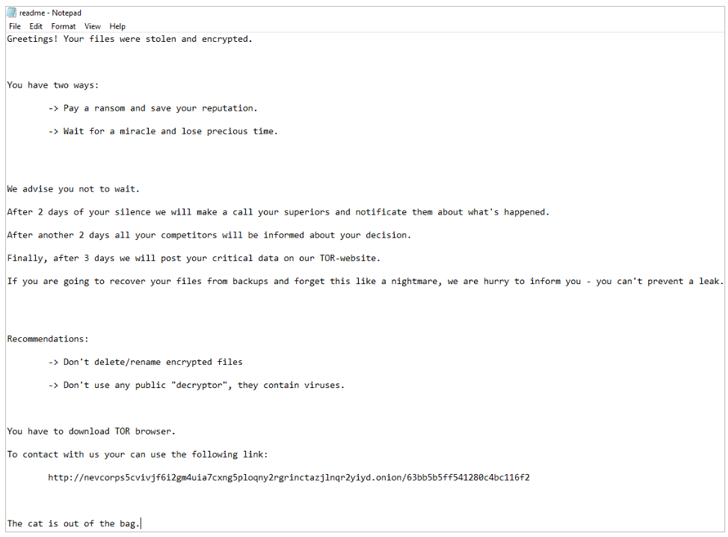
However, Bleeping Computer reports that the ransom notes[9]
seen in the attacks bear no similarities to Nevada ransomware,
adding the strain is being tracked under the name ESXiArgs.
Users are recommended to upgrade to the latest version of ESXi
to mitigate potential threats as well as restrict access to the
OpenSLP service to trusted IP addresses.
Found this article interesting? Follow us on Twitter [10] and LinkedIn[11] to read more exclusive
content we post.
References
- ^
said
(www.cert.ssi.gouv.fr) - ^
OpenSLP
(en.wikipedia.org) - ^
noted
(www.vmware.com) - ^
said
(blog.ovhcloud.com) - ^
Other
(thehackernews.com) - ^
ransomware
(thehackernews.com) - ^
families
(thehackernews.com) - ^
said
(www.resecurity.com) - ^
ransom
notes (www.bleepingcomputer.com) - ^
Twitter
(twitter.com) - ^
LinkedIn
(www.linkedin.com)
Read more https://thehackernews.com/2023/02/new-wave-of-ransomware-attacks.html