When SaaS applications started growing in popularity, it was
unclear who was responsible for securing the data. Today, most
security and IT teams understand the shared responsibility model,
in which the SaaS vendor is responsible for securing the
application, while the organization is responsible for securing
their data.
What’s far murkier, however, is where the data responsibility
lies on the organization’s side. For large organizations, this is a
particularly challenging question. They store terabytes of customer
data, employee data, financial data, strategic data, and other
sensitive data records online.
SaaS data breaches and SaaS ransomware attacks can lead to the
loss or public exposure of that data. Depending on the industry,
some businesses could face stiff regulatory penalties for data
breaches on top of the negative PR and loss of faith these breaches
bring with them.
Finding the right security model is the first step before
deploying any type of SSPM or other SaaS security solution.
Learn how Adaptive Shield’s SSPM solution
can help secure your SaaS stack.[1]
Getting to Know the Players
There are several different groups of players involved in the
SaaS security ecosystem.
SaaS App Owners – When business units subscribe
to SaaS software, someone from within the business unit is
typically responsible for setting up and onboarding the
application. While they may have some help from IT, the application
is their responsibility.
They choose settings and configurations that align with their
business needs, add users, and get to work. SaaS App Owners
recognize the need for data security, but it isn’t their
responsibility or something they know very much about. Some
mistakenly assume that data security is only the responsibility of
the SaaS vendor.
Central IT – In most large organizations,
Central IT is responsible for things like infrastructure, hardware,
and passwords. They manage IDP and servers, as well as oversee help
desk activities. SaaS applications typically do not fall under
their direct domain.
Central IT is more familiar with security requirements than the
average employee, but it isn’t their primary concern. However, it
is important to keep in mind that they aren’t security
professionals.
Security Teams – The security team is the
natural fit for implementing security controls and oversight. They
are tasked with creating and implementing a cybersecurity policy
that applies across the organization.
However, they have several challenges inhibiting their ability
to secure applications. For starters, they are often unaware of
SaaS applications that are being used by the company. Even for
applications that they are aware of, they lack access to the
configuration panels within the SaaS stack, and aren’t always aware
of the unique security aspects associated with each application.
Those are controlled and maintained by the SaaS App Owners and
Central IT.
GRC Teams – Compliance and governance teams are
tasked with ensuring that all IT meets specific security standards.
While they don’t play a specific role in securing corporate assets,
they do have oversight and need to determine whether the company is
living up to its compliance responsibilities.
SaaS Vendor – While the SaaS vendor is absolved
from any responsibility to secure the data, they are the team that
built the security apparatus for the SaaS application, and have a
deep knowledge of their application and its security
capabilities.
Defining Roles and Responsibilities
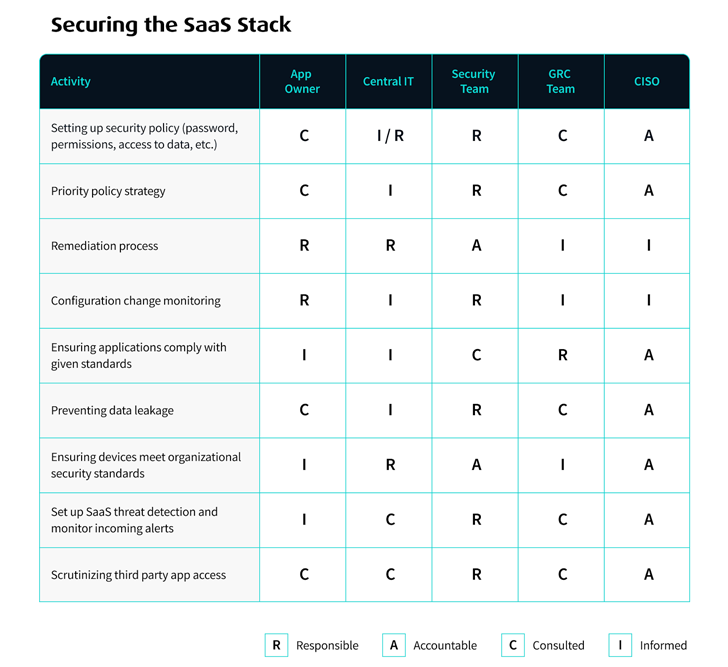
Securing the entire SaaS stack requires close collaboration
between the security experts and those managing and running their
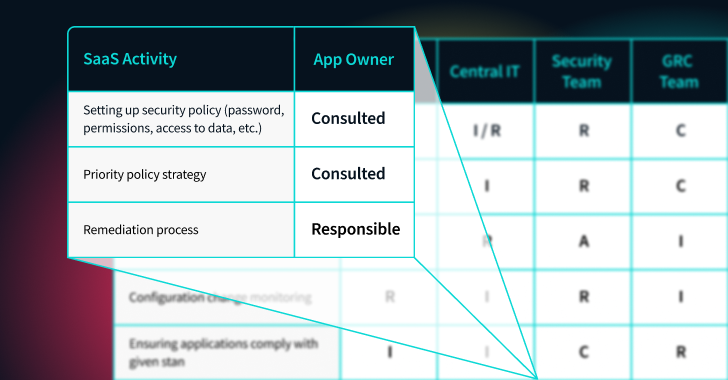
individual SaaS applications. We developed this RACI chart to share
our perspective on the departments that are responsible,
accountable, consulted, and informed for the different tasks
involved in securing SaaS data.
Bear in mind, this table is not one size fits all, but a
framework based on the way we see many companies handling their
SaaS security roles. It should be adapted to the needs of your
organization.
Learn more about SaaS user roles and responsibilities. Schedule a demo today.[2]
Building the Right Infrastructure
Developing the RACI matrix is important, but without the right
tools in place, implementing security responsibilities becomes a
near-impossible task.
Organizations need a SaaS Security platform that facilitates
clear communication between the security team and app owners. This
communication should include alerts when misconfigurations occur
that weaken the individual app’s security posture and when threats
are detected by its IAM governance tools.
Communication should be channel agnostic, so users can receive
messages and alerts over email, Slack, Splunk, or the messaging
platform of choice. All security-related notifications should also
include remediation steps, providing app owners and central IT with
a clear understanding of the steps required to mitigate the
risk.
Within the platform, each owner should have visibility and
access to the app or apps under their control. They should be able
to see the status of their security settings, their security score,
their users, third-party SaaS applications that are connected to
their app, and the devices being used to access their SaaS app.
App owners and central IT should also have the capabilities to
dismiss a security alert due, either because it doesn’t apply or
due to business needs, and consult with the security team on
risk.
Securing SaaS Data Takes a Cross-Team Effort
It’s easy for SaaS application security to be overlooked. It
sits outside the view of the security team and is managed by
competent professionals whose responsibilities don’t include
security.
However, the data contained within the SaaS applications are
often the lifeblood of an organization, and failure to secure the
data can have disastrous consequences.
Fully protecting the data from exposure requires a cross-team
effort and commitment from all parties involved, as well as a
sophisticated SSPM platform built for SaaS in the real world.
Learn how an SSPM can help secure your data. Book a demo.[3]
Found this article interesting? Follow us on Twitter [4]
and LinkedIn[5]
to read more exclusive content we post.
References
- ^
Learn
how Adaptive Shield’s SSPM solution can help secure your SaaS
stack. (www.adaptive-shield.com) - ^
Schedule
a demo today. (www.adaptive-shield.com) - ^
Book a
demo. (www.adaptive-shield.com) - ^
Twitter
(twitter.com) - ^
LinkedIn
(www.linkedin.com)
Read more https://thehackernews.com/2023/02/saas-in-real-world-whos-responsible-to.html