Feb 15, 2023Ravie Lakshmanan

Google announced on Tuesday that it’s officially rolling out
Privacy Sandbox on Android[1] in beta to eligible
mobile devices running Android 13.
“The Privacy Sandbox Beta provides new APIs that are designed
with privacy at the core, and don’t use identifiers that can track
your activity across apps and websites,” the search and advertising
giant said[2]. “Apps that choose to
participate in the Beta can use these APIs to show you relevant ads
and measure their effectiveness.”
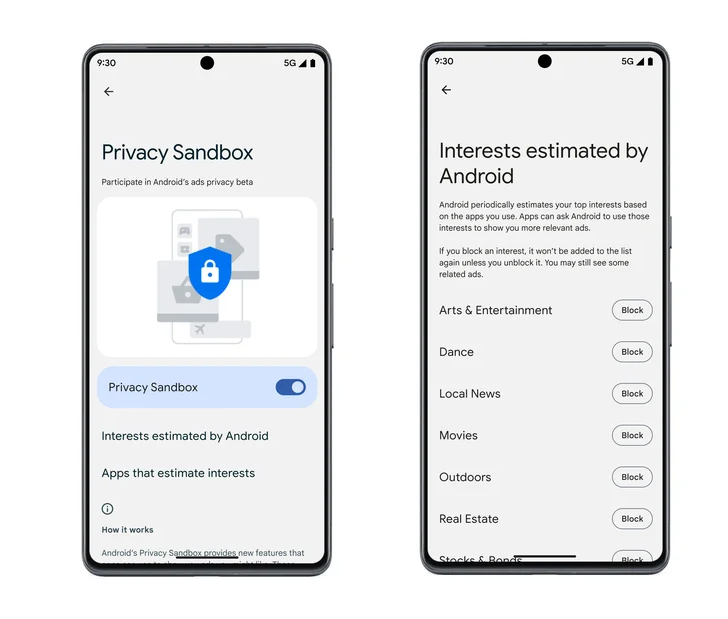
Devices that have been selected for the Beta test will have a
Privacy Sandbox section within Settings so as to allow users to
control their participation as well as view and manage their top
interests as determined by the Topics API[3]
to serve relevant ads.
The initial Topics taxonomy[4]
is set to include somewhere between a few hundred and a few
thousand topics, according to Google[5], and will be
human-curated to exclude sensitive topics.
The Beta test is expected to start off with a “small percentage”
of Android 13 devices and will gradually expand over time.
The Privacy Sandbox on Android is Google’s answer to Apple’s App
Tracking Transparency (ATT[6]), which requires app
developers to seek users’ explicit consent before tracking their
online behavior across apps and websites through unique
identifiers. It was introduced by Apple in iOS 14.5.
The experiment is part of a broader initiative for the web that
also aims to begin phasing out third-party
cookies[7] in the Chrome web
browser by 2024.
The technology that underpins its ability to glean users’ evolving interests[8] is a machine learning
technique called federated learning[9]
that decouples[10] the “ability to do
machine learning from the need to store the data in the cloud.”
This effectively allows decentralized edge devices such as
smartphones to learn a shared prediction model while keeping all
the training data on device, thereby making it possible for
websites to access information about consumers without compromising
user privacy.
Currently, Android devices are assigned a unique user-resettable identifier[11] that can be used by app
developers for tracking online behavior. Privacy Sandbox replaces
the identifier with a set of privacy-preserving tools that are
engineered to limit information sharing and at the same time
support personalized ads.
While Google’s proposals hope to strike a balance between
interest-based advertising and privacy, the company also criticized
that “blunt approaches” such as those from Apple don’t provide
viable alternatives.
That having said, Apple’s ATT has faced criticism of its own. In
September 2021, Lockdown Privacy called[12] Apple’s policy
“functionally useless in stopping third-party tracking” and that it
“made no difference in the total number of active third-party
trackers.”
What’s more, a report from the Financial Times in December 2021
found[13] that apps are
continuing to track users on iOS, albeit in an anonymized and
aggregated fashion similar to Google’s Privacy Sandbox.
Found this article interesting? Follow us on Twitter [14] and LinkedIn[15] to read more exclusive
content we post.
References
- ^
Privacy
Sandbox on Android (thehackernews.com) - ^
said
(blog.google) - ^
Topics
API (thehackernews.com) - ^
Topics
taxonomy (github.com) - ^
according to Google
(developer.android.com) - ^
ATT
(thehackernews.com) - ^
begin
phasing out third-party cookies
(thehackernews.com) - ^
glean
users’ evolving interests (github.com) - ^
federated learning
(federated.withgoogle.com) - ^
decouples
(ai.googleblog.com) - ^
user-resettable identifier
(thehackernews.com) - ^
called
(blog.lockdownprivacy.com) - ^
found
(arstechnica.com) - ^
Twitter
(twitter.com) - ^
LinkedIn
(www.linkedin.com)
Read more https://thehackernews.com/2023/02/google-rolling-out-privacy-sandbox-beta.html