Feb 15, 2023Ravie Lakshmanan
The North Korea-linked threat actor tracked as
APT37 has been linked to a piece of new malware
dubbed M2RAT in attacks targeting its southern
counterpart, suggesting continued evolution of the group’s features
and tactics.
APT37, also tracked under the monikers Reaper, RedEyes, Ricochet
Chollima, and ScarCruft, is linked to North Korea’s Ministry of
State Security (MSS) unlike the Lazarus and Kimsuky threat clusters
that are part of the Reconnaissance General Bureau (RGB).
According to Google-owned Mandiant, MSS is tasked with “domestic
counterespionage and overseas counterintelligence activities,” with
APT37’s attack campaigns reflective of the agency’s priorities. The
operations have historically singled out individuals such as
defectors and human rights activists.
“APT37’s assessed primary mission is covert intelligence
gathering in support of DPRK’s strategic military, political, and
economic interests,” the threat intelligence firm said[1].
The threat actor is known[2]
to rely[3]
on customized[4]
tools[5]
such as Chinotto, RokRat, BLUELIGHT, GOLDBACKDOOR, and Dolphin to
harvest sensitive information from compromised hosts.
“The main feature of this RedEyes Group attack case is that it
used a Hangul EPS vulnerability and used steganography techniques
to distribute malicious codes,” AhnLab Security Emergency response
Center (ASEC) said[6]
in a report published Tuesday.
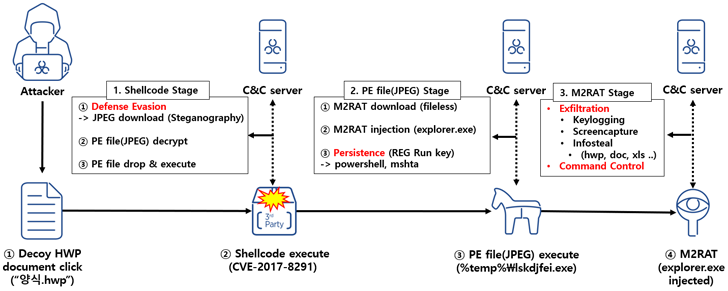
The infection chain observed in January 2023 commences with a
decoy Hangul document, which exploits a now-patched flaw in the
word processing software (CVE-2017-8291[7]) to trigger shellcode
that downloads an image from a remote server.
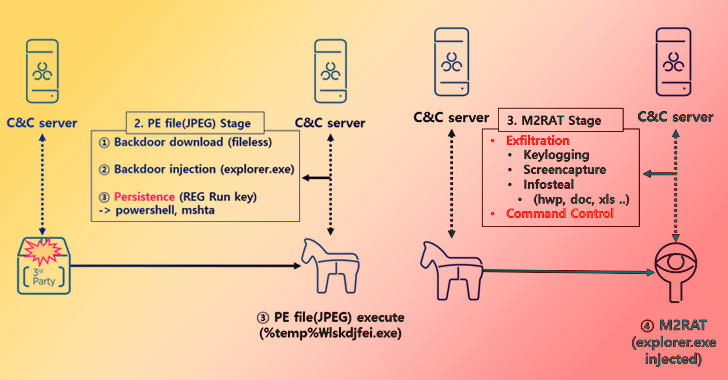
The JPEG file uses steganographic techniques to conceal a
portable executable that, when launched, downloads the M2RAT
implant and injects it into the legitimate explorer.exe
process.
While persistence is achieved by means of a Windows Registry
modification, M2RAT functions as a backdoor capable of keylogging,
screen capture, process execution, and information theft. Like
Dolphin, it’s also designed to siphon data from removable disks and
connected smartphones.
“These APT attacks are very difficult to defend against, and the
RedEyes group in particular is known to primarily target
individuals, so it can be difficult for non-corporate individuals
to even recognize the damage,” ASEC said.
This is not the first time CVE-2017-8291 has been weaponized by
North Korean threat actors. In late 2017, the Lazarus Group was
observed targeting South Korean cryptocurrency exchanges and users
to deploy Destover malware, according to Recorded Future[8].
Found this article interesting? Follow us on Twitter [9]
and LinkedIn[10] to read more exclusive
content we post.
References
Read more https://thehackernews.com/2023/02/north-koreas-apt37-targeting-southern.html