Feb 17, 2023Ravie Lakshmanan

A new variant of the notorious Mirai botnet has been found
leveraging several security vulnerabilities to propagate itself to
Linux and IoT devices.
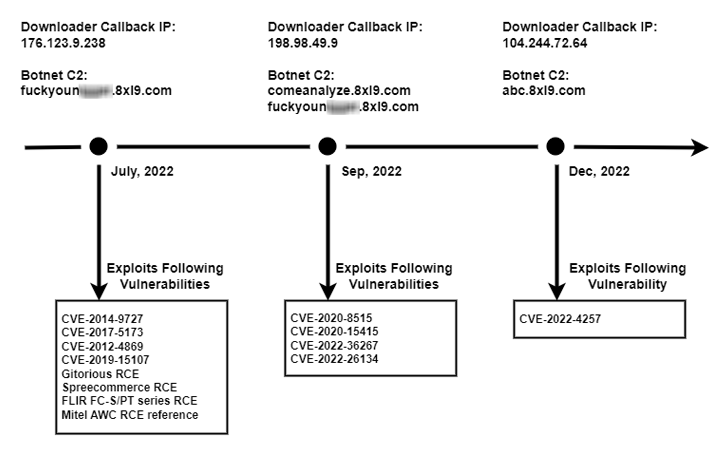
Observed during the second half of 2022, the new version has
been dubbed V3G4 by Palo Alto Networks Unit 42,
which identified three different campaigns likely conducted by the
same threat actor.
“Once the vulnerable devices are compromised, they will be fully
controlled by attackers and become a part of the botnet,” Unit 42
researchers said[1]. “The threat actor has
the capability to utilize those devices to conduct further attacks,
such as distributed denial-of-service (DDoS) attacks.”
The attacks primarily single out exposed servers and networking
devices running Linux, with the adversary weaponizing as many as 13
flaws that could lead to remote code execution (RCE).
Some of the notable flaws relate to critical flaws in Atlassian
Confluence Server and Data Center, DrayTek Vigor routers, Airspan
AirSpot, and Geutebruck IP cameras, among others. The oldest flaw
in the list is CVE-2012-4869[2], an RCE bug in
FreePBX.
Following a successful compromise, the botnet payload is
retrieved from a remote server using the wget[3] and cURL[4] utilities.
The botnet, in addition to checking if it’s already running on
the infected machine, also takes steps to terminate other competing
botnets such as Mozi, Okami, and Yakuza.
V3G4 further packs a set of default or weak login credentials
that it uses to carry out brute-force attacks through Telnet/SSH
and proliferate to other machines.
It also establishes contact with a command-and-control server to
await commands for launching DDoS attacks against targets via UDP,
TCP, and HTTP protocols.
“The vulnerabilities mentioned above have less attack complexity
than previously observed variants, but they maintain a critical
security impact that can lead to remote code execution,” the
researchers said.
To stave off such attacks, it’s recommended that users apply
necessary patches and updates as and when they become applicable,
and secure the devices with strong passwords.
Found this article interesting? Follow us on Twitter [5]
and LinkedIn[6]
to read more exclusive content we post.
References
Read more https://thehackernews.com/2023/02/new-mirai-botnet-variant-v3g4.html