
Mar 02, 2023Ravie Lakshmanan
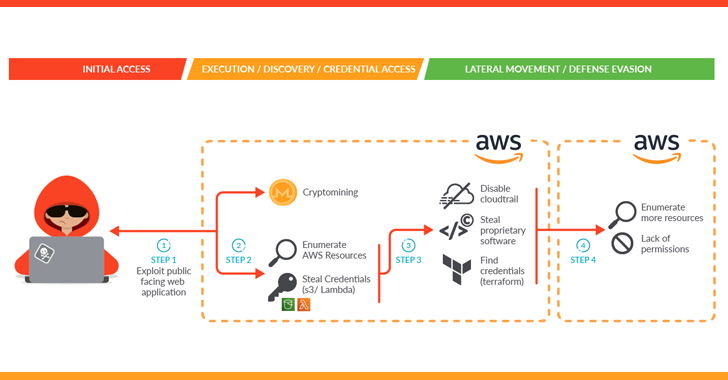
A sophisticated attack campaign dubbed
SCARLETEEL is targeting containerized environments
to perpetrate theft of proprietary data and software.
“The attacker exploited a containerized workload and then
leveraged it to perform privilege escalation into an AWS account in
order to steal proprietary software and credentials,” Sysdig
said[1]
in a new report.
The advanced cloud attack also entailed the deployment of crypto
miner software, which the cybersecurity company said is either an
attempt to generate illicit profits or a ploy to distract defenders
and throw them off the trail.
The initial infection vector banked on exploiting a vulnerable
public-facing service in a self-managed Kubernetes cluster hosted
on Amazon Web Services (AWS).
Upon gaining a successful foothold, an XMRig crypto miner was
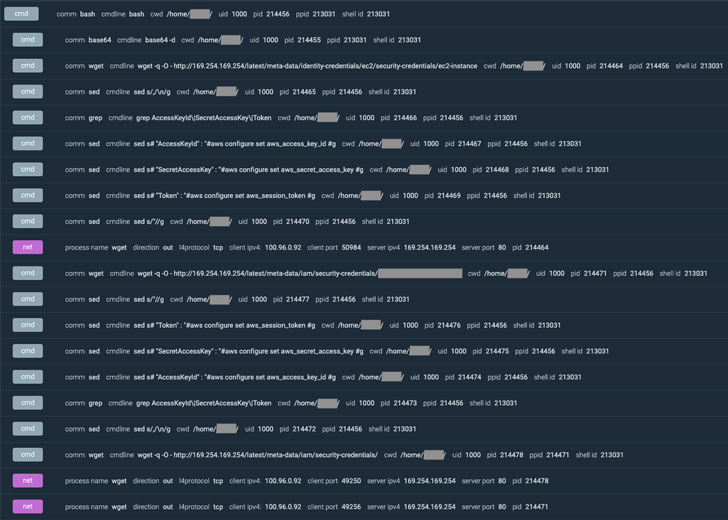
launched and a bash script was used to obtain credentials that
could be used to further burrow into the AWS cloud infrastructure
and exfiltrate sensitive data.
“Either crypto mining was the attacker’s initial goal and the
goal changed once they accessed the victim’s environment, or crypto
mining was used as a decoy to evade the detection of data
exfiltration,” the company said.
The intrusion notably also disabled CloudTrail logs[2]
to minimize the digital footprint, preventing Sysdig from accessing
additional evidence. In all, it allowed the threat actor to access
more than 1TB of data, including customer scripts, troubleshooting
tools, and logging files.
“They also attempted to pivot using a Terraform state file to
other connected AWS accounts to spread their reach throughout the
organization,” the company said. This, however, proved to be
unsuccessful due to lack of permissions.
The findings come weeks after Sysdig also detailed[3]
another cryptojacking campaign mounted by the 8220 Gang[4]
between November 2022 and January 2023 targeting exploitable Apache
web server and Oracle Weblogic applications.
Found this article interesting? Follow us on Twitter [5]
and LinkedIn[6]
to read more exclusive content we post.
References
Read more https://thehackernews.com/2023/03/hackers-exploit-containerized.html