
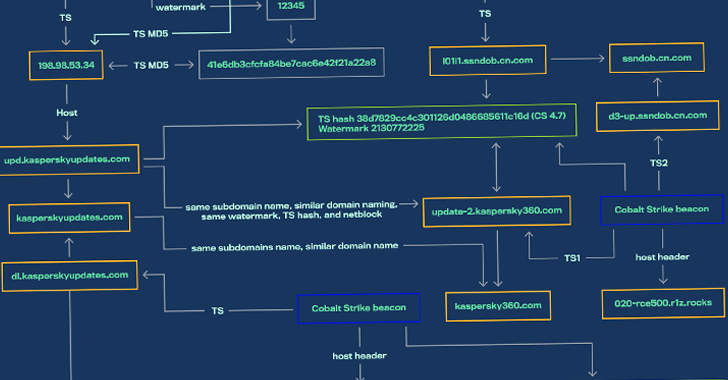
Threat activity clusters affiliated with the Chinese and Russian
cybercriminal ecosystems have been observed using a new piece of
malware that’s designed to load Cobalt Strike onto infected
machines.
Dubbed SILKLOADER by Finnish cybersecurity
company WithSecure, the malware leverages DLL side-loading techniques[1] to deliver commercial
adversary simulation software.
The development comes as improved detection capabilities[2] against Cobalt Strike, a
legitimate post-exploitation tool used for red team operations, is
forcing threat actors to seek alternative options[3] or concoct new ways to
propagate the framework to evade detection.
“The most common of these include adding complexity to the
auto-generated beacon or stager payloads via the utilization of
packers, crypters, loaders, or similar techniques,” WithSecure
researchers said[4].
SILKLOADER joins other loaders such as KoboldLoader,
MagnetLoader, and LithiumLoader that have been recently discovered[5]
incorporating Cobalt Strike components.
It also shares overlaps with LithiumLoader in that both employ
the DLL side-loading method to hijack a legitimate application with
the goal of running a separate, malicious dynamic link library
(DLL[6]).
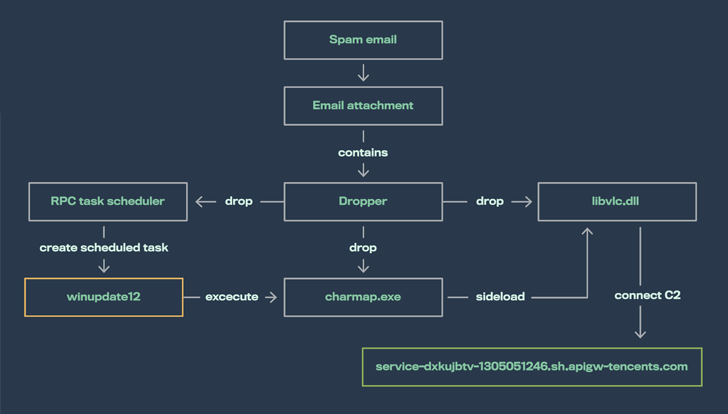
SILKLOADER achieves this via specially crafted libvlc.dll files
that are dropped alongside a legitimate but renamed VLC media
player binary (Charmap.exe).
WithSecure said it identified the shellcode loader following an
analysis of “several human-operated intrusions” targeting various
entities spanning a wide range of organizations located in Brazil,
France, and Taiwan in Q4 2022.
Although these attacks were unsuccessful, the activity is
suspected to be a lead-up to ransomware deployments, with the
tactics and tooling “heavily overlapping” with those attributed to
the operators[7]
of the Play ransomware[8].
In one attack aimed at an unnamed French social welfare
organization, the threat actor gained a foothold into the network
by exploiting a compromised Fortinet SSL VPN appliance to stage
Cobalt Strike beacons.
“The threat actor maintained a foothold in this organization for
several months,” WithSecure said. “During this time, they performed
discovery and credential stealing activities, followed by
deployment of multiple Cobalt Strike beacons.”
But when this attempt failed, the adversary switched to using
SILKLOADER to bypass detection and deliver the beacon payload.
That’s not all. Another loader known as BAILLOADER, which is
also used to distribute Cobalt Strike beacons, has been linked to
attacks involving Quantum ransomware[9], GootLoader[10], and the IcedID trojan[11] in recent months.
BAILLOADER, for its part, is said to exhibit similarities with a
crypter codenamed Tron[12] that has been put to
use by different adversaries to distribute Emotet, TrickBot,
BazarLoader, IcedID, Conti ransomware, and Cobalt Strike.
This has given rise to the possibility that disparate threat
actors share Cobalt Strike beacons, crypters, and infrastructure
provided by third-party affiliates to service multiple intrusions
utilizing different tactics.
In other words, SILKLOADER is likely being offered as an
off-the-shelf loader through a Packer-as-a-Service program to
Russian-based threat actors.
“This loader is being provided either directly to ransomware
groups or possibly via groups offering Cobalt
Strike/Infrastructure-as-a-Service to trusted affiliates,”
WithSecure said.
WEBINAR
Discover the Hidden Dangers of Third-Party SaaS Apps
Are you aware of the risks associated with third-party app
access to your company’s SaaS apps? Join our webinar to learn about
the types of permissions being granted and how to minimize
risk.
“Most of these affiliates appear to have been part of or have
had close working relationships with the Conti group[14], its members, and
offspring after its alleged shutdown[15].”
SILKLOADER samples analyzed by the company show that early
versions of the malware date back to the start of 2022, with the
loader exclusively put to use in different attacks targeting
victims in China and Hong Kong.
The shift from East Asian targets to other countries such as
Brazil and France is believed to have occurred around July 2022,
after which all SILKLOADER-related incidents have been attributed
to Russian cybercriminal actors.
This has further given way to a hypothesis that “SILKLOADER was
originally written by threat actors acting within the Chinese
cybercriminal ecosystem” and that the “loader was used by the
threat actors within this nexus at least as early as May 2022 till
July 2022.”
“The builder or source code was later acquired by a threat actor
within the Russian cybercriminal ecosystem between July 2022 and
September 2022,” WithSecure said, adding, “the original Chinese
author sold the loader to a Russian threat actor once they no
longer had any use for it.”
Both SILKLOADER and BAILLOADER are just the latest examples of
threat actors refining and retooling their approaches to stay ahead
of the detection curve.
“As the cybercriminal ecosystem becomes more and more
modularized via service offerings[16], it is no longer
possible to attribute attacks to threat groups simply by
linking them to specific components within their attacks,”
WithSecure researchers concluded.
Found this article interesting? Follow us on Twitter [17] and LinkedIn[18] to read more exclusive
content we post.
References
- ^
DLL
side-loading techniques (attack.mitre.org) - ^
improved
detection capabilities (thehackernews.com) - ^
seek
alternative options (thehackernews.com) - ^
said
(labs.withsecure.com) - ^
recently
discovered (unit42.paloaltonetworks.com) - ^
DLL
(learn.microsoft.com) - ^
operators
(thehackernews.com) - ^
Play
ransomware (infosec.exchange) - ^
Quantum
ransomware (darktrace.com) - ^
GootLoader
(thehackernews.com) - ^
IcedID
trojan (thehackernews.com) - ^
Tron
(securityintelligence.com) - ^
RESERVE YOUR SEAT
(thn.news) - ^
Conti
group (thehackernews.com) - ^
alleged shutdown
(thehackernews.com) - ^
service offerings
(www.microsoft.com) - ^
Twitter
(twitter.com) - ^
LinkedIn
(www.linkedin.com)
Read more https://thehackernews.com/2023/03/chinese-and-russian-hackers-using.html