
Mar 20, 2023Ravie Lakshmanan
A banking trojan dubbed Mispadu has been linked
to multiple spam campaigns targeting countries like Bolivia, Chile,
Mexico, Peru, and Portugal with the goal of stealing credentials
and delivering other payloads.
The activity, which commenced in August 2022, is currently
ongoing, Ocelot Team from Latin American cybersecurity firm
Metabase Q said in a report[1]
shared with The Hacker News.
Mispadu[2]
(aka URSA) was first documented[3]
by ESET in November 2019, describing its ability to perpetrate
monetary and credential theft and act as a backdoor by taking
screenshots and capturing keystrokes.
“One of their main strategies is to compromise legitimate
websites, searching for vulnerable versions of WordPress, to turn
them into their command-and-control server to spread malware from
there, filtering out countries they do not wish to infect, dropping
different type of malware based on the country being infected,”
researchers Fernando García and Dan Regalado said.
It’s also said to share similarities[4]
with other banking trojans targeting the region, like Grandoreiro[5], Javali[6], and Lampion[7]. Attack chains involving
the Delphi malware leverage email messages urging recipients to
open fake overdue invoices, thereby triggering a multi-stage
infection process.
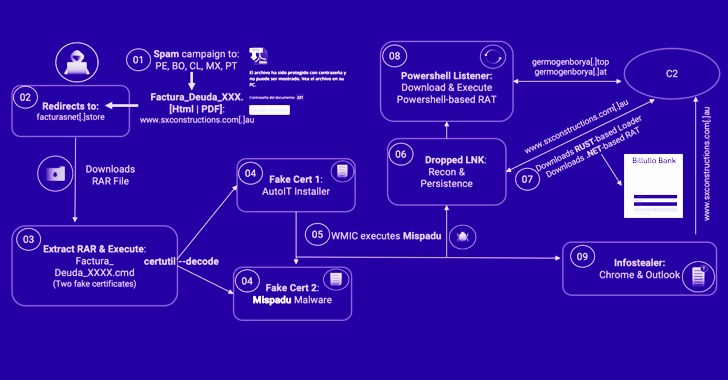
Should a victim open the HTML attachment sent via the spam
email, it verifies that the file was opened from a desktop device
and then redirects to a remote server to fetch the first-stage
malware.
The RAR or ZIP archive, when launched, is designed to make use
of rogue digital certificates – one which is the Mispadu malware
and the other, an AutoIT installer – to decode and execute the
trojan by abusing the legitimate certutil command-line utility[8].
Mispadu is equipped to gather the list of antivirus solutions
installed on the compromised host, siphon credentials from Google
Chrome and Microsoft Outlook, and facilitate the retrieval of
additional malware.
WEBINAR
Discover the Hidden Dangers of Third-Party SaaS Apps
Are you aware of the risks associated with third-party app
access to your company’s SaaS apps? Join our webinar to learn about
the types of permissions being granted and how to minimize
risk.
This includes an obfuscated Visual Basic Script dropper that
serves to download another payload from a hard-coded domain, a
.NET-based remote access tool that can run commands issued by an
actor-controlled server, and a loader written in Rust that, in
turn, executes a PowerShell loader to run files directly from
memory.
What’s more, the malware utilizes malicious overlay screens to
obtain credentials associated with online banking portals and other
sensitive information.
Metabase Q noted that the certutil approach has allowed Mispadu
to bypass detection by a wide range of security software and
harvest over 90,000 bank account credentials from over 17,500
unique websites.
Found this article interesting? Follow us on Twitter [10] and LinkedIn[11] to read more exclusive
content we post.
References
- ^
report
(www.metabaseq.com) - ^
Mispadu
(csirt.gob.cl) - ^
first
documented (www.welivesecurity.com) - ^
share
similarities (seguranca-informatica.pt) - ^
Grandoreiro
(thehackernews.com) - ^
Javali
(seguranca-informatica.pt) - ^
Lampion
(seguranca-informatica.pt) - ^
certutil
command-line utility (attack.mitre.org) - ^
RESERVE YOUR SEAT
(thn.news) - ^
Twitter
(twitter.com) - ^
LinkedIn
(www.linkedin.com)
Read more https://thehackernews.com/2023/03/mispadu-banking-trojan-targets-latin.html