
It didn’t take long. Intelligence agencies and cybersecurity
researchers had been warning that unpatched Exchange Servers could
open the pathway for ransomware infections in the wake of swift
escalation of the attacks since last week.
Now it appears that threat actors have caught up.
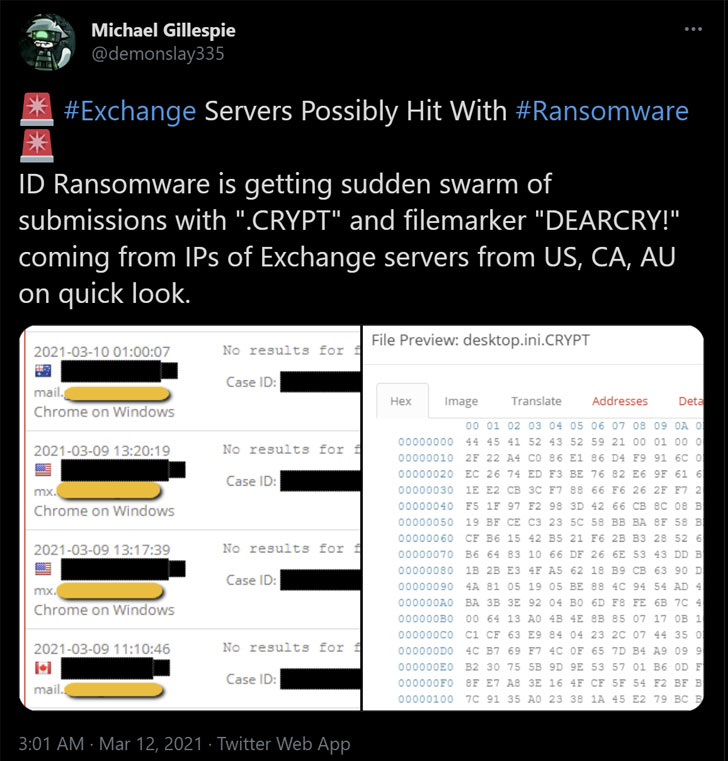
According to the latest reports[1], cybercriminals are
leveraging the heavily exploited ProxyLogon Exchange Server flaws
to install a new strain of ransomware called “DearCry.”
“Microsoft observed a new family of human operated ransomware
attack customers – detected as Ransom:Win32/DoejoCrypt.A,”
Microsoft researcher Phillip Misner tweeted[2]. “Human operated
ransomware attacks are utilizing the Microsoft Exchange
vulnerabilities to exploit customers.”
In a joint advisory[3]
published by the U.S. Cybersecurity and Infrastructure Security
Agency (CISA) and the Federal Bureau of Investigation (FBI), the
agencies warned that “adversaries could exploit these
vulnerabilities to compromise networks, steal information, encrypt
data for ransom, or even execute a destructive attack.”
Successful weaponization of the flaws allows an attacker to
access victims’ Exchange Servers, enabling them to gain persistent
system access and control of an enterprise network. With the new
ransomware threat, unpatched Servers are not only at risk of
potential data theft but also get potentially encrypted, preventing
access to an organization’s mailboxes.
Meanwhile, as nation-state hackers and cybercriminals pile on to
take advantage of the ProxyLogon flaws, a proof-of-concept (PoC)
code shared on Microsoft-owned GitHub by a security researcher has
been taken down by the company, citing that the exploit is under
active attack.
In a statement to Vice[4], the company said, “In
accordance with our Acceptable Use Policies[5], we disabled the gist
following reports that it contains proof of concept code for a
recently disclosed vulnerability that is being actively
exploited.”
The move has also sparked a debate of its own, with researchers
arguing that Microsoft is “silencing security researchers” by
removing PoCs shared on GitHub.
“This is huge, removing a security researchers code from GitHub
against their own product and which has already been patched,”
TrustedSec’s Dave Kennedy said. “It was a PoC, not a working
exploit — none of the PoCs have had the RCE. Even if it did, that’s
not their call on when the appropriate time to release is. It’s an
issue in their own product, and they are silencing security
researchers on that.”
This was also echoed by Google Project Zero researcher Tavis
Normandy.
“If the policy from the start was no PoC/metasploit/etc — that
would suck, but it’s their service,” Normandy said in a tweet.
“Instead they said OK, and now that it’s become the standard for
security pros to share code, they have elected themselves the
arbiters of what is ‘responsible.’ How convenient.”
If anything, the avalanche of attacks should serve as a warning
to patch all versions of the Exchange Server as soon as possible,
while also take steps to identify signs of indicators of compromise
associated with the hacks, given that the attackers were exploiting
these zero-day vulnerabilities in the wild for at least two months
before Microsoft released the patches on March 2.
We have reached out to Microsoft for more details, and we will
update the story if we hear back.
References
- ^
reports
(twitter.com) - ^
tweeted
(twitter.com) - ^
joint
advisory (thehackernews.com) - ^
Vice
(www.vice.com) - ^
Acceptable Use Policies
(docs.github.com)
Read more http://feedproxy.google.com/~r/TheHackersNews/~3/YNZgPucSGkw/icrosoft-exchange-ransomware.html