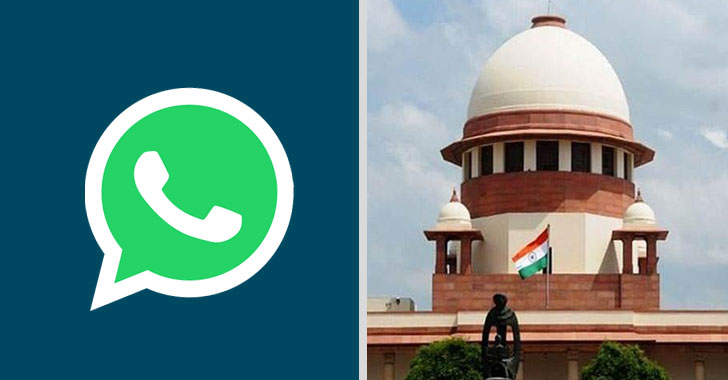
WhatsApp on Wednesday fired a legal salvo against the Indian
government to block new regulations that would require messaging
apps to trace the “first originator” of messages shared on the
platform, thus effectively breaking encryption protections.
“Requiring messaging apps to ‘trace’ chats is the equivalent of
asking us to keep a fingerprint of every single message sent on
WhatsApp, which would break end-to-end encryption and fundamentally
undermines people’s right to privacy,” a WhatsApp spokesperson told
The Hacker News via email. “We have consistently joined civil
society and experts around the world in opposing requirements that
would violate the privacy of our users.”
With over 450 million active users, India is WhatsApp’s biggest
market by users.
The lawsuit, filed by the Facebook-owned messaging service in
the Delhi High Court, seeks to bar new internet rules that come
into force effective May 26. Called the Intermediary Guidelines
and Digital Media Ethics Code, the rules[1]
require significant social media
intermediaries[2]
— platforms with 5 million registered users in India and above — to
remove non-consensual sexually explicit content within 24 hours,
and appoint a resident grievance officer for acknowledging and
addressing complaints from users and victims.
The reduced timelines for takedowns aside, also buried among the
clauses is the traceability requirement —
Significant social media intermediaries providing services
primarily in the nature of messaging shall enable identification of
the first originator of the information that is required only for
the purposes of prevention, detection, investigation, prosecution
or punishment of an offence related to sovereignty and integrity of
India, the security of the State, friendly relations with foreign
States, or public order or of incitement to an offence relating to
the above or in relation with rape, sexually explicit material or
child sexual abuse material punishable with imprisonment for a term
of not less than five years. Intermediary shall not be required to
disclose the contents of any message or any other information to
the first originator.
The lawsuit arrives at a crucial juncture as governments around
the world have stepped up to regulate[3]
internet[4]
platforms[5]
for reasons as varied as financial fraud, stifling competition,
inciting violence, and spreading misinformation, hate speech, and
obscene content. WhatsApp is also locked in a similar legal battle
with Brazil[6]
over similar legislation[7].
WhatsApp, for its part, has long argued against[8]
incorporating traceability[9]
as it would not only force companies to collect more data about the
kind of messages being sent and shared and the identities behind
them, but also subvert users’ expectation of secure and private
messaging.
Adding such a requirement would mean breaking WhatsApp’s
end-to-end encryption (E2EE), which secures messages from potential
eavesdroppers – including telecom providers, internet service
providers, and even WhatsApp itself — from being able to access the
cryptographic keys necessary to decode the conversation.
“Traceability is intended to do the opposite by requiring
private messaging services like WhatsApp to keep track of
who-said-what and who-shared-what for billions of messages sent
every day,” the company said[10].
“Traceability requires messaging services to store information
that can be used to ascertain the content of people’s messages,
thereby breaking the very guarantees that end-to-end encryption
provides. In order to trace even one message, services would have
to trace every message.”
As a workaround, the Indian government had previously proposed[11] that WhatsApp assign an
alphanumeric hash to every message sent through its platform to
enable traceability without weakening encryption, according to a
report from the Economic Times in March 2021.
The company also contends that traceability is not so much
effective as it’s highly susceptible to abuse, noting that users
could be labeled as “originators” simply for sharing an article or
a downloaded image that could then be repurposed by other users on
the platform in an entirely different circumstance.
Furthermore, WhatsApp contended that the new requirement inverts
the way law enforcement typically investigates crimes. “In a
typical law enforcement request, a government requests technology
companies provide account information about a known individual’s
account,” it said. “With traceability, a government would provide a
technology company a piece of content and ask who sent it
first.”
WhatsApp recently landed in the crosshairs of Indian government
over its updated privacy policy that it implemented on May 15, with
the Ministry of Electronics and Information Technology (MeitY)
urging the company to retract what it said were “unfair terms and
conditions on Indian users,” calling it “discriminatory” and
“irresponsible.”
In response, WhatsApp — which earlier said[12] it will continue to
push users into accepting the updates with a “persistent reminder”
in return for a “limited functionality” — has since completely walked back[13] from that stance,
stating it has “no plans for these reminders to become persistent
and to limit the functionality of the app.”
WhatsApp however said it intends to keep reminding users about
the update at least till India’s upcoming Personal Data Protection
(PDP[14]) bill comes into
effect. WhatsApp’s new terms don’t apply to the European Union due
to prevailing GDPR data regulations in the region.
References
- ^
rules
(pib.gov.in) - ^
significant social media
intermediaries (egazette.nic.in) - ^
regulate
(www.reuters.com) - ^
internet
(www.nytimes.com) - ^
platforms
(www.bbc.com) - ^
Brazil
(faq.whatsapp.com) - ^
similar
legislation (www.eff.org) - ^
argued
against (thenextweb.com) - ^
traceability
(onezero.medium.com) - ^
said
(faq.whatsapp.com) - ^
proposed
(economictimes.indiatimes.com) - ^
said
(thehackernews.com) - ^
completely walked back
(faq.whatsapp.com) - ^
PDP
(en.wikipedia.org)