
Microsoft on Tuesday confirmed[1]
that the LAPSUS$ extortion-focused hacking crew had gained “limited
access” to its systems, as authentication services provider Okta
revealed that nearly 2.5% of its customers have been potentially
impacted in the wake of the breach.
“No customer code or data was involved in the observed
activities,” Microsoft’s Threat Intelligence Center (MSTIC) said,
adding that the breach was facilitated by means of a single
compromised account that has since been remediated to prevent
further malicious activity.
The Windows maker, which was already tracking the group under
the moniker DEV-0537 prior to the public disclosure, said[2]
it “does not rely on the secrecy of code as a security measure and
viewing source code does not lead to elevation of risk.”
“This public disclosure escalated our action allowing our team
to intervene and interrupt the actor mid-operation, limiting
broader impact,” the company’s security teams noted.
Identity and access management company Okta, which also acknowledged the breach[3]
through the account of a customer support engineer working for a
third-party provider, said that the attackers had access to the
engineer’s laptop during a five-day window between January 16 and
21, but that the service itself was not compromised.
The San Francisco-based cloud software firm also said it’s
identified the affected customers and that it’s contacting them
directly, stressing that the “Okta service is fully operational,
and there are no corrective actions our customers need to
take.”
“In the case of the Okta compromise, it would not suffice to
just change a user’s password,” web infrastructure company
Cloudflare said[4]
in a post mortem analysis of the incident. “The attacker would also
need to change the hardware (FIDO) token configured for the same
user. As a result, it would be easy to spot compromised accounts
based on the associated hardware keys.”
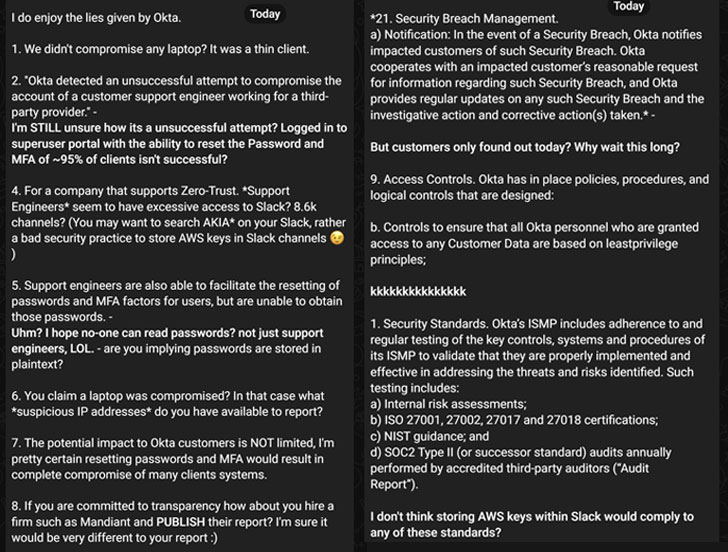
That said, of particular concern is the fact that Okta failed to
publicly disclose the breach for two months, prompting the cyber
criminal group to ask “Why wait this long?” in its counter
statement.
LAPSUS$ has also claimed in its rebuttal that Okta was storing
Amazon Web Services (AWS) keys within Slack and that support
engineers seem to have “excessive access” to the communications
platform. “The potential impact to Okta customers is NOT limited,
I’m pretty certain resetting passwords and MFA would result in
complete compromise of many clients’ systems,” the gang
elaborated.
Microsoft Exposes the Tactics of LAPSUS$
LAPSUS$, which first emerged in July 2021, has been on a hacking
spree in recent months, targeting a wealth of companies over the
intervening period, including Impresa, Brazil’s Ministry of Health,
Claro, Embratel, NVIDIA, Samsung, Mercado Libre, Vodafone, and most
recently Ubisoft.
The financially motivated group’s modus operandi has been
relatively straightforward: break into a target’s network, steal
sensitive data, and blackmail the victim company into paying up by
publicizing snippets of the stolen data on their Telegram
channel.
Microsoft described LAPSUS$ as a group as following a “pure
extortion and destruction model without deploying ransomware
payloads” that “doesn’t seem to cover its tracks.”
Other tactics adopted by the crew include phone-based social
engineering schemes such as SIM-swapping to facilitate account
takeover, accessing personal email accounts of employees at target
organizations, bribing employees, suppliers, or business partners
of companies for access, and intruding in the ongoing
crisis-response calls of their targets to initiate extortion
demands.
LAPSUS$ has also been observed deploying the RedLine Stealer[5]
that’s available for sale on underground forums to obtain passwords
and session tokens, in addition to buying credentials and access
tokens from dark web marketplaces as well as searching public code
repositories for exposed credentials, to gain an initial
foothold.
“The objective of DEV-0537 actors is to gain elevated access
through stolen credentials that enable data theft and destructive
attacks against a targeted organization, often resulting in
extortion,” the company said. “Tactics and objectives indicate this
is a cybercriminal actor motivated by theft and destruction.”
Following initial access, the group is known to exploit
unpatched vulnerabilities on internally accessible Confluence,
JIRA, and GitLab servers for privilege escalation, before
proceeding to exfiltrate relevant information and delete the
target’s systems and resources.
To mitigate such incidents, Microsoft is recommending
organizations to mandate multi-factor authentication (but not
SMS-based[6]), leverage modern
authentication options such as OAuth or SAML, review individual
sign-ins for signs of anomalous activity, and monitor incident
response communications for unauthorized attendees.
“Based on observed activity, this group understands the
interconnected nature of identities and trust relationships in
modern technology ecosystems and targets telecommunications,
technology, IT services and support companies – to leverage their
access from one organization to access the partner or supplier
organizations.”
Amidst the fallout from the leaks, LAPSUS$ appear to be taking a
break. “A few of our members has [sic] a vacation until 30/3/2022.
We might be quiet for some times [sic],” the group said on its
Telegram channel.
References
Read more https://thehackernews.com/2022/03/microsoft-and-okta-confirm-breach-by.html