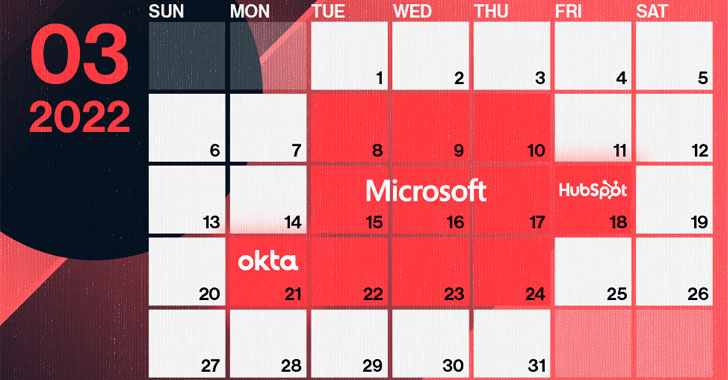
During the last week of March, three major tech companies –
Microsoft, Okta, and HubSpot – reported significant data breaches.
DEV-0537, also known as LAPSUS$, performed the first two. This
highly sophisticated group utilizes state-of-the-art attack vectors
to great success. Meanwhile, the group behind the HubSpot breach
was not disclosed. This blog will review the three breaches based
on publicly disclosed information and suggest best practices to
minimize the risk of such attacks succeeding against your
organization.
HubSpot – Employee Access
On March 21, 2022, HubSpot reported the breach[1] which happened on March
18. Malicious actors compromised a HubSpot employee account that
the employee used for customer support. This allowed malicious
actors the ability to access and export contact data using the
employee’s access to several HubSpot accounts.
With little information regarding this breach, defending against
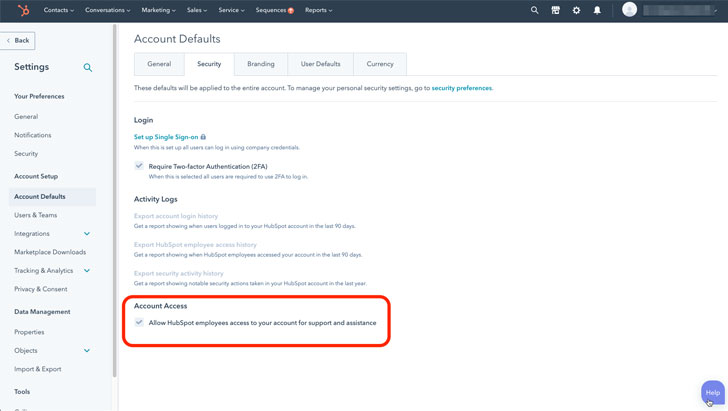
an attack is challenging, but a key configuration within HubSpot
can help. This is the “HubSpot Employee Access” control (shown in
the figure below) in HubSpot’s account setting. Customers should
disable this setting at all times, unless they require specific
assistance, and then immediately turn it off after completing the
service call.
A similar setting appears in other SaaS applications and should
be disabled there as well. Employee access is typically recorded in
Audit Logs, which should be reviewed regularly.
Learn how an SSPM can help protect your
organization from SaaS misconfigurations[2]
Okta – Lack of Device Security for Privileged User
Okta subcontracts some of its customer support to the Sitel
Group. On January 21, an Okta security team member received an
alert that a new MFA factor was added to a Sitel Group employee
account from a new location.
An investigation revealed that a Sitel support engineer’s
computer was compromised using a remote desktop protocol. This
known vulnerability is normally disabled except when specifically
needed — which helped Okta investigators narrow the timeframe for
the attack to a five-day window between Jan. 16-21, 2022.
Due to the limited access support engineers have to their
system, the impact on Okta customers was minimal. Support engineers
don’t have access to create or delete users or download customer
databases. Their access to customer data is quite limited as
well.
On March 22, DEV-0537, which is more commonly known as LAPSUS$,
shared screenshots online. In response, Okta released a statement[3]
saying, “there are no corrective actions our customers need to
take.” The following day the company shared details of its
investigation[4], which included a
detailed response timeline.
While this breach was limited in the damage it caused, it offers
three important security lessons.
- Security from Device to SaaS – securing a SaaS
environment isn’t enough when it comes to protecting against a
breach. Securing the devices used by highly privileged users is of
paramount importance. Organizations should review their roster of
high-privilege users and ensure that their devices are secure. This
can limit the damage of a breach via the attack vector that faced
Okta. - MFA – It was the addition of MFA that allowed
Okta security to discover the breach. SSO does not go far enough,
and organizations that take SaaS security seriously must also
include MFA security measures. - Event monitoring – The Okta breach was
discovered when security personnel saw an unexpected change in the
event monitoring log. Reviewing events such as changes to MFA,
password reset, suspicious logins, and more, are critical for SaaS
security and should be performed daily.
See Cloudflare’s investigation of the January
2022 Okta compromise[5]
for a good example of a response to such a breach.
Find out how Adaptive Shield provides
endpoint posture management and SaaS configuration
control[6]
Microsoft – MFA for all privileged users
On March 22, Microsoft Security shared information[7]
relating to an attack it suffered at the hands of DEV-0537.
Microsoft had a single account compromised, which resulted in
source code being stolen and published.
Microsoft assured its users that the LAPSUS$ attack didn’t
compromise any of their information, and further stated that there
was no risk to any of their products due to the stolen code.
Microsoft did not specifically share how the breach was carried
out, although it did alert readers that LAPSUS$ actively recruits
employees at telecoms, major software developers, call centers, and
other industries to share credentials.
The company also offered these suggestions for securing
platforms against these attacks.
- Strengthen MFA implementation – MFA gaps are a
key attack vector. Organizations should require MFA options,
limiting SMS and email as much as possible, such as with
Authenticator or FIDO tokens. - Require healthy and trusted endpoints –
Organizations should continuously assess device security. Ensure
that the devices accessing SaaS platforms comply with their
security policies by enforcing secure device configurations with a
low vulnerability risk score. - Leverage modern authentication options for
VPNs – VPN authentication should leverage modern
authentication options such as OAuth or SAML. - Strengthen and monitor your cloud security
posture – Organizations should, at minimum, set
conditional access for users and session risk configurations,
require MFA, and block high risk logins.
For a full list of Microsoft’s recommendations, see this[8]
note.
Final thoughts
Securing SaaS platforms is a major challenge, and as seen this
week, even global enterprises need to stay on top of their
security. Malicious actors continue to evolve and improve their
attack methods, which forces organizations to be on the lookout and
prioritize their SaaS security constantly.
Strong passwords and SSO solutions are no longer enough by
themselves. Companies need advanced security measures, such as
strong MFA, IP allow lists, and blocking unnecessary support
engineer access. An automated solution like SaaS Security Posture
Management (SSPM) can help security teams stay on top of these
issues.
The importance of device security in SaaS is another takeaway
from these attacks. Even a fully secured SaaS platform can be
compromised when a privileged user accesses a SaaS app from a
compromised device. Leverage a security solution that combines
device security posture with SaaS security posture for full,
end-to-end protection.
The challenge of securing SaaS solutions is complex and beyond
burdensome to complete manually. SSPM solutions, like Adaptive
Shield, can provide automated SaaS security posture management,
with configuration control, endpoint posture management, and 3rd
party application control[9].
Note — This article is written and contributed by Hananel
Livneh, Senior Product Analyst at Adaptive Shield.
References
- ^
HubSpot
reported the breach (www.hubspot.com) - ^
Learn
how an SSPM can help protect your organization from SaaS
misconfigurations (www.adaptive-shield.com) - ^
released
a statement (www.okta.com) - ^
shared
details of its investigation (www.okta.com) - ^
Cloudflare’s investigation of the
January 2022 Okta compromise
(blog.cloudflare.com) - ^
Find out
how Adaptive Shield provides endpoint posture management and SaaS
configuration control
(www.adaptive-shield.com) - ^
shared
information (www.microsoft.com) - ^
this
(www.microsoft.com) - ^
automated SaaS security posture
management, with configuration control, endpoint posture
management, and 3rd party application control
(www.adaptive-shield.com)
Read more https://thehackernews.com/2022/04/into-breach-breaking-down-3-saas-app.html