A previously undocumented remote access trojan (RAT) written in
the Go programming language has been spotted disproportionately
targeting entities in Italy, Spain, and the U.K.
Called Nerbian RAT by enterprise security firm
Proofpoint, the novel malware leverages COVID-19-themed lures to
propagate as part of a low volume email-borne phishing campaign
that started on April 26, 2022.
“The newly identified Nerbian RAT leverages multiple
anti-analysis components spread across several stages, including
multiple open-source libraries,” Proofpoint researchers said[1]
in a report shared with The Hacker News.
“It is written in operating system (OS) agnostic Go programming
language, compiled for 64-bit systems, and leverages several
encryption routines to further evade network analysis.”
The messages, amounting to less than 100 in number, purport to
be from the World Health Organization about safety measures related
to COVID-19, urging potential victims to open a macro-laced
Microsoft Word document to access the “latest health advice.”
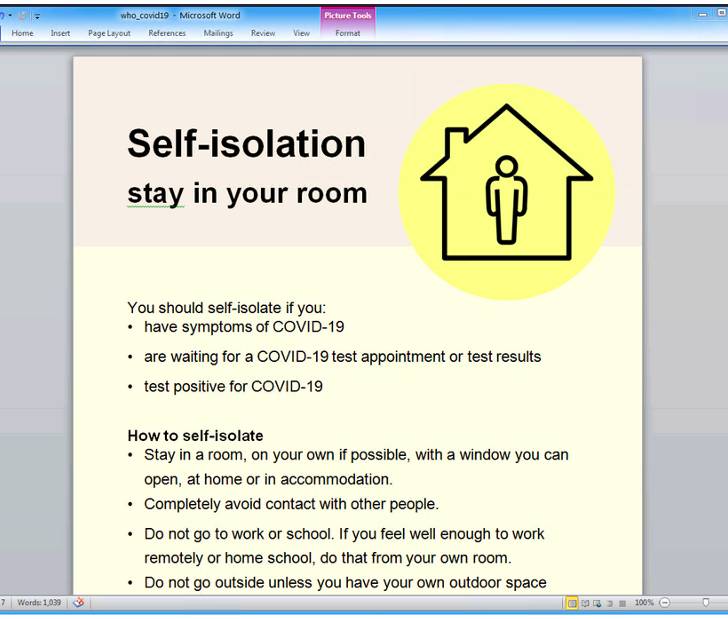
Enabling the macros displays COVID-19 guidance, including steps
for self-isolation, while in the background, the embedded macro
triggers an infection chain that delivers a payload called
“UpdateUAV.exe”, which acts as dropper for Nerbian RAT
(“MoUsoCore.exe”) from a remote server.
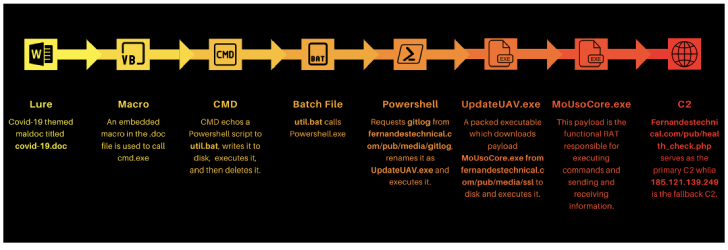
The dropper also makes use of the open-source Chacal[2] “anti-VM framework” to
make reverse engineering difficult, using it to carry out
anti-reversing checks and terminating itself should it encounter
any debuggers or memory analysis programs.
The remote access trojan, for its part, is equipped to log
keystrokes, capture screenshots, and execute arbitrary commands,
before exfiltrating the results back to the server.
While both the dropper and the RAT are said to have been
developed by the same author, the identity of the threat actor
remains unknown as yet.
Furthermore, Proofpoint cautioned that the dropper could be
customized to deliver different payloads in future attacks,
although in its current form, it can only retrieve the Nerbian
RAT.
“Malware authors continue to operate at the intersection of
open-source capability and criminal opportunity,” Sherrod DeGrippo,
vice president of threat research and detection at Proofpoint, said
in a statement.
Read more https://thehackernews.com/2022/05/researchers-warn-of-nerbian-rat.html