A newly designed privacy-sensitive architecture aims to enable
developers to create smart home apps in a manner that addresses
data sharing concerns and puts users in control over their personal
information.
Dubbed Peekaboo[1] by researchers from
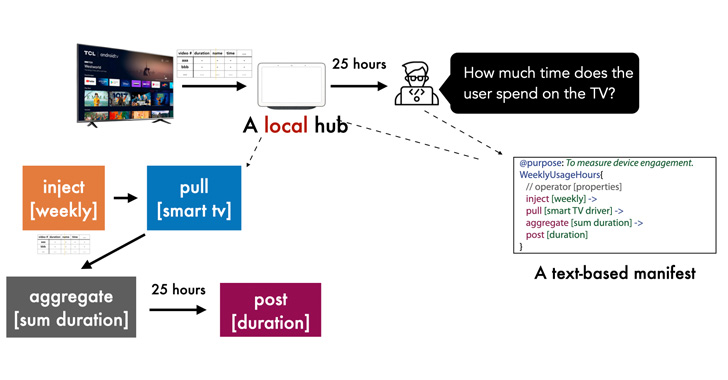
Carnegie Mellon University, the system[2] “leverages an in-home
hub to pre-process and minimize outgoing data in a structured and
enforceable manner before sending it to external cloud
servers.”
Peekaboo operates on the principle of data minimization, which
refers to the practice of limiting data collection to only what is
required to fulfill a specific purpose.
To achieve this the system requires developers to explicitly
declare the relevant data collection behaviors in the form of a
manifest file that’s then fed into an in-home trusted hub to
transmit sensitive data from smart home apps such as smart
doorbells on a need-to-know basis.
The hub not only functions as a mediator between raw data from
IoT devices and the respective cloud services, it also enables
third-party auditors to vet an app developer’s data collection
claims.
The manifest file, for its part, is analogous to Android’s
“AndroidManifest.xml[3]” file that details the
permissions the app needs in order to access protected parts of the
system or other apps.
But while it is more of a binary approach in Android where apps
are either unilaterally allowed or denied access to a specific
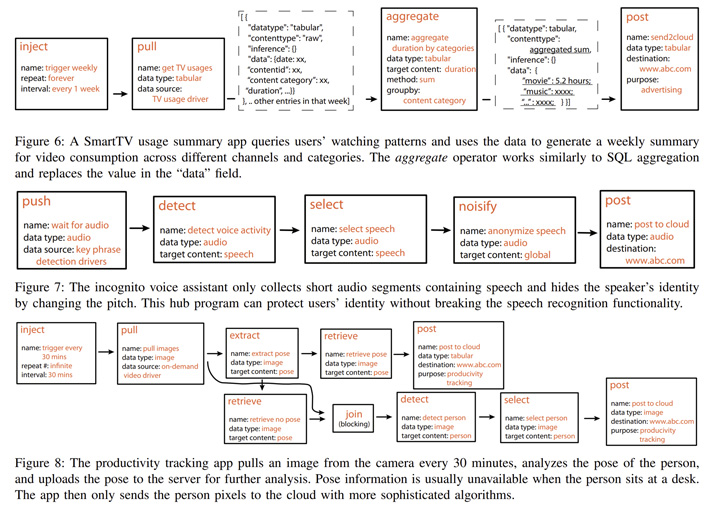
feature (e.g., camera), Peekaboo makes it possible to define the
data collection practices — the kind of data to be gathered, when
it should be carried out, and how frequently.
“With Peekaboo, a user can install a new smart home app by
simply downloading a manifest to the hub rather than a binary,” the
researchers explained.
“This approach offers more flexibility than permissions, as well
as a mechanism for enforcement. It also offers users (and auditors)
more transparency about a device’s behavior, in terms of what data
will flow out, at what granularity, where it will go, and under
what conditions.”
What’s more, Peekaboo is also designed to auto-generate live
privacy nutrition labels that summarize an app’s declared behavior
à la Apple’s privacy labels[4]
in iOS and Android’s Data safety[5]
section.
“Peekaboo offers a hybrid architecture, where a local
user-controlled hub pre-processes smart home data in a structured
manner before relaying it to external cloud servers,” the
researchers said.
References
- ^
Peekaboo
(arxiv.org) - ^
system
(github.com) - ^
AndroidManifest.xml
(developer.android.com) - ^
privacy
labels (thehackernews.com) - ^
Data
safety (thehackernews.com)
Read more https://thehackernews.com/2022/06/new-privacy-framework-for-iot-devices.html