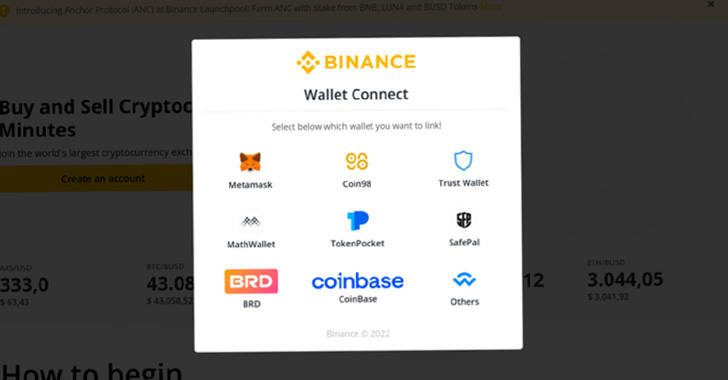
Cybercriminals are impersonating popular crypto platforms such
as Binance, Celo, and Trust Wallet with spoofed emails and fake
login pages in an attempt to steal login details and deceptively
transfer virtual funds.
“As cryptocurrency and non-fungible tokens (NFTs) become more
mainstream, and capture headlines for their volatility, there is a
greater likelihood of more individuals falling victim to fraud
attempting to exploit people for digital currencies,” Proofpoint
said[1]
in a new report.
“The rise and proliferation of cryptocurrency has also provided
attackers with a new method of financial extraction.”
The targeting of sensitive cryptocurrency data by threat actors
was recently echoed by the Microsoft 365 Defender Research Team,
which warned about the emerging threat of cryware[2]
wherein private keys, seed phrases, and wallet addresses are
plundered with the goal of siphoning virtual currencies by means of
fraudulent transfers.
The swift popularity of Web3[3] in recent years has
caused a shift in the phishing landscape, paving the way for a
variety of social engineering and exploitation mechanisms that are
aimed at stealing cryptocurrencies in different ways ranging from
credential harvesting to the use of commodity stealer malware.
This includes spam emails that contain links to rogue URLs that
download malware and redirect users to a credential harvesting
landing page or even fake lookalike versions of NFT trading
platforms like OpenSea. Other campaigns prompt potential victims to
enter their seed phrases.
In a phishing attack detected by the enterprise security firm in
February 2022, a Trust Wallet-themed lure was observed nudging
email recipients, specifically university students, to verify their
wallets by entering the recovery phrases.
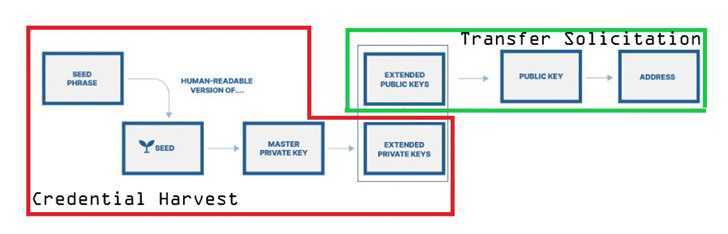
A crucial enabler of these tailored campaigns is the relative
ease with which counterfeit landing pages can be built using
phishing kits[4], allowing less skilled
threat actors to distribute and manage campaigns at a massive
scale.
Further incentivizing the cybercriminal scheme are
phishing-as-a-service (PHaaS) operators like BulletProofLink[5]
that offer phishing templates, spamming services, bulletproof
hosting services, and credential collection services, among
others.
The kits, which are continually updated and expanded, are
designed to mimic different brands such as blockchain[.]com as well
as other NFT and other cryptocurrency wallet service providers.
Also prominent are business email compromise (BEC) attempts to
facilitate the fraudulent transfer of digital coins through
messages that solicit cryptocurrency under the guise of vendor
payments and donation requests to support the Ukraine war
effort.
The findings come as losses from crypto-related crime jumped 79%
year-over-year in 2021, with the U.S. Federal Trade Commission
(FTC) noting[6]
that more than 46,000 people have reported losing over $1 billion
in digital currencies to scams.

What’s more, Blockchain analytics firm Chainalysis found[7]
that cryptocurrency-based crime hit a new all-time high in 2021,
even as illicit addresses received $14 billion over the course of
the year, up from $7.8 billion in 2020.
“Cybercriminal threats to cryptocurrency are not new, however as
the general public experiences growing adoption of cryptocurrency,
people may be more likely to engage with social engineering lures
using such themes,” Sherrod DeGrippo, vice president of threat
research and detection at Proofpoint, said.
“Crypto went mainstream with Superbowl[8]
ads[9]
this year[10] and threat actors have
taken note of the opportunity for a quick payday. There is no
easier method of financial extraction than the illicit transfer of
cryptocurrency.”
References
- ^
said
(www.proofpoint.com) - ^
cryware
(thehackernews.com) - ^
swift
popularity of Web3 (thehackernews.com) - ^
phishing
kits (www.proofpoint.com) - ^
BulletProofLink
(thehackernews.com) - ^
noting
(www.ftc.gov) - ^
found
(blog.chainalysis.com) - ^
Superbowl
(cointelegraph.com) - ^
ads
(www.npr.org) - ^
this
year (techcrunch.com)
Read more https://thehackernews.com/2022/06/researchers-detail-how-cyber-criminals.html