
Two client-side risks dominate the problems with data loss and
data exfiltration: improperly placed trackers on websites and web
applications and malicious client-side code pulled from third-party
repositories like NPM.
Client-side security researchers are finding that improperly
placed trackers, while not intentionally malicious, are a growing
problem and have clear and significant privacy implications when it
comes to both compliance/regulatory concerns, like HIPAA or PCI DSS
4.0. To highlight the risks with misplaced trackers, a recent study[1]
by The Markup (a non-profit news organization) examined Newsweek’s
top 100 hospitals in America. They found a Facebook tracker on
one-third of the hospital websites which sent Facebook highly
personal healthcare data whenever the user clicked the “schedule
appointment” button. The data was not necessarily anonymized,
because the data was connected to an IP address, and both the IP
address and the appointment information get delivered to
Facebook.

Journalists and client-side security researchers aren’t the only
ones looking at data privacy issues. Last week, the FTC announced its plans to crack
down[2] on tech companies’
improper or illegal use and sharing of highly sensitive data. The
FTC indicated they also plan to target false claims about data
anonymization. The government agency points out that sensitive
health information combined with the shadowy data security
practices used by technology companies is extremely problematic,
with most customers having little or no knowledge of how their data
is collected, what data is collected, how it is used, or how it is
protected.
The security industry has repeatedly proven how easy it is to
re-identify anonymized data by combining several datasets to create
a clear picture of the end user’s identity.
In addition to improperly placed web trackers, client-side
security researchers are warning about the risks associated with
JavaScript code pulled from third-party repositories, like NPM.
Recent research found that package managers containing obfuscated and
malicious JavaScript[3]
was being used to harvest sensitive information from websites and
web applications. Using sources like NPM, malicious threat actors
target organizations via a JavaScript software supply chain
attack[4] using rogue components
to exfiltrate data entered into forms by users on websites that
include this malicious code.
Client-side security researchers advise several approaches for
identifying and mitigating these two primary risks. Client-side attack surface
monitoring[5] is the most
comprehensive and fully protects end users and businesses from the
risk of data theft due to Magecart, e-skimming, cross-site
scripting, and JavaScript injection attacks. Other tools, like web
application firewalls (WAFs), protect some aspects of the
client-side attack surface but fail to protect activities happening
on dynamic web pages. Content security policies (CSPs) are another
good client-side security tool, but CSPs are cumbersome. Manual
code reviews to identify problems with CSPs can mean long hours (or
days) scouring through thousands of lines of web application
script.
Security professionals can also explore client-side attack
surface mapping solutions that incorporate threat intelligence,
access insights (which assets are accessing what data), and privacy
(is any of the data being shared to external sources
inappropriately).
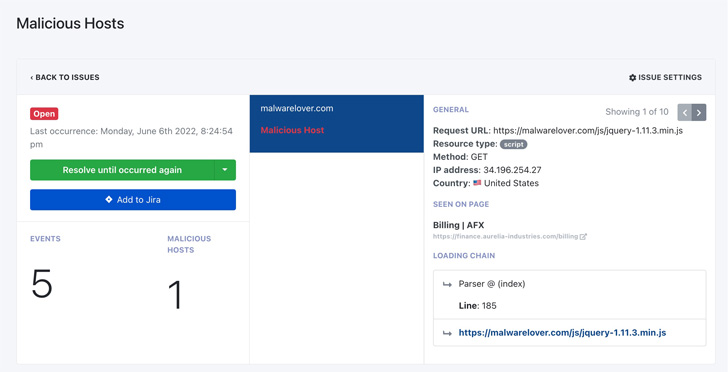
Client-side attack surface monitoring solutions are a relatively
new cybersecurity technology that automatically discovers all of a
company’s web assets and reports on their data access. These
solutions use headless browsers to navigate through all the
JavaScript contained on the website and web application pages. They
gather real-time information about how the scanned website works
from the end user’s perspective.
A key technological component in client-side attack surface
monitoring solutions are synthetic users, deployed during threat
detection crawls to interact the way a real human would on dynamic
web pages. These synthetic users can complete a variety of
activities, including clicking active links, submitting forms,
solving Captchas, and entering financial information. Synthetic
user interaction is logged and monitored, followed by behavioral
analyses and logic injection into each page to gather the
information that is difficult to collect manually, including form
data, the data third-party scripts have access to, trackers that
are deployed and their activities, and any forms or third-party
scripts transferring data across national boundaries.
Solutions should also be able to operationalize any issues
discovered in the identification or client-side mapping process
through the use of allowlists and blocklists and through post-scan
informational analyses to obtain synthesized intelligence to secure
web applications from harm.
Security professionals with expertise on the client side are
strongly advising organizations in industries such as financial
services, media/entertainment, e-commerce, healthcare, and
technology/SaaS that have multiple front-end web applications to
understand client-side security[6]
and how client-side risks may impact their business.
References
- ^
recent
study (themarkup.org) - ^
FTC
announced its plans to crack down
(thehackernews.com) - ^
package
managers containing obfuscated and malicious JavaScript
(thehackernews.com) - ^
JavaScript software supply chain
attack (www.feroot.com) - ^
Client-side attack surface
monitoring (www.feroot.com) - ^
client-side security
(www.feroot.com)
Read more https://thehackernews.com/2022/07/security-experts-warn-of-two-primary.html