The operators of the XCSSET macOS malware have upped the stakes
by making iterative improvements that add support for macOS
Monterey by upgrading its source code components to Python 3.
“The malware authors have changed from hiding the primary
executable in a fake Xcode.app in the initial versions in 2020 to a
fake Mail.app in 2021 and now to a fake Notes.app in 2022,”
SentinelOne researchers Phil Stokes and Dinesh Devadoss said[1]
in a report.
XCSSET, first documented[2]
by Trend Micro in 2020, has many moving parts that allow it to
harvest sensitive information[3] from Apple Notes,
WeChat, Skype, and Telegram; inject malicious JavaScript code into
various websites; and dump cookies from Safari web browser.
Infection chains entail using a dropper to compromise users’
Xcode projects with the backdoor, with the latter also taking steps
to evade detection by masquerading as either system software or the
Google Chrome web browser application.
The primary executable is an AppleScript that’s designed to
retrieve second-stage AppleScript payloads from a network of remote
servers that siphon data stored in web browsers such as Google
Chrome, Mozilla Firefox, Microsoft Edge, Brave, and Yandex Browser
as well as chat apps like Telegram and WeChat.
The threat actor is also known to use a custom AppleScript
(“listing.applescript”) to determine “how up-to-date the victim is
with Apple’s XProtect and MRT malware removal tool, presumably all
the better to target them with more effective payloads,” the
researchers said.
One of the novel aspects of the attack is that deploying the
malware within Xcode projects is seen as a method of propagation
via GitHub repositories to further expand its reach.
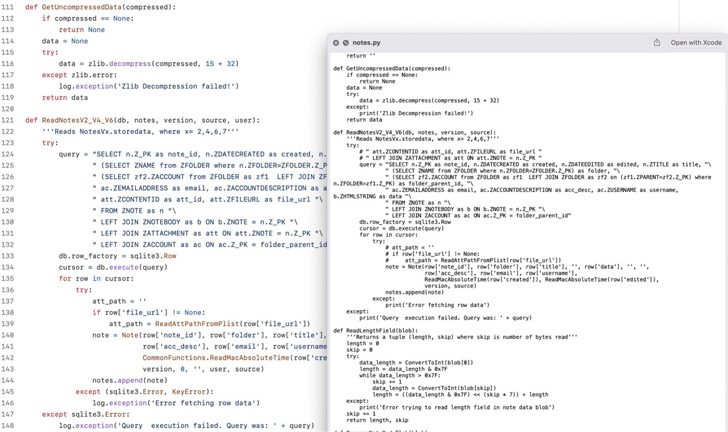
Besides leveraging AppleScripts, the malware also takes
advantage of Python scripts for dropping fake application icons on
the macOS Dock and stealing data from the legitimate Notes app.
The latest version of XCSSET is also notable for incorporating
modifications to AppleScripts to account for Apple’s removal[4]
of Python 2.7 from macOS 12.3 released on March 14, 2022,
indicating that the authors are continually updating the malware to
increase their chance of success.
To that end, the adversary is said to have updated their
“safari_remote.applescript” by eliminating Python 2 in favor of
Python 3 for systems running macOS Monterey 12.3 and above.
Despite being in the wild for two years, very little is known
about the identity of the threat actors and their motivations or
their exact targets. That said, XCSSET malware attacks have been
reported in China[5]
as recently as May 2022 that demanded victims pay 200 USDT in
return for unlocking stolen accounts.
“At this point in time, it’s unclear whether these infected
repos are victims or plants by threat actors hoping to infect
unwary users,” the researchers noted. “It has been suggested that
unsuspecting users may be pointed to the infected repositories
through tutorials and screencasts for novice developers.”
References
- ^
said
(www.sentinelone.com) - ^
documented
(thehackernews.com) - ^
harvest
sensitive information (thehackernews.com) - ^
removal
(developer.apple.com) - ^
reported
in China (juejin.cn)
Read more https://thehackernews.com/2022/08/xcsset-malware-updates-with-python-3-to.html