Critical infrastructure is important for societal existence,
growth, and development. Societies are reliant on the services
provided by critical infrastructure sectors like telecommunication,
energy, healthcare, transportation, and information technology.
Safety and security are necessary for the optimal operation of
these critical infrastructures. Critical infrastructure is made up
of digital and non-digital assets. Organizations must stay ahead of
cybersecurity threats to prevent failures caused by cyber attacks
on critical infrastructure. Finding ways to protect digital assets
in an ever-changing landscape filled with threats is a continuous
activity. Organizations must also employ efficient security
solutions and best practices to stay protected and reduce the
chances of compromise.
Security solutions help secure and improve the visibility of an
organization’s threat landscape. Different solutions use different
concepts and approaches. An important concept that has risen
recently is Extended Detection and Response (XDR).
XDR solutions provide detection and response capabilities across
multiple layers. XDR tools correlate data using threat detection
and response methods by gathering logs and events from various
sources, such as network devices, servers, and applications. These
capabilities make it possible for security teams to quickly detect,
investigate and respond to incidents.
Attacks on critical infrastructure
In February 2022, a supply chain attack occurred in one of
Germany’s energy giants. This attack led to the closure of more
than 200 gas stations across Germany, affecting lives and
businesses. This event occurred nearly a year after the Colonial
Pipeline attack in the United States of America, where data
exfiltration occurred and a ransomware infection shut down digital
services within their infrastructure for days. An article from the
NYTimes reported that an estimated 5 million dollars were paid to
the hackers involved in the Colonial Pipeline ransomware attack.
The hackers in the Colonial Pipeline case were able to gain entry
using a compromised VPN password, and they proceeded to perform
intrusion activities for an entire day before they were
detected.
There are several entry points for attacks on critical
infrastructure, and some vectors are more prevalent than others.
These vectors include compromised credentials, unpatched operating
systems, vulnerable applications, and malware delivered through
various techniques.
Emphasis should be placed on securing critical infrastructure
before an attack happens, regardless of how it originates. Security
solutions help organizations protect themselves from different
attack vectors. These solutions include XDR, SIEM, code scanners,
infrastructure analyzers, vulnerability scanners, and malware
detection solutions. In addition to these solutions are compliance
standards. A few recommended standards are NIST, PCI DSS, HIPAA,
and GDPR. The correct application of these solutions and compliance
standards can help improve an organization’s security posture.
How XDR can mitigate attacks
An XDR plays a significant role in situations where threat
actors target different digital assets of an organization. With an
XDR integrated into an organization’s infrastructure, security
events from various sources and assets are analyzed and correlated
to determine what activities are happening in the infrastructure.
An XDR has the ability to detect and provide automated responses to
malicious activities in an environment. Such a response can kill a
malicious process, delete a malicious file, or isolate a
compromised endpoint. As the responses are executed in near
real-time, speed plays a critical role in the execution of these
tasks.
Wazuh SIEM/XDR
Wazuh[1] is a free and open
source SIEM and XDR platform. It includes several components that
protect both cloud and on-premises workloads. The Wazuh platform
operates with an agent-server model. The Wazuh central components
(server, indexer, and dashboard) analyze security data from
endpoints in your infrastructure. At the same time, the Wazuh agent
is deployed on endpoints to collect security data and provide
threat detection and response. The Wazuh agent is lightweight and
supports multiple platforms. Wazuh also supports agentless
monitoring on routers, firewalls, and switches.
Wazuh XDR capabilities
Wazuh has several capabilities that help an organization stay
ahead of security threats. Some of these capabilities are malware
detection, vulnerability detection, file integrity monitoring, and
automated response to threats, amongst others. The following
sections contain more details on Wazuh capabilities that help in
protecting critical infrastructure.
Log data analysis
The Wazuh log data analysis module collects and analyzes
security data from various sources. Such data include system event
logs, application logs, and abnormal system behavior logs.
Consequently, the analyzed data is used for threat detection and
automated response. This capability gives you visibility into
events happening at different endpoints in your infrastructure.
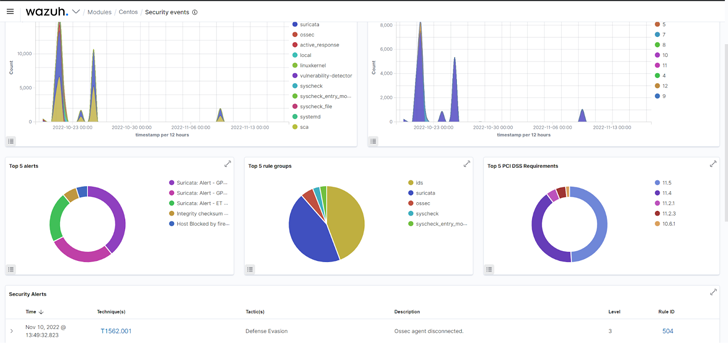 |
| Fig 1: Security events of a monitored endpoint on the Wazuh dashboard. |
Malware detection
Wazuh has several features that help in malware detection. In
addition, Wazuh can be integrated with other security tools like
YARA[2]
and VirusTotal[3]
to detect malware. By properly configuring Wazuh Constant Database (CDB) lists[4], values from decoded
alerts such as users, file hashes, IP addresses, or domain names
can be compared with malicious records. Here is a blog post that
shows how Wazuh can be integrated with CDB
lists[5] for detecting and
responding to malicious files. This Wazuh capability helps you
detect malware on various monitored endpoints.
File integrity monitoring
The Wazuh File Integrity Monitoring (FIM) module monitors an
endpoint filesystem to detect changes in predefined files and
directories. Alerts are triggered when a file is created, modified,
or deleted in monitored directories. You can see how this module is
utilized to detect changes to an SSH key file in the blog post
Detecting illegitimate crypto miners on
Linux endpoints[6]. Using the Wazuh FIM
module, you can detect changes to configuration files on critical
systems and determine if the activity is authorized or
malicious.
Vulnerability detection
Wazuh uses the Vulnerability detector module to find
vulnerabilities on a monitored endpoint. Vulnerability detection
works by performing software audits. These audits are made possible
by leveraging vulnerability feeds indexed from sources like
Canonical, Debian, Red Hat, Arch Linux, ALAS (Amazon Linux
Advisories Security), Microsoft, and the National Vulnerability
Database. These feeds are cross-correlated by Wazuh with
information from the endpoint’s application inventory.
Administrators should commence remediation immediately after
vulnerabilities are detected before malicious actors can exploit
them.

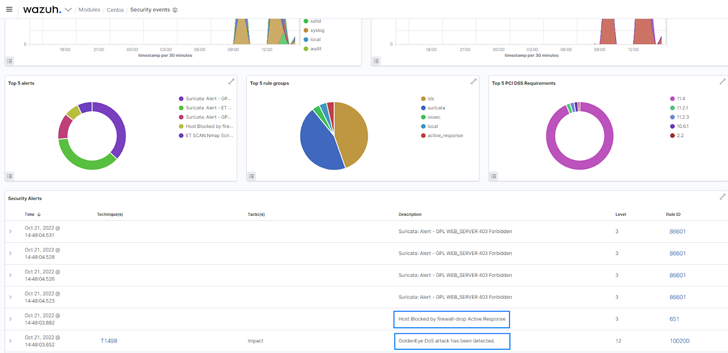
Automated response to threats
The Wazuh active response module can be configured to
automatically execute countermeasures when events match specific
criteria. It can execute user-defined actions, such as a firewall
block or drop, traffic shaping or throttling, account lockout,
system shutdown, etc. The active response module was configured to
deny network connection from an identified malicious source in the
blog post Responding to network attacks with Suricata
and Wazuh XDR[7].
Conclusion
Implementing security across multiple layers of critical
infrastructure reduces an organization’s attack surface. We have
emphasized a few factors to keep in mind to maintain a proper
security posture. In protecting your digital assets, we suggest a
solution that works well with various endpoints, systems, and
technologies.
Wazuh[8] is a free and open
source XDR solution. It includes the capabilities necessary to
discover vulnerabilities, determine the system configuration state,
and respond to threats on your digital assets. Wazuh also provides
support for compliance standards like PCI DSS, HIPAA, NIST, and
GDPR. Wazuh has an ever-growing community[9] where support is
provided to users. Check out the Wazuh documentation[10] for more
information.
Found this article interesting? Follow us on Twitter [11] and LinkedIn[12] to read more exclusive
content we post.
References
- ^
Wazuh
(wazuh.com) - ^
YARA
(documentation.wazuh.com) - ^
VirusTotal
(documentation.wazuh.com) - ^
Constant
Database (CDB) lists
(documentation.wazuh.com) - ^
Wazuh
can be integrated with CDB lists
(wazuh.com) - ^
Detecting illegitimate crypto miners on
Linux endpoints (wazuh.com) - ^
Responding to network attacks with
Suricata and Wazuh XDR (wazuh.com) - ^
Wazuh
(wazuh.com) - ^
community
(wazuh.com) - ^
documentation
(documentation.wazuh.com) - ^
Twitter
(twitter.com) - ^
LinkedIn
(www.linkedin.com)
Read more https://thehackernews.com/2022/12/how-xdr-helps-protect-critical.html