Dec 08, 2022Ravie Lakshmanan
An unconventional data exfiltration method leverages a
previously undocumented covert channel to leak sensitive
information from air-gapped systems.
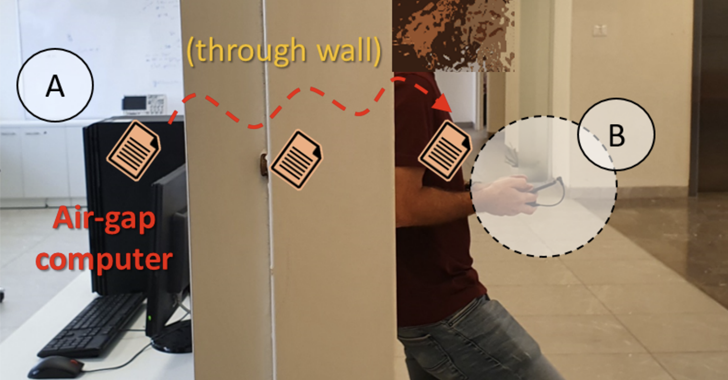
“The information emanates from the air-gapped computer over the
air to a distance of 2 m and more and can be picked up by a nearby
insider or spy with a mobile phone or laptop,” Dr. Mordechai Guri[1], the head of R&D in
the Cyber Security Research Center in the Ben Gurion University of
the Negev in Israel and the head of Offensive-Defensive Cyber
Research Lab, said in a new paper[2]
shared with The Hacker News.
The mechanism, dubbed COVID-bit, leverages
malware planted on the machine to generate electromagnetic
radiation in the 0-60 kHz frequency band that’s subsequently
transmitted and picked up by a stealthy receiving device in close
physical proximity.
This, in turn, is made possible by exploiting the dynamic power
consumption of modern computers and manipulating the momentary
loads on CPU cores.
COVID-bit is the latest technique[3]
devised by Dr. Guri this year, after SATAn[4], GAIROSCOPE[5], and ETHERLED[6], which are designed to
jump over air-gaps and harvest confidential data.
Air-gapped networks, despite their high level of isolation, can
be compromised[7]
by various strategies such as infected USB drives[8], supply chain attacks,
and even rogue insiders.
Exfiltrating the data after breaching the network, however, is a
challenge due to the lack of internet connectivity, necessitating
that attackers concoct special methods to deliver the
information.
The COVID-bit is one such covert channel that’s used by the
malware to transmit information by taking advantage of the
electromagnetic emissions from a component called switched-mode
power supply (SMPS[9]) and using a mechanism
called frequency-shift keying (FSK[10]) to encode the binary
data.
“By regulating the workload of the CPU, it is possible to govern
its power consumption and hence control the momentary switching
frequency of the SMPS,” Dr. Guri explains.
“The electromagnetic radiation generated by this intentional
process can be received from a distance using appropriate antennas”
that cost as low as $1 and can be connected to a phone’s 3.5 mm
audio jack to capture the low-frequency signals at a bandwidth of
1,000 bps.
The emanations are then demodulated to extract the data. The
attack is also evasive in that the malicious code doesn’t require
elevated privileges and can be executed from within a virtual
machine.
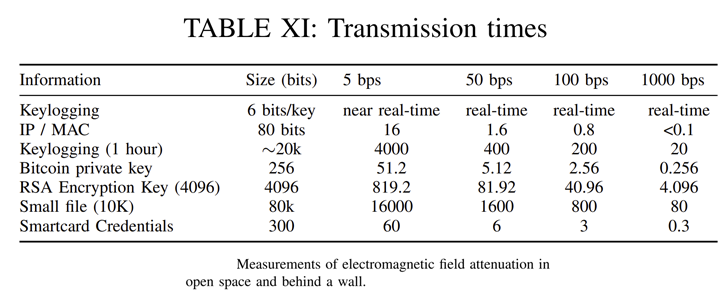
An evaluation of the data transmissions reveals that keystrokes
can be exfiltrated in near real-time, with IP and MAC addresses
taking anywhere between less than 0.1 seconds to 16 seconds,
depending on the bitrate.
Countermeasures against the proposed covert channel include
carrying out dynamic opcode analysis to flag threats, initiate
random workloads on the CPU processors when anomalous activity is
detected, and monitoring or jamming signals in the 0-60 kHz
spectrum.
Found this article interesting? Follow us on Twitter [11] and LinkedIn[12] to read more exclusive
content we post.
References
- ^
Dr.
Mordechai Guri (www.linkedin.com) - ^
new paper
(arxiv.org) - ^
latest
technique (cyber.bgu.ac.il) - ^
SATAn
(thehackernews.com) - ^
GAIROSCOPE
(thehackernews.com) - ^
ETHERLED
(thehackernews.com) - ^
compromised
(thehackernews.com) - ^
infected
USB drives (unit42.paloaltonetworks.com) - ^
SMPS
(en.wikipedia.org) - ^
FSK
(en.wikipedia.org) - ^
Twitter
(twitter.com) - ^
LinkedIn
(www.linkedin.com)
Read more https://thehackernews.com/2022/12/covid-bit-new-covert-channel-to.html