
The Uyghur community located in China and Pakistan has been the
subject of an ongoing espionage campaign aiming to trick the
targets into downloading a Windows backdoor to amass sensitive
information from their systems.
“Considerable effort was put into disguising the payloads,
whether by creating delivery documents that appear to be
originating from the United Nations using up to date related
themes, or by setting up websites for non-existing organizations
claiming to fund charity groups,” according to joint research
published by Check Point Research[1]
and Kaspersky today.
The Uyghurs are a Turkic ethnic minority group originating from
Central and East Asia and are recognized as native to the Xinjiang
Uyghur Autonomous Region in Northwest China. At least since 2015,
government authorities have placed the region under tight
surveillance, putting hundreds of thousands into prisons and
internment camps that the government calls “Vocational Education
and Training Centers.”
Over the years, the community has also been at the receiving end
of a series of sustained cyberattacks that have leveraged[2]
exploit[3]
chains[4]
and watering holes[5]
to install spyware designed to harvest and exfiltrate sensitive
data from email and messaging apps as well as plunder photos and
login credentials.
Earlier this March, Facebook disclosed[6]
that it disrupted a network of bad actors using its platform to
target the Uyghur community and lure them into downloading
malicious software that would allow surveillance of their devices,
attributing the “persistent operation” to a China-based threat
actor known as Evil Eye.
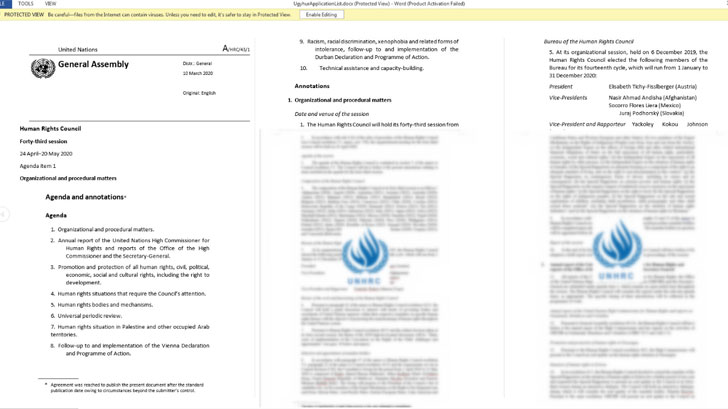
The latest cyber offensive follows a similar modus operandi in
that the attacks involve sending UN-themed decoy documents
(“UgyhurApplicationList.docx”) to the targets under the pretext of
discussing human rights violations. The goal of the phishing
message is to lure the recipients into installing a backdoor on the
Windows machines.
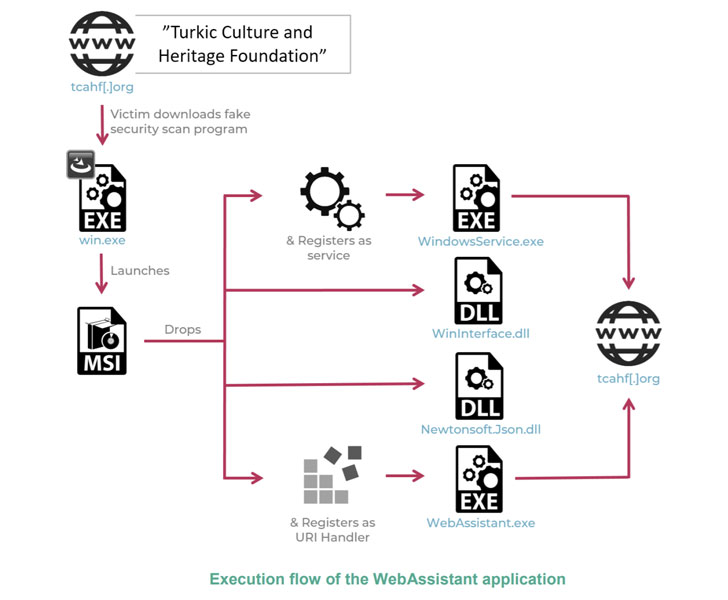
In an alternative infection vector observed by the researchers,
a fake human rights foundation called the “Turkic Culture and
Heritage Foundation” (“tcahf[.]org”) — with its content copied from
George Soros-founded Open Society Foundations — was used as a bait
to download a .NET backdoor that purports to be a security scanner,
only to connect to a remote server and transmit the gathered data,
which includes system metadata and a list of installed apps and
running processes.
“The malicious functionality of the TCAHF website is well
disguised and only appears when the victim attempts to apply for a
grant,” the researchers said. “The website then claims it must make
sure the operating system is safe before entering sensitive
information for the transaction, and therefore asks the victims to
download a program to scan their environments.”
At least two different versions of the Windows implants have
been detected to date, one called “WebAssistant” that was available
for download from the rogue website in May 2020 and a second
variant dubbed “TcahfUpdate” that was available in October
2020.
The two cybersecurity firms did not attribute the attacks to a
known threat group but pinned the intrusions on a Chinese-speaking
adversary with low to medium confidence based on overlaps in the
VBA code embedded in the Word document. Only a handful of victims
in China and Pakistan have been identified so far, based on
telemetry data compiled during the analysis.
Unsurprisingly, the attackers behind the campaign continue to
remain active and evolve its infrastructure, with the group
registering two new domains in 2021, both of which redirect to the
website of a Malaysian government body called the “Terengganu
Islamic Foundation,” suggesting the threat actor may have set its
sights on targets in Malaysia and Turkey.
“We believe that these cyber-attacks are motivated by espionage,
with the end-game of the operation being the installation of a
backdoor into the computers of high-profile targets in the Uyghur
community,” said Lotem Finkelsteen, Check Point’s head of threat
intelligence. “The attacks are designed to fingerprint infected
devices … [and] from what we can tell, these attacks are ongoing,
and new infrastructure is being created for what looks like future
attacks.”
References
Read more http://feedproxy.google.com/~r/TheHackersNews/~3/uzzaDEG6cEg/hackers-using-fake-foundations-to.html