Severe security flaws uncovered in popular Visual Studio Code
extensions could enable attackers to compromise local machines as
well as build and deployment systems through a developer’s
integrated development environment (IDE).
The vulnerable extensions could be exploited to run arbitrary
code on a developer’s system remotely, in what could ultimately
pave the way for supply chain attacks.
Some of the extensions in question are “LaTeX Workshop,”
“Rainbow Fart,” “Open in Default Browser,” and “Instant Markdown,”
all of which have cumulatively racked up about two million
installations between them.
“Developer machines usually hold significant credentials,
allowing them (directly or indirectly) to interact with many parts
of the product,” researchers from open-source security platform
Synk said[1]
in a deep-dive published on May 26. “Leaking a developer’s private
key can allow a malicious stakeholder to clone important parts of
the code base or even connect to production servers.”
VS Code extensions[2], like browser add-ons,
allow developers to augment Microsoft’s Visual Studio Code
source-code editor with additional features like programming
languages and debuggers relevant to their development workflows. VS
Code is used by 14 million active users, making it a huge attack
surface.
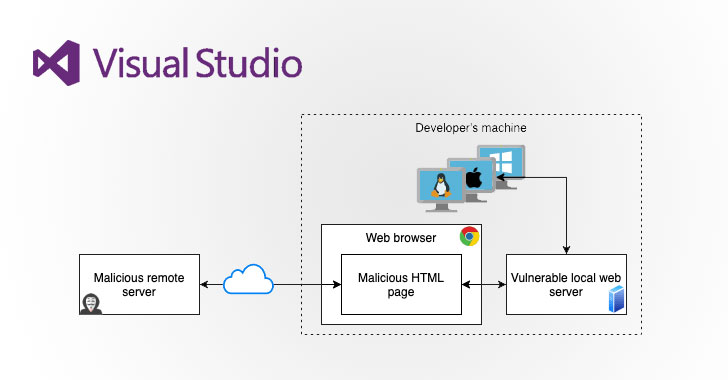
The attack scenarios devised by Synk bank on the possibility
that the installed extensions could be abused as a vector for
supply chain attacks by exploiting weaknesses in the plugins to
break into a developer system effectively. To that effect, the
researchers examined VS Code extensions that had vulnerable
implementations of local web servers.
In one case identified by Synk researchers, a path traversal
vulnerability identified in Instant Markdown could be leveraged by
a nefarious actor with access to the local webserver (aka localhost[3]) to retrieve any file
hosted on the machine by simply tricking a developer into clicking
a malicious URL.
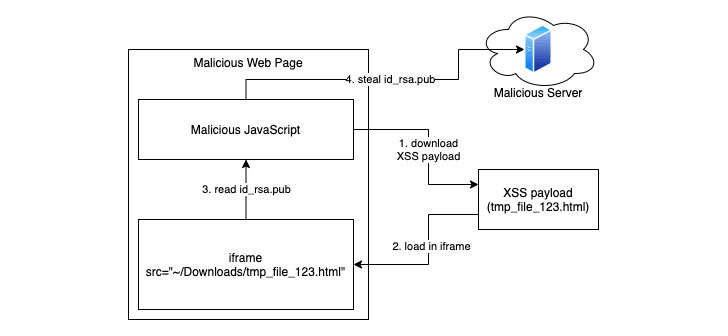
As a proof-of-concept (PoC) demonstration, the researchers
showed it was possible to exploit this flaw to steal SSH keys from
a developer who is running VS Code and has Instant Markdown or Open
in Default Browser installed in the IDE. LaTeX Workshop, on the
other hand, was found susceptible to a command injection
vulnerability due to unsanitized input that could be exploited to
run malicious payloads.
Lastly, an extension named Rainbow Fart was ascertained to have
a zip slip vulnerability[4], which allows an
adversary to overwrite arbitrary files on a victim’s machine and
gain remote code execution. In an attack formulated by the
researchers, a specially-crafted ZIP file was sent over an
“import-voice-package” endpoint used by the plugin and written to a
location that’s outside of the working directory of the
extension.
“This attack could be used to overwrite files like ‘.bashrc’ and
gain remote code execution eventually,” the researchers noted.
Although the flaws in the extensions have since been addressed,
the findings are important in light of a series[5]
of security[6]
incidents[7]
that show how developers[8]
have emerged as a lucrative attack target[9], what with threat actors
unleashing a variety of malware to compromise development tools and
environments for other campaigns.
“What has been clear for third-party dependencies is also now
clear for IDE plugins — they introduce an inherent risk to an
application,” Synk researchers Raul Onitza-Klugman and Kirill
Efimov said. “They’re potentially dangerous both because of their
custom written code pieces and the dependencies they are built
upon. What has been shown here for VS Code might be applicable to
other IDEs as well, meaning that blindly installing extensions or
plugins is not safe (it never has been).”
References
- ^
said
(snyk.io) - ^
VS Code
extensions (code.visualstudio.com) - ^
localhost
(en.wikipedia.org) - ^
zip slip
vulnerability (snyk.io) - ^
series
(thehackernews.com) - ^
security
(thehackernews.com) - ^
incidents
(thehackernews.com) - ^
developers
(thehackernews.com) - ^
attack
target (thehackernews.com)
Read more http://feedproxy.google.com/~r/TheHackersNews/~3/QtUYnshsHuU/newly-discovered-bugs-in-vscode.html