

Attackers are using many types of attacks to compromise
business-critical data. These can include zero-day attacks, supply
chain attacks, and others. However, one of the most common ways
that hackers get into your environment is by compromising
passwords.
The password spraying attack is a special kind of password
attack that can prove effective in compromising your environment.
Let’s look closer at the password spraying attack and how
organizations can prevent it.
Beware of compromised credentials
Are compromised credentials dangerous to your environment? Yes!
Compromised credentials allow an attacker to “walk in the front
door” of your environment with legitimate credentials. They assume
all the rights and permissions to systems, data, and resources the
compromised account can access.
The compromise of a privileged account is even worse. Privileged
accounts are accounts that have high levels of access, such as an
administrator user account. These types of accounts represent the
“holy grail” to an attacker as they generally have the “keys to the
kingdom” in terms of access. For example, with an administrator
account, an attacker can not only access systems but can also
create other backdoors and high-level accounts that may be
difficult to detect.
According to the IBM Cost of a Data
Breach Report 2021, “the most common initial attack vector
in 2021 was compromised credentials, responsible for 20% of
breaches.” It continues: “Breaches caused by
stolen/compromised credentials took the longest number of days to
identify (250) and contain (91) on average, for an average total of
341 days.”[1]
The longer it takes to identify an attack, they are more costly
and damaging to a business, leading to an increased risk of a
tarnished reputation and lost business.
What is a password spraying attack?
The password spraying attack is a slightly different take on the
brute force attack. In a typical brute force attack, an attacker
tries an exponential number of passwords against a single account
to crack that single account. With the password spraying attack,
the attacker “sprays” multiple accounts with the same password.
Many businesses use Microsoft Active Directory Domain Services
(ADDS) and account lockout policies. With the account lockout
policy, administrators can set the number of failed login attempts
before the account locks out for a specified duration. For example,
lockout policies configure a low number of failed login attempts,
such as five failed login attempts. The advantage of password
spraying is that the attacker spreads the attack out over multiple
accounts, which helps avoid account lockouts.
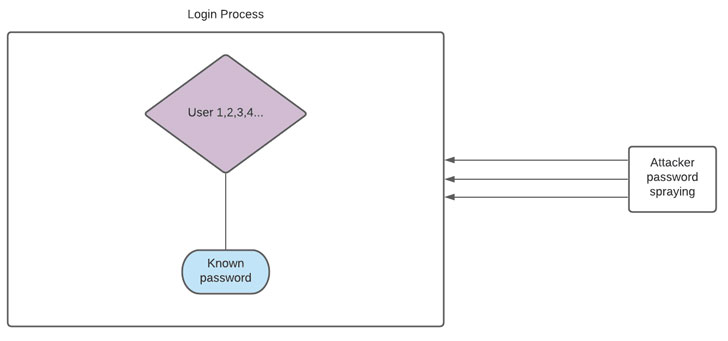 |
| Password spraying attacks target multiple user accounts with a single commonly used password |
Attackers may target an environment with common passwords that
are found as password defaults or found in known or breached
password lists. If an attacker sprays these passwords across many
user accounts, they are likely to find a user account configured
with a known, breached, or default password.
Prevent password spraying attacks
Any credential compromise is undoubtedly a cybersecurity event
that companies want to avoid at all costs. Password spraying is
another tool in the attack arsenal of cybercriminals used to breach
valuable or sensitive data. What steps can organizations take to
prevent password spraying attacks in particular?
As with many cybersecurity threats, there is no one “silver
bullet” that prevents all types of attacks. Instead, password
security involves a multi-layered approach that includes many
mitigations. So, what do these mitigations include?
- Enforce account lockout policies limiting bad password
attempts - Effective password policies enforcing good password
hygiene - Use breached password protection
- Implement multi-factor authentication
1 — Enforce account lockout policies limiting bad password
attempts
As mentioned earlier, account lockout policies prevent an
attacker from trying an infinite number of passwords against an
account until they crack the password.
Organizations can configure a threshold of bad password attempts
that lock the account for a specific time with an account lockout
policy.
While a password spraying attack attempts to bypass this
mitigation and can prove successful, password lockout policies are
a good line of defense against brute force attacks in general.
Current cybersecurity best-practice standards recommend
implementing password lockout policies.
2 — Effective password policies enforcing good password
hygiene
Password policies control the characteristics of passwords used
in an environment. Weak passwords or passwords that are easily
guessed are extremely dangerous for businesses for obvious reasons,
but particularly the incredibly high cost of recovery.
Password policies allow companies to define the length,
complexity, and content of passwords in their environments.
Microsoft’s Active Directory Domain Services allow creating basic
password policies used by most enterprise organizations today.
However, it is limited in providing modern password policy
features recommended, such as breached password protection and
advanced password policy features. As a result, businesses must
implement third-party solutions to effectively prevent the use of
breached passwords and other weak passwords in the environment.
3 — Use breached password protection
Breached password protection is an essential cybersecurity
protection mechanism for password credentials. Attackers can use
previously breached password lists to attempt breaching the current
accounts maintained by organizations. How does this work?
Attackers know that different end-users commonly use the same
passwords. Due to human nature, we all tend to think alike.
Therefore, users tend to think of and use the same types of
passwords. It means that lists of breached passwords most likely
contain passwords that other users currently use for their user
accounts.
Implementing breached password protection means that
organizations are scanning their Active Directory environments for
passwords that have been found on breached password lists. However,
as mentioned earlier, breached password protection is not a feature
natively found in Active Directory. So, organizations must use
third-party tools to implement this protection effectively.
4 — Implement multi-factor authentication
Along with strong passwords with breached password protection,
organizations do well to implement multi-factor authentication.
Multi-factor authentication combines something you know (your
password) with something you have (a hardware authentication
device).
Multi-factor authentication such as two-factor makes it
exponentially harder for attackers to compromise credentials. Even
if they guess or possess the password via a breach, they still do
not have everything needed to authenticate (the second factor, such
as a hardware device).
Modern password protection
For businesses looking to implement modern password protection
in their Active Directory environment, third-party tools are needed
to protect against breached passwords and bolster default Active
Directory password policies. By increasing the cybersecurity
posture by having more robust password protection, organizations
can help to prevent password spraying attacks.
Specops[2] Password Policy is a
solution that allows organizations to improve their password
security significantly. It provides built-in Breached Password
Protection and the ability to implement multiple password
dictionaries that include disallowed passwords customized for your
business.
Recently Specops has introduced an update to the Breached Password Protection module that
includes live attack data[3]. It means that Breached
Password Protection protects you from passwords observed as
breached in actual attacks. With this new feature, customers can be
protected from passwords in breached password dictionaries and live
attacks.
Below notes the ability to create custom dictionaries and make
use of downloadable dictionaries.
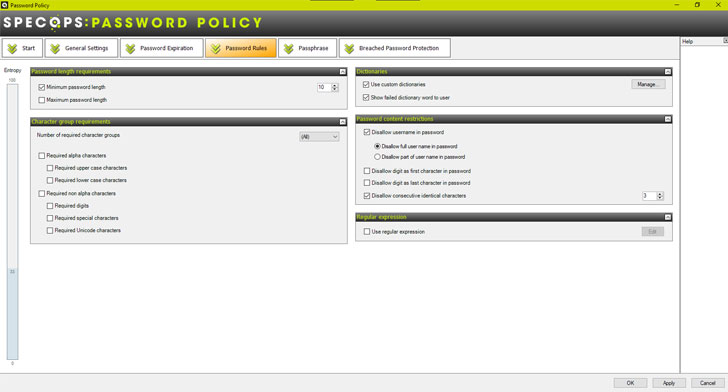 |
| Custom password dictionaries available in Specops Password Policy |
Specops provides robust Breached Password Protection with the
real-time Breached Password API.
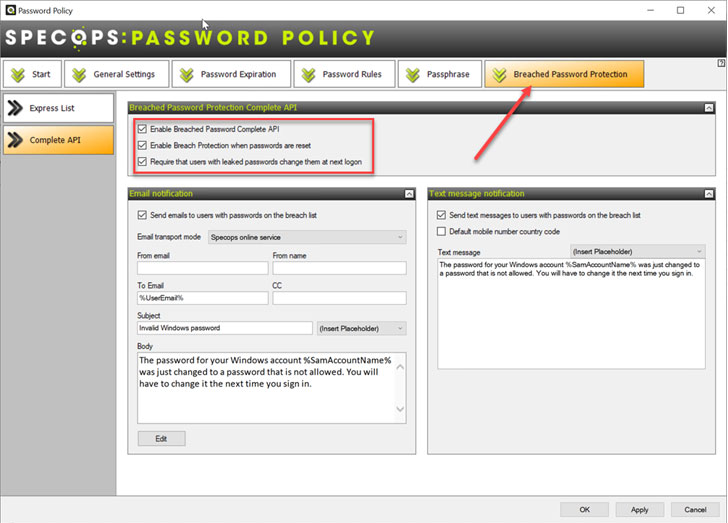 |
| Breached password protection in Specops Password Policy |
Wrapping Up
Credential theft is a dangerous risk for organizations resulting
in more costly and lengthy breach events. Attackers often use
password spraying attacks to compromise accounts with known
passwords and avoid the password lockout policy.
Specops Password Policy helps businesses to implement the best
practice recommendations needed for a modern cybersecurity posture.
It includes breached password protection, password dictionaries,
and robust password policy capabilities above and beyond native
features in Active Directory.
In addition, its breached password protection service includes a
new addition of live attack data that protects businesses from real
password spray attacks happening right now.
Learn more about Specops Password Policy and download a free
trial[4] here.
References
- ^
IBM Cost
of a Data Breach Report 2021 (www.ibm.com) - ^
Specops
(specopssoft.com) - ^
Breached
Password Protection module that includes live attack data
(specopssoft.com) - ^
Specops
Password Policy and download a free trial
(specopssoft.com)