

A previously undocumented malware packer[1]
named DTPacker has been observed distributing multiple remote
access trojans (RATs) and information stealers such as Agent Tesla,
Ave Maria, AsyncRAT, and FormBook to plunder information and
facilitate follow-on attacks.
“The malware uses multiple obfuscation techniques to evade
antivirus, sandboxing, and analysis,” enterprise security company
Proofpoint said[2]
in an analysis published Monday. “It is likely distributed on
underground forums.”
The .NET-based commodity malware has been associated with dozens
of campaigns and multiple threat groups, both advanced persistent
threat (APT) and cybercrime actors, since 2020, with the intrusions
aimed at hundreds of customers across many sectors.
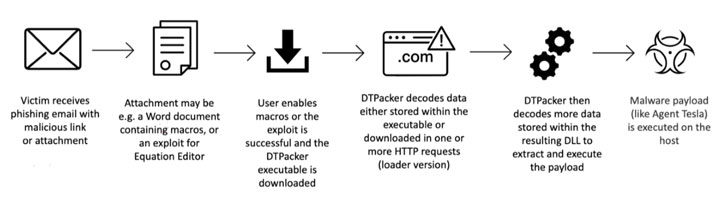
Attack chains involving the packer rely on phishing emails as an
initial infection vector. The messages contain a malicious document
or a compressed executable attachment, which, when opened, deploys
the packer to launch the malware.
Packers[3]
differ from downloaders in that unlike the latter, they carry an
obfuscated payload to hide their true behavior from security
solutions in a manner that acts as an “armor to protect the binary”
and make reverse engineering more difficult.
What makes DTPacker different is that it functions as both. Its
name is derived from the fact that it used two Donald Trump-themed
fixed keys — “trump2020” and “Trump2026” — to decode the embedded
or downloaded resource that ultimately extracts and executes the
final payload.
It’s currently not known why the authors chose this specific
reference to the former U.S. president as the malware is neither
used to target politicians or political organizations nor are the
keys seen by the targeted victims.
Proofpoint said it observed the operators making subtle changes
by switching to using soccer fan club websites as decoys to host
the malware from March 2021, with the packer employed by groups
like TA2536[4]
and TA2715 in their own campaigns a year before that.
“DTPacker’s use as both a packer and downloader and its
variation in delivery and obfuscation whilst keeping two such
unique keys as part of its decoding is very unusual,” said the
researchers, who expect the malware to be used by multiple threat
actors for the foreseeable future.
References
Read more https://thehackernews.com/2022/01/hackers-using-new-malware-packer.html