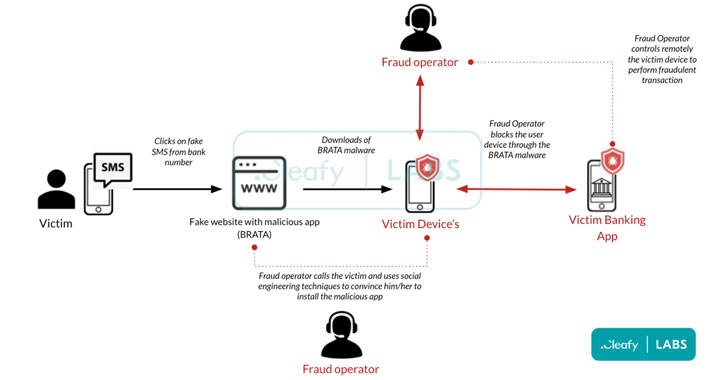
The Android malware tracked as BRATA has been updated with new
features that grants it the ability to track device locations and
even perform a factory reset in an apparent bid to cover up
fraudulent wire transfers.
The latest variants, detected late last year, are said to be
distributed through a downloader to avoid being detected by
security software, Italian cybersecurity firm Cleafy said in a
technical write-up[1]. Targets include banks
and financial institutions in the U.K., Poland, Italy, and Latin
America.
“What makes Android RAT so interesting for attackers is its
capability to operate directly on the victim devices instead of
using a new device,” Cleafy researchers noted[2]
in December 2021. “By doing so, Threat Actors (TAs) can drastically
reduce the possibility of being flagged “as suspicious”, since the
device’s fingerprinting is already known to the bank.”
First seen in the wild at the end of 2018 and short for
“Brazilian Remote Access Tool Android,” BRATA[3]
initially targeted users in Brazil and then rapidly evolved into a
feature-packed banking trojan. Since then, the malware has received
numerous upgrades and changes, while also posing as security scanner apps[4]
to elude detection.
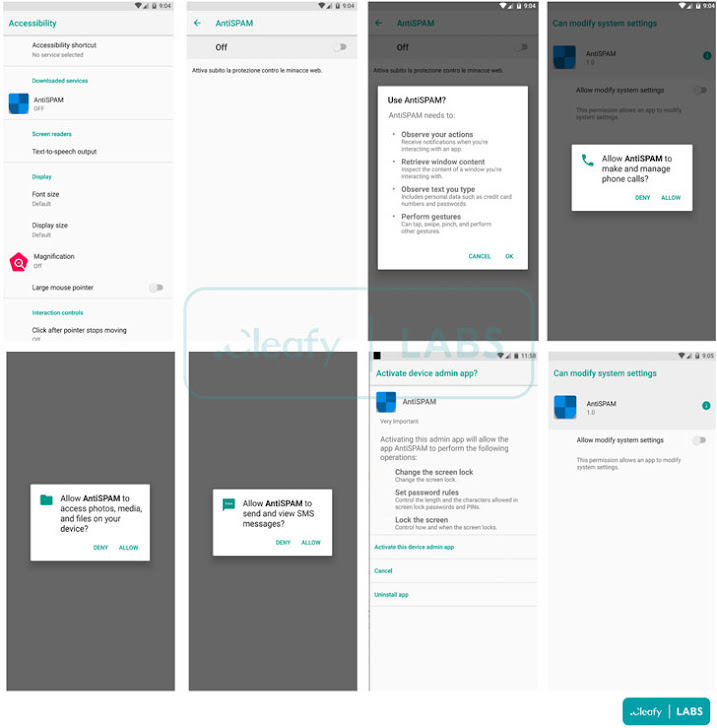
The latest “tailored” samples of BRATA set aim at different
countries and constitute an initial dropper — a security app dubbed
“iSecurity[5]” — that remains
undetected by virtually all malware scanning engines and is used to
download and execute the real malicious software.
“After the victim installs the downloader app, it requires
accepting just one permission to download and install the malicious
application from an untrusted source,” the researchers said. “When
the victim clicks on the install button, the downloader app sends a
GET request to the C2 server to download the malicious .APK.”
BRATA, like other banking trojans observed in the wild, is known
to abuse its Accessibility Service permissions obtained during the
installation phase to monitor the user’s activity on the
compromised device stealthily.
Furthermore, the new versions have incorporated a kill switch
mechanism that allows the operators to restore the Android phone to
its factory settings upon successfully completing a fraudulent wire
transfer or in scenarios where the application is installed in a
virtual environment.
“BRATA is trying to reach out to new targets and to develop new
features,” the researchers said, adding threat actors are
“leveraging this banking trojan for performing frauds, typically
through unauthorized wire transfer (e.g., SEPA) or through Instant
Payments, using a wide network of money mules accounts in multiple
European countries.”
References
- ^
technical write-up
(www.cleafy.com) - ^
noted
(www.cleafy.com) - ^
BRATA
(securelist.com) - ^
security
scanner apps (thehackernews.com) - ^
iSecurity
(www.virustotal.com)
Read more https://thehackernews.com/2022/01/mobile-banking-trojan-brata-gains-new.html