
APT41, the state-sponsored threat actor affiliated with China,
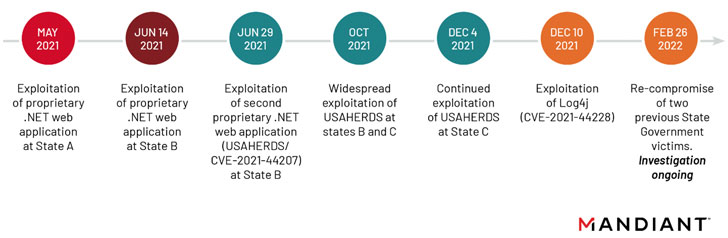
breached at least six U.S. state government networks between May
2021 and February 2022 by retooling its attack vectors to take
advantage of vulnerable internet-facing web applications.
The exploited vulnerabilities included “a zero-day vulnerability
in the USAHERDS application (CVE-2021-44207[1]) as well as the now
infamous zero-day in Log4j (CVE-2021-44228[2]),” researchers from
Mandiant said[3]
in a report published Tuesday, calling it a “deliberate
campaign.”
Besides web compromises, the persistent attacks also involved
the weaponization of exploiting deserialization, SQL injection, and
directory traversal vulnerabilities, the cybersecurity and incident
response firm noted.
The prolific[4]
advanced persistent threat, also known by the monikers Barium and
Winnti, has a track record[5]
of targeting organizations in both the public and private sectors
to orchestrate espionage activity in parallel with financially
motivated operations.
In early 2020, the group was linked to a global intrusion
campaign that leveraged a variety of exploits involving Citrix
NetScaler/ADC, Cisco routers, and Zoho ManageEngine Desktop Central
to strike dozens of entities in 20 countries with malicious
payloads.
The latest disclosure continues the trend of APT41 quickly
co-opting newly disclosed vulnerabilities such as Log4Shell to gain
initial access into target networks of two U.S. state governments
alongside insurance and telecom firms within hours of it becoming
public knowledge.
The intrusions continued well into February 2022 when the
hacking crew re-compromised two U.S. state government victims that
were infiltrated for the first time in May and June 2021,
“demonstrating their unceasing desire to access state government
networks,” the researchers said.
What’s more, the foothold established after the exploitation of
Log4Shell resulted in the deployment of a new variant of a modular
C++ backdoor called KEYPLUG on Linux systems, but not before
performing extensive reconnaissance and credential harvesting of
the target environments.
Also observed during the attacks were an in-memory dropper
called DUSTPAN (aka StealthVector[6]) that’s orchestrated to
execute the next-stage payload, alongside advanced post-compromise
tools like DEADEYE[7], a malware loader that’s
responsible for launching the LOWKEY[8]
implant.
Chief among the variety of techniques, evasion methods, and
capabilities used by APT41 involved the “substantially increased”
usage of Cloudflare services for command-and-control (C2)
communications and data exfiltration, the researchers said.
Though Mandiant noted it found evidence of the adversaries
exfiltrating personally identifiable information that’s typically
in line with an espionage operation, the ultimate goal of the
campaign is currently unclear.
The findings also mark the second time a Chinese nation-state
group has abused security flaws in the ubiquitous Apache Log4j
library to penetrate targets.
In January 2022, Microsoft detailed[9]
an attack campaign mounted by Hafnium – the threat actor behind the
widespread exploitation of Exchange Server flaws[10] a year ago – that
utilized the vulnerability to “attack virtualization infrastructure
to extend their typical targeting.”
If anything, the latest activities are yet another sign of a
constantly adapting adversary that’s capable of shifting its
goalposts as well as refine its malware arsenal to strike entities
around the world that are of strategic interest.
APT41’s cyber operations against healthcare, high-tech, and
telecommunications sectors over the years have since caught the
attention of the U.S. Justice Department, which issued charges[11] against five members of
the group in 2020, landing the hackers a place on the FBI’s cyber
most wanted list.
“APT41 can quickly adapt their initial access techniques by
re-compromising an environment through a different vector, or by
rapidly operationalizing a fresh vulnerability,” the researchers
said. “The group also demonstrates a willingness to retool and
deploy capabilities through new attack vectors as opposed to
holding onto them for future use.”
In a related development, Google’s Threat Analysis Group
said[12] it took steps to block
a phishing campaign staged by another Chinese state-backed group
tracked as APT31[13] (aka Zirconium) last
month that was aimed at “high profile Gmail users affiliated with
the U.S. government.”
References
- ^
CVE-2021-44207
(nvd.nist.gov) - ^
CVE-2021-44228
(thehackernews.com) - ^
said
(www.mandiant.com) - ^
prolific
(thehackernews.com) - ^
track
record (www.mandiant.com) - ^
StealthVector
(www.trendmicro.com) - ^
DEADEYE
(www.mandiant.com) - ^
LOWKEY
(malpedia.caad.fkie.fraunhofer.de) - ^
detailed
(thehackernews.com) - ^
Exchange Server flaws
(thehackernews.com) - ^
issued
charges (thehackernews.com) - ^
said
(twitter.com) - ^
APT31
(malpedia.caad.fkie.fraunhofer.de)
Read more https://thehackernews.com/2022/03/chinese-apt41-hackers-broke-into-at.html